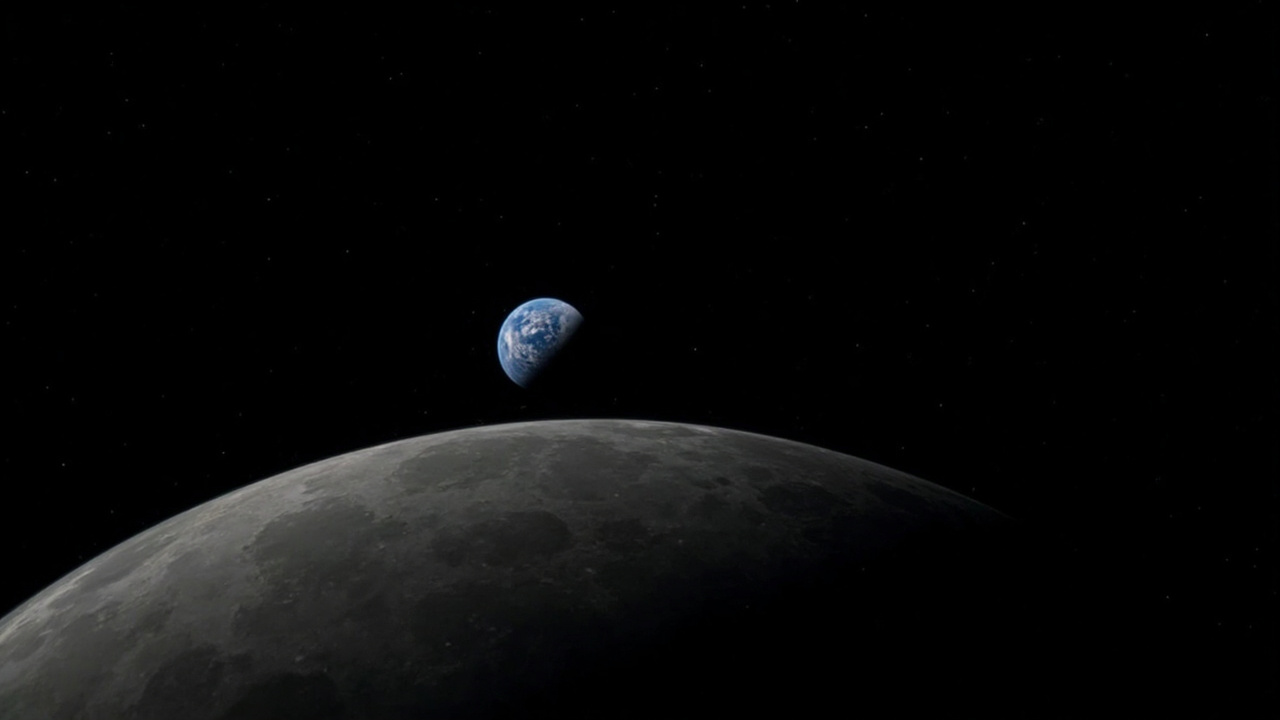
The Orion capsule is two days from home, decelerating through cislunar space on a trajectory that will bring it into Earth's atmosphere Friday evening. [1]
Reid Wiseman, Victor Glover, Christina Koch, and Jeremy Hansen — the four people who went around the Moon while the world was watching whether Trump would bomb Iran's power plants — have been conducting daily press conferences, releasing imagery, and answering questions about what they saw. [2]
What they saw was extraordinary. The far-side eclipse — the Sun visible only as a corona ring around the Moon's black silhouette, an image possible only from that specific geometry — Koch described as "the most beautiful thing I have ever seen." The crew recorded six meteoroid impacts flashing across the lunar surface during the observation window. They filmed Earth from a distance that no human has experienced since Apollo 17 in December 1972: a blue point of light with visible cloud systems, small enough to hold between two fingers. [3]
The splashdown is scheduled for 8:07 PM Eastern on Friday, April 10, off the coast of San Diego. NASA has rated the mission nominal throughout. No technical anomalies. No emergencies. No drama on the spacecraft — which made the spacecraft, in the context of the week's other events, feel like the most functional institution operating. [1]
The Context of the Return
This paper noted on April 7 the juxtaposition of Artemis II and "Power Plant Day" — the same government, the same Tuesday, reaching for the Moon and threatening to turn off the lights. The ceasefire announcement on Tuesday evening added a third element to that juxtaposition: the crew is returning to a world that, while they were away, came within hours of a war's worst escalation and then stepped back.
The Moon does not know about ceasefires. The crew does. Their first full awareness of the ceasefire will come from ground communication that has been carefully filtered for operational relevance. Whatever they knew about Tuesday's deadline and its resolution, they kept working. [4]
There is something worth naming in the contrast: four people in a vehicle with no margin for error, operating a mission planned over a decade, returned to safety on schedule, while the same government that funded their flight spent the same week threatening to execute infrastructure attacks "on a calendar." Both are true. Neither cancels the other.
Friday's splashdown, barring weather or technical issues, will be the most-watched space recovery since Apollo. The crew will emerge from the capsule having done what the program promised. The rest of 2026 will receive them back.
-- KENJI NAKAMURA, Tokyo