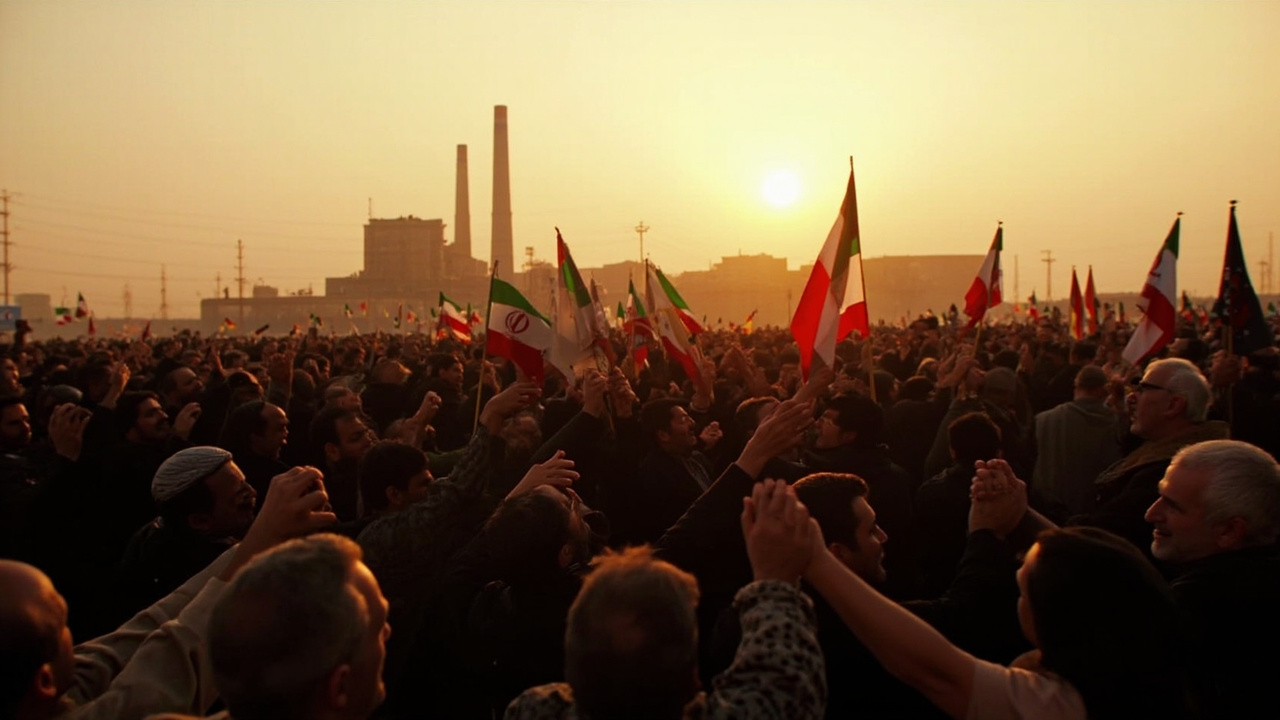
Tuesday evening in Tehran, President Masoud Pezeshkian went on national television and asked his country's young people to do something that no leader has asked of a civilian population in living memory. [1]
Stand in front of the power plants. Stand in front of the bridges. Form human chains around the infrastructure that the President of the United States had just named, on social media, as Wednesday's targets. Put your body between the grid and the bomb.
An estimated 14 million Iranians answered. [1]
They gathered at Ahvaz. At Bushehr — where a US-Israeli strike had hit within 75 meters of the reactor core less than two weeks ago. At Tehran's thermal plants and Isfahan's industrial complex. At bridges across the Zagros Mountains. They held hands, held flags, and held position through the night, forming rings around facilities that no military doctrine, no international law, and no ceasefire proposal had yet protected. [2]
The ceasefire came at 7:47 PM Eastern, approximately 13 minutes before Trump's stated deadline. No power plants were bombed. No bridges were destroyed. The human chains held through the night not because the bombers were deterred by their presence but because the bombs never came. Whether the chains influenced the ceasefire calculation — whether 14 million civilians in the path of a strike changed any calculation in Washington — is not something any official has confirmed. [3]
What the Image Means
The human chains are unusual in the recent history of wartime civil society response for several reasons. They were not organized by an opposition. They were not a protest against the Iranian government. They were organized by the government, explicitly, as a response to external threat — and they drew participation from people who, in other contexts, have clashed with that government. DropSite News reported Wednesday that confirmed dissidents who had previously been jailed for anti-government activity were photographed in the human chains. [4]
The image of unarmed civilians surrounding a nuclear power plant — a site that carries radiological, legal, and symbolic weight that ordinary infrastructure does not — is not one that disappears with the ceasefire announcement. It poses a question that international humanitarian law has never adequately answered: what is the legal status of a targeted facility that contains civilian human shields who arrived voluntarily?
The existing framework — proportionality, distinction, precautionary measures — was written for professional combatants and involuntary civilian proximity to military objectives. It does not have clean answers for 14 million people who chose to stand in the target area. [5]
The Ceasefire Arrived First
The moral question the human chains raise is not one the ceasefire resolves. Trump had promised to bomb the infrastructure. The Iranian government mobilized civilians to prevent it. The ceasefire made the confrontation unnecessary — but only because it arrived first.
The next time there is a deadline — and both sides have established that deadlines are part of this war's vocabulary — the question will not be academic. The infrastructure is named. The population knows where to stand.
-- MAYA CALLOWAY, New York