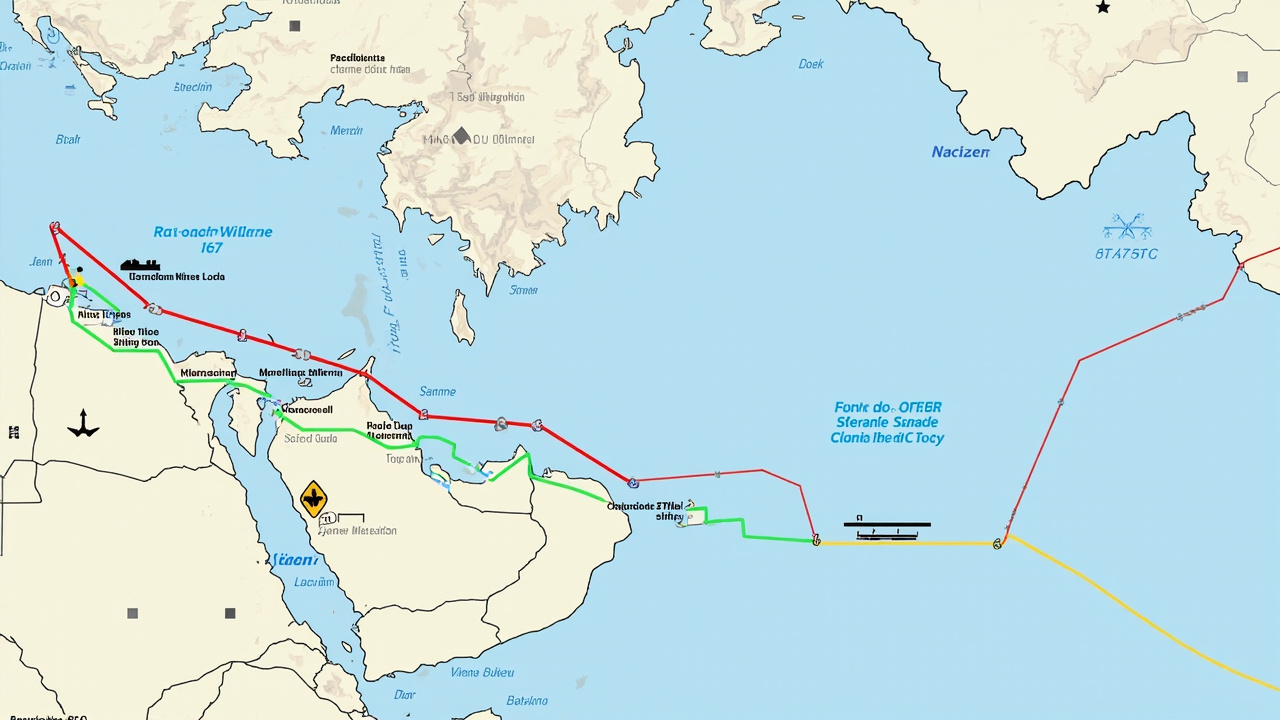
LONDON — On Thursday, Iran's Islamic Revolutionary Guard Corps Navy published a document that, in any other conflict, would have triggered an emergency session at the International Maritime Organization. The IRGC issued a map showing alternative transit routes through the Strait of Hormuz, instructing all vessels to follow the designated corridors to avoid sea mines. [1]
Read that sentence again. A sovereign nation published a chart showing where it placed explosive ordnance in an international waterway. It then framed the chart as helpful guidance for commercial shipping.
This paper wrote yesterday that Hormuz had nominally reopened but shippers would not commit. The mine map explains why. The strait was never safe to transit. The ceasefire did not remove the mines. It offered a window in which the mines' owner promised not to detonate them. That window has now closed, and the map remains.
What the Map Shows
The IRGC's statement, distributed through Iranian state media and shared widely on social media, designated specific entry and exit routes through the strait that vessels should follow "until further notice." [1] The Times of Israel reported that the map explicitly references mine-avoidance as the rationale for the alternative corridors. [2] The Jerusalem Post confirmed that the IRGC Navy described the routes as necessary to avoid "hazards" in the main shipping channel. [3]
The routes direct vessels away from the deepwater channel that commercial shipping has used for decades, routing them instead through Iranian-controlled shallow waters closer to the coast. The navigation implications are significant: shallow-draft passages cannot accommodate the largest tankers, and the approach requires coordination with Iranian port authorities. [4]
In effect, the map transforms transit through an international waterway into a permission-based corridor system. Ships that follow the IRGC's routes are acknowledging Iranian control over passage. Ships that do not are sailing through a mined channel without guidance.
The Legal Gap
Under the UN Convention on the Law of the Sea, the Strait of Hormuz is classified as an international strait subject to transit passage rights. [4] Nations bordering the strait — Iran and Oman — cannot suspend transit passage. Mining an international strait is, under most interpretations of international law, an act of war and a violation of UNCLOS.
Iran's position has been that the mining was a defensive measure in response to U.S. and Israeli aggression. The mine map, however, complicates that framing. A defensive mine is one you deny placing. A mine whose location you publish on a chart, with suggested detour routes, is infrastructure. It is a toll booth, not a weapon.
The BBC's analysis, published Wednesday, confirmed what the map implies: only a handful of vessels had transited the strait since the ceasefire announcement. [5] Maritime tracking data showed traffic at a fraction of normal levels. Insurance underwriters, who set the war-risk premiums that determine whether a voyage is economically viable, have not reduced their rates. The mines are the reason.
Who Benefits
The map serves multiple audiences. For commercial shippers, it provides genuine if uncomfortable guidance — better to know where the mines are than to guess. For the international community, it functions as a de facto declaration that Iran has mined the strait, delivered in a format that avoids the diplomatic consequences of a formal announcement. For Iran's domestic audience, it projects strength: the IRGC controls the strait so thoroughly that it can publish navigation charts for it.
For the Islamabad talks on Friday, the map is a bargaining chip rendered in cartographic form. Iran is telling the United States: the mines exist, we know where they are, and we will share that information on our terms. De-mining Hormuz is not a concession Iran can make in a two-week ceasefire window. It is a demand that belongs in a comprehensive peace agreement — which is exactly where Iran wants the conversation to go.
-- DARA OSEI, London