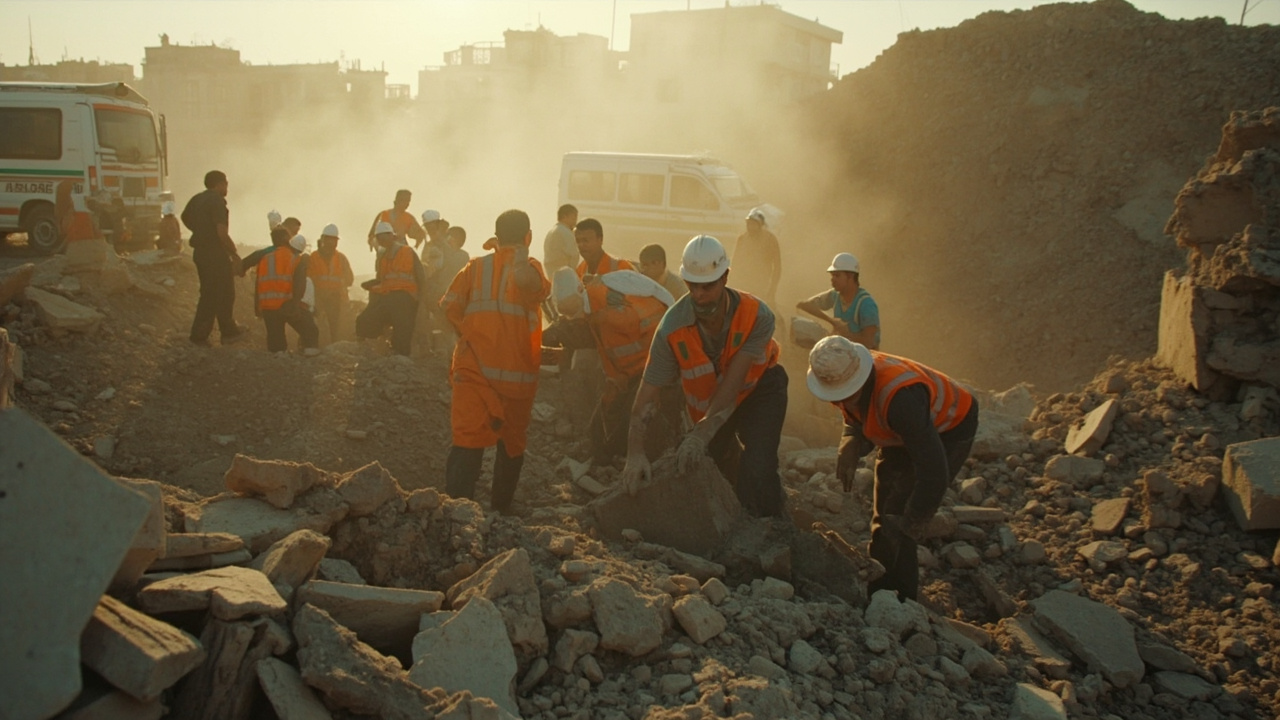
JERUSALEM — The numbers arrived before the context could catch up. On Wednesday, April 8, Israel launched what its military called the largest coordinated strike across Lebanon since the renewed campaign began. By nightfall, Lebanon's Civil Defence had counted 254 dead and 1,165 wounded — the single deadliest day of the Lebanon war. [1]
The strikes hit Beirut's southern suburbs, the coastal city of Tyre, and positions across the Bekaa Valley. The targets, according to the Israeli military, were Hezbollah command infrastructure and weapons depots. The casualties, according to Lebanon's health authorities and the ICRC, were overwhelmingly civilian. [2]
What made the day grotesque rather than merely catastrophic was its timing. The strikes fell within hours of a ceasefire between the United States and Iran that Hezbollah had voluntarily honored. This paper argued yesterday that the Lebanon carveout was the ceasefire's fatal flaw — a diplomatic loophole dressed as a strategic omission. Wednesday's death toll is what that flaw looks like in practice.
The Mechanism of Exemption
Hezbollah, according to sources close to the group cited by Reuters, paused its operations as a gesture aligned with Iran's ceasefire commitment. [1] The logic was straightforward: Iran had agreed to a truce; Hezbollah, as Iran's primary ally in the Levant, would demonstrate solidarity by standing down.
Israel did not reciprocate. The Israeli position, confirmed by senior officials on both April 7 and 8, is that the Lebanon campaign operates independently of the bilateral U.S.-Iran ceasefire framework. [3] The campaign's stated objectives — the degradation of Hezbollah's military infrastructure and the prevention of attacks on northern Israel — predated the ceasefire and, in Jerusalem's view, survive it.
The effect was a one-sided killing day. The party that paused was struck. The party that struck was not in violation of any agreed text. The ceasefire exemption functioned, in operational terms, as a permission slip.
That permission slip is not an accident of drafting. It is the predictable product of incentives the text created. A carveout that lets one ally keep bombing during a bilateral truce does three things at once: it lets Israel press its campaign against Hezbollah without Washington owning the escalation; it gives Iran an external explanation for any hardening it chooses — including, as it happened within hours, re-closing Hormuz [4] — so that Tehran never has to admit breaking its own ceasefire; and it tells every party in the region that the paper architecture of peace is subordinate to the operational reality of who still wants to fight. Wednesday's casualty figure is what those incentives produce when they are executed at scale against dense neighborhoods.
The 2006 Mirror
Lebanon has run this experiment before. The summer war of 2006 lasted thirty-four days, killed roughly twelve hundred Lebanese — most of them civilians — and destroyed the same categories of infrastructure now burning again: bridges in the Bekaa, apartment blocks in Beirut's southern suburbs, fuel depots on the coast. The deadliest single days of 2006, including the Qana strike that killed twenty-eight civilians, did more than any communiqué to end that war by stripping it of international tolerance. The comparison explains both the scale of Wednesday's toll — worse than anything 2006 produced in a single day — and the absence so far of its political consequence: there is no superpower pressure valve this time, because the superpower is a belligerent on the other side of the ceasefire whose terms everyone else is violating by proxy.
The humanitarian arithmetic compounds the historical one. More than a million people were displaced inside Lebanon during the 2024 round of fighting, and the camps and rented rooms absorbing them never emptied; Wednesday's wounded poured into hospitals already running on generator power and imported morphine. The Lebanese Red Cross reported facilities turning away casualties for the first time in the current conflict [2]. A state that cannot shelter its existing displaced cannot absorb a second wave without externalizing the cost onto anyone too poor to leave the strike zones.
Why Voluntary Pauses Fail
Hezbollah's stand-down was always structurally fragile, for reasons that have less to do with intent than with organizational physics. The movement that fought Israel in 2006 and absorbed its leadership decapitation in 2024 no longer commands the chain of discipline it once advertised; authority is distributed among regional commanders whose communications are hunted and whose survival instinct favors firing before being fired upon. A voluntary pause requires every node to hold. A targeted campaign requires only one side to shoot. Asymmetry of that kind resolves in one direction, usually within days.
There is also no mechanism to catch the first mistake. The 2024 truce survived its wobbles because violations went to a chaired committee with response ladders; today's pause has no hotline between the IDF and Hezbollah remnants, no UNIFIL role anyone has defined, and no agreed definition of what would even count as a breach. In that vacuum, each side's worst-case reading of the other's move becomes official policy by morning. The strikes came first; the justification arrived after; the pattern guarantees recurrence.
What Islamabad Inherits
Iran's response was immediate and structural. The Supreme National Security Council announced the re-closure of the Strait of Hormuz, explicitly citing the Lebanon strikes as the cause. [4] The message to Washington was unambiguous: you cannot have Hormuz open and Lebanon burning simultaneously.
The sequencing rewards attention. Re-closing the strait lets Tehran present a strategic response as a moral one — retaliation dressed as principle — while technically remaining inside its ceasefire commitment, since the commitment bound Iran's own conduct, not its chokepoints. It converts grief into leverage without firing a missile. For the Islamabad talks scheduled for Friday, the Lebanon question has moved from a diplomatic footnote to the central obstacle. Iran's 10-point plan already included a demand for a permanent end to hostilities covering Lebanon. [5] Wednesday's casualties have transformed that demand from a negotiating position into a domestic political imperative for Tehran. An Iranian delegation that returned home having traded away the Lebanon clause after 254 funerals would be signing its own denunciation; the American delegation, arriving with the carveout still in force, will be asking Tehran to do precisely that.
The mediators inherit the wreckage. Egypt, Pakistan, and Turkey brokered a framework that worked on paper because it excluded the one theater where fighting was certain to continue; their credibility now rides on widening a document whose authors designed it narrow enough to fail. Expect the demand for a Security Council guarantor — which Iran has raised before [1] — to become the opening position in Islamabad rather than a closing flourish.
The ICRC Responds
The International Committee of the Red Cross broke its customary restraint. In a statement released Wednesday evening, the ICRC said it was "outraged by the devastating death and destruction in densely populated areas" and called for immediate adherence to international humanitarian law. [2]
The ICRC's language — "outraged" is not a word the organization uses lightly — reflected a recognition that the legal framework surrounding the conflict had reached a breaking point. Strikes on populated areas during a declared ceasefire period, even if the ceasefire technically excludes the territory being struck, create a legal and moral ambiguity that humanitarian organizations cannot navigate.
The death toll of 254 in a single day exceeds the worst single-day figures from the 2006 Lebanon war. It ranks among the highest daily tolls in any Middle Eastern conflict since the 2003 invasion of Iraq. The wounded figure of 1,165 overwhelmed hospital capacity in Beirut and Tyre, with the Lebanese Red Cross reporting that some facilities turned away patients for the first time in the current conflict. [2]
What Changes
Iran's response was immediate and structural. The Supreme National Security Council announced the re-closure of the Strait of Hormuz, explicitly citing the Lebanon strikes as the cause. [4] The message to Washington was unambiguous: you cannot have Hormuz open and Lebanon burning simultaneously.
For the Islamabad talks scheduled for Friday, the Lebanon question has moved from a diplomatic footnote to the central obstacle. Iran's 10-point plan already included a demand for a permanent end to hostilities covering Lebanon. [5] Wednesday's casualties have transformed that demand from a negotiating position into a domestic political imperative for Tehran.
For the civilians of southern Lebanon and Beirut, the diplomatic classifications are academic. The ceasefire exists on paper. The bombs exist in their neighborhoods. The gap between those two realities is measured in the 254 names that Lebanese Civil Defence workers were still compiling as Thursday dawned.
-- YOSEF STERN, Jerusalem