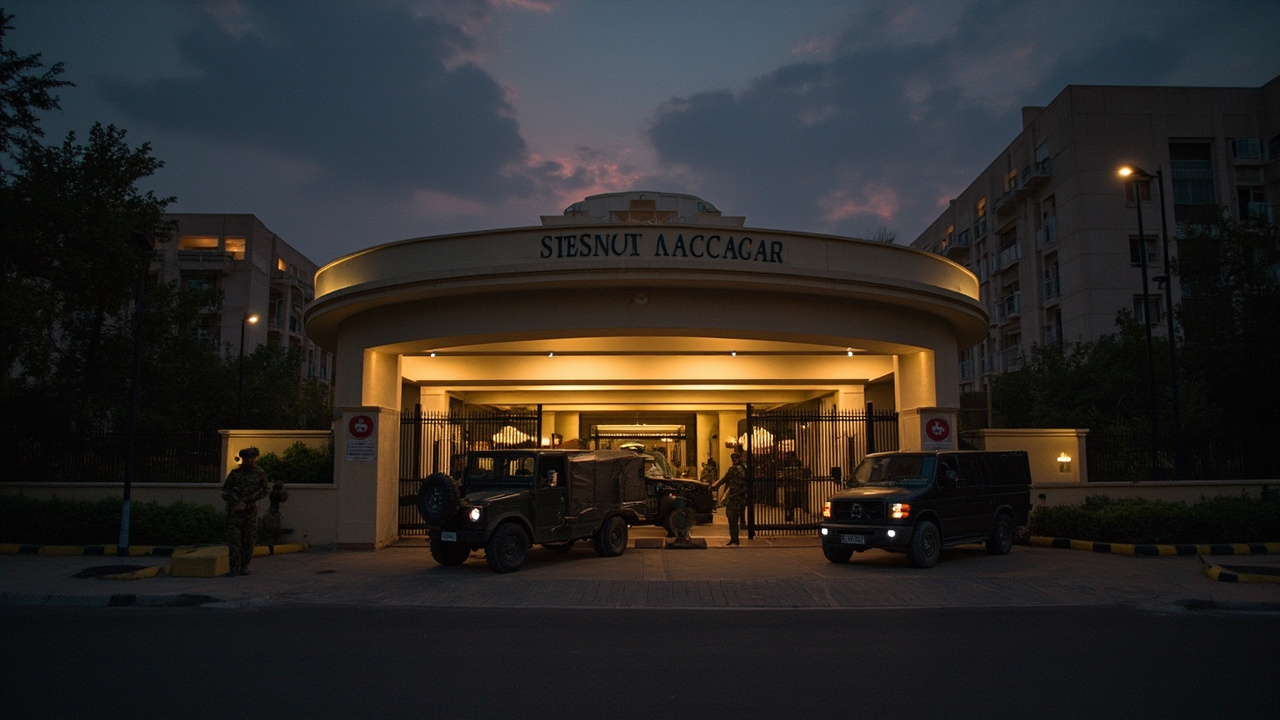
The 30-member American advance team arrived at the Serena Hotel in Islamabad on Wednesday evening, and by Thursday morning the lobby's Italian marble floors were covered in cable runs, swept twice for listening devices, and guarded by a ring of Pakistani Rangers whose checkpoint began 400 metres from the front entrance. On Friday, Vice President JD Vance will walk through those doors carrying a 10-point plan that the Iranian delegation — already installed on the hotel's fourth floor — has signalled it cannot accept. The most consequential face-to-face encounter between American and Iranian officials since the 1979 revolution is about to begin, and as yesterday's account of how positions remain irreconcilable made clear, both sides appear to be preparing not for agreement but for the controlled failure of talks that neither could afford to refuse.
The American delegation is unusually heavy. Vance leads it, accompanied by Steve Witkoff, the New York real-estate lawyer turned special envoy who brokered the original ceasefire, and by Jared Kushner, whose formal title remains unclear but whose presence signals that the White House considers Islamabad a venue for deal-making, not mere diplomacy. Secretary of State Marco Rubio is advising from Washington [1]. The composition tells its own story: this is not the State Department's show. It is a negotiation run by men who think in term sheets, not communiqués.
Iran has sent a smaller team — ten officials led by Speaker Mohammad Bagher Ghalibaf and Foreign Minister Abbas Araghchi, who arrived Thursday afternoon on a charter from Tehran via Lahore [2]. Ghalibaf's presence is itself remarkable. He is not head of state; he is the speaker of the Majlis, a former IRGC air force commander who ran Tehran as mayor for twelve years, a man whose political career has been built on the proposition that Iran's revolutionary institutions are non-negotiable. That Supreme Leader Khamenei chose him, rather than President Masoud Pezeshkian, suggests Tehran wants a negotiator who can say no and be believed.
The Geometry of Impossibility
The format of the talks remains uncertain. American officials have told reporters they expect "proximity negotiations" — the two delegations in separate suites, with Pakistani intermediaries shuttling between them — rather than direct, across-the-table sessions [3]. This is the format used in the 2015 JCPOA talks in Vienna, and it is the format of parties who wish to be seen talking without actually speaking to each other. But Witkoff, who spent three weeks in Oman before the ceasefire, is said to prefer direct engagement, and the Iranians have not ruled it out.
What is not uncertain is the distance between the two positions.
The American 10-point plan, details of which have been reported by Reuters and Al Jazeera, demands that Iran halt all uranium enrichment above 3.67 percent, submit to a verification regime more intrusive than the JCPOA's Additional Protocol, dismantle its advanced centrifuge cascades at Fordow, and accept constraints on its ballistic missile programme [4]. These are maximal positions. Iran enriched to 60 percent during the war and is widely assessed to have enough material for several weapons, though it denies any military intent. Asking Tehran to surrender that capability without a corresponding American concession — sanctions relief, a security guarantee, diplomatic recognition — is asking it to accept strategic defeat at a negotiating table after having survived strategic assault on the battlefield.
The Iranians have their own impossibilities. They want the Strait of Hormuz reopened on their terms, which means maintaining some form of sovereignty over transit — a toll, an inspection regime, a veto over military vessels. They want sanctions lifted before they discuss enrichment. They want Lebanon settled — Hezbollah's position in the south, the status of UNIFIL, the reconstruction funds that Europe has promised and not delivered. Each of these demands runs directly into an American red line [5].
"The enrichment gap alone makes agreement impossible in this round," a European diplomat involved in back-channel preparations told me Thursday. "Everything else — Hormuz, Lebanon, missiles — is decoration on a house that has no foundation."
Pakistan's Gamble
That the talks are happening at all is owed largely to Pakistan, and specifically to Prime Minister Shehbaz Sharif, who has spent six weeks on the phone to Tehran, Washington, and Riyadh in an effort to position Islamabad as the indispensable neutral venue. Pakistan declared Friday a public holiday in the capital — officially for "national security reasons" — and activated its Blue Book VVIP protocol, the highest tier of diplomatic security, which was last used for the 2004 SAARC summit [3].
Reuters reported this week that Pakistan's mediation nearly collapsed in late March. "The talks were almost dead," a senior Pakistani official told the agency. The Iranians had balked at the American precondition that enrichment be on the table from the first session; the Americans had refused to discuss sanctions relief without it. Sharif personally intervened, proposing a formula in which both sides would present their full positions in opening statements without preconditions, deferring the question of sequencing to a later round [3]. It was a procedural fix to a substantive problem, and both sides accepted it — not because it resolved anything, but because neither wanted to be blamed for refusing to show up.
The diplomatic choreography is exquisite. Vance will arrive Friday morning, Islamabad time. He will be received by Sharif at the Prime Minister's House for a bilateral meeting that will last, according to Pakistani officials, exactly forty-five minutes — long enough to be substantive, short enough to signal that the real business is elsewhere. He will then proceed to the Serena, where the opening session is scheduled for Friday afternoon.
"I Don't Think They Care That Much"
Vance's public posture has been, characteristically, a blend of nonchalance and menace. Asked by reporters at Andrews Air Force Base whether he expected Iran to make concessions, the Vice President replied: "I don't think they care that much" — a line that was immediately interpreted in Tehran as either strategic dismissal or genuine indifference, and in Washington as Vance doing what Vance does, which is to say the quiet part loudly and then insist he was being honest [1].
President Trump, for his part, has been working the margins via Truth Social. On Thursday morning, he posted that Iran was doing a "very poor job" of allowing oil tankers through the Strait of Hormuz, a remark that managed to simultaneously acknowledge the blockade, blame Iran for it, and imply that the ceasefire he had brokered was not, in fact, functioning [1]. The post was deleted within two hours, then reposted with the addition of "but we'll see what happens!" — the Trumpian coda that functions as both threat and escape clause.
The reality on the water is starker than any social media post. Only ten vessels have transited the Strait since the ceasefire took effect — four tankers and six bulk carriers, all of them apparently pre-approved through a back-channel arrangement that neither side will confirm. Pre-war traffic averaged more than 135 vessels per day. The International Energy Agency has called it "the most severe supply disruption in history." ADNOC's chief executive, Sultan Al Jaber, said plainly this week what diplomats will not: "The Strait of Hormuz is not open."
The Lebanon Complication
There is a second front at the negotiating table, and it may prove harder than enrichment. Iran has demanded that any comprehensive agreement include the resolution of Lebanon's post-war status — specifically, the terms under which Hezbollah's forces would withdraw from positions south of the Litani River, the mandate and composition of a reinforced UNIFIL, and the disbursement of European reconstruction funds that were pledged in February but have not moved [5]. The Americans consider Lebanon a separate negotiation, to be handled through different channels with different parties. The Iranians consider it inseparable from any deal, because Hezbollah is Iran's most important strategic asset west of its borders, and because the group's survival or destruction will determine whether Tehran emerges from this war as a regional power or a diminished state. Rubio has reportedly told European counterparts that Washington will not discuss Lebanon at Islamabad "under any circumstances." Araghchi has reportedly told his Pakistani hosts that Iran will not discuss enrichment without it. The geometry of impossibility, as the European diplomat put it, extends in every direction.
What Islamabad Can and Cannot Do
The question hanging over the Serena Hotel tonight is not whether Vance and Ghalibaf will agree — they almost certainly will not — but whether they will agree to keep talking. The minimum viable outcome for Washington is an Iranian commitment to a second round of talks, ideally in a venue that allows for direct sessions. The minimum viable outcome for Tehran is a signal that sanctions relief is on the table, even if it is wrapped in enough conditionality to let Trump claim he has not given anything away.
Pakistan can provide the room and the security cordon. It can provide the procedural formula that lets both sides save face. What it cannot provide is the strategic concession that makes agreement possible: an American willingness to accept an Iran that enriches, or an Iranian willingness to accept an America that dictates the terms of their nuclear programme.
Fifty-three years ago, Henry Kissinger flew to Beijing in secret to meet Zhou Enlai. The world did not know until afterward. The Islamabad talks are the opposite: the world is watching in real time, the positions are public, the domestic audiences on both sides are primed for betrayal. Vance's challenge is not to negotiate a deal. It is to fail in a way that keeps the next conversation alive.
The Serena's lobby lights will be on late tonight. The cable runs are in place. The Rangers are at their posts. And in suites on different floors of the same building, two delegations are preparing to tell each other things that both already know and neither can accept.