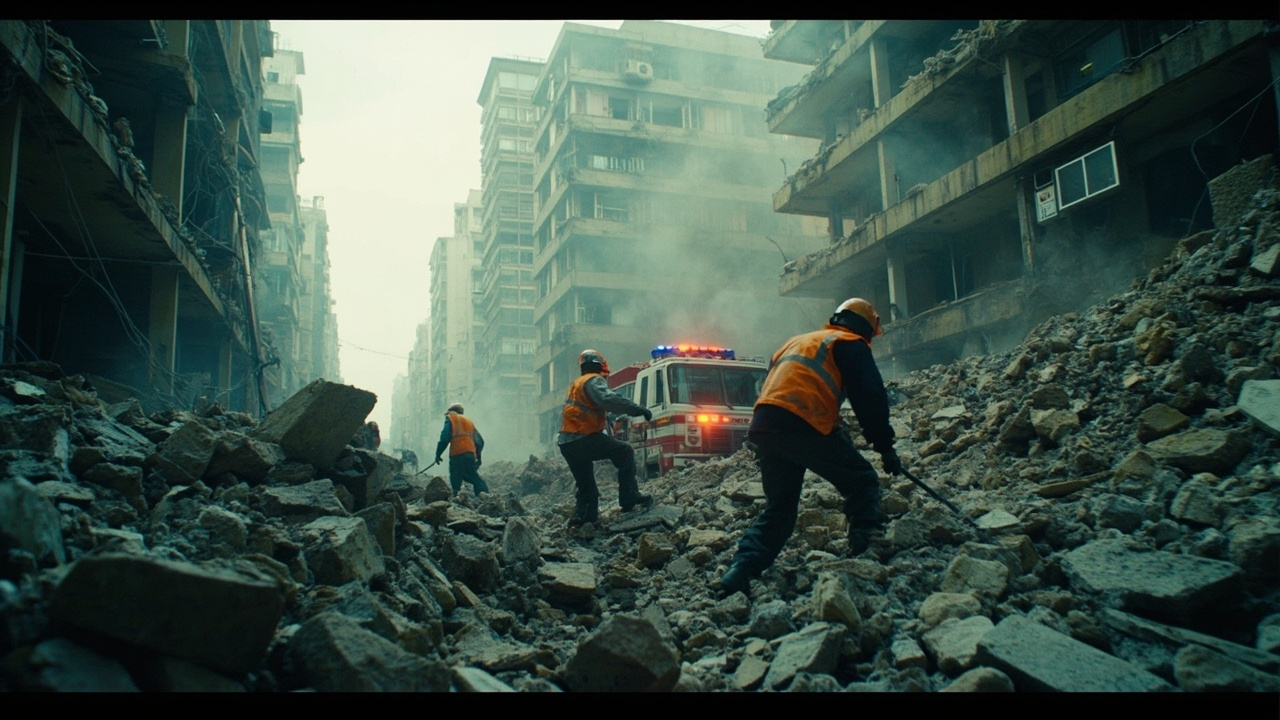
The Lebanese Health Ministry's final count arrived Thursday morning, forty-nine bodies later than the first tally: 303 dead in a single day [1][2]. Not 254, the figure that circulated through wire copy on Wednesday evening. Not "over 250," the formulation Reuters used when the strikes were still fresh. Three hundred and three human beings, most of them killed in a ten-minute window that the Israeli Air Force described, with clinical satisfaction, as the largest coordinated strike of the war [1].
Wednesday's report that 254 dead proved the ceasefire's Lebanon exemption creates a separate reality — but the reality kept revising itself upward as rescuers pulled bodies from the pancaked floors of apartment buildings in central Beirut. By Thursday morning, health workers in the Ras Beirut district alone had recovered seventeen additional corpses from a single residential tower that had folded in on itself like a closing book.
The operational details matter because they describe a decision. Fifty fighter jets carrying 160 munitions struck more than 100 targets across Lebanon in approximately ten minutes [1]. The targets included military infrastructure, Hezbollah command nodes, and — this is the part that does not appear in the Israeli Defence Forces' operational summary — the Corniche promenade area of central Beirut, struck without evacuation warnings [2]. No leaflets. No phone calls. No text messages of the kind Israel has used in Gaza to claim procedural humanity. The residents of the Corniche heard the jets and then heard nothing at all.
The Arithmetic of a Ceasefire
The strikes landed on the same day that Iran and the United States announced a ceasefire framework. The framework, by its own terms, applied to the Iran-US conflict and did not extend to Lebanon. This was not an oversight. It was a design feature. And Israel exploited the feature with the mechanical efficiency of a state that had been planning the operation for weeks [1].
Hezbollah, for its part, had held fire under the ceasefire's terms, pausing rocket launches in apparent coordination with Tehran's negotiating posture. After the strikes, it resumed — approximately 30 rockets fired into northern Israel, a fraction of its pre-ceasefire rate [1]. The restraint was notable. The resumption was predictable. Neither fact appeared to weigh on the diplomatic choreography that followed.
Within hours of the 303 dead being counted, and before many of them had been identified, Prime Minister Benjamin Netanyahu authorized direct peace talks with Lebanon, to be hosted by the US State Department "as soon as possible" [3]. The offer was striking in its timing and its ambition. Israel and Lebanon have technically been in a state of war since 1948 — no peace treaty, no mutual recognition, a border that exists as a line on a map and a string of UNIFIL observation posts [3]. Netanyahu proposed, in effect, to end a 78-year war on the day his air force killed more Lebanese civilians than on any other single day of the current conflict.
What the Corniche Looked Like
The Corniche is not a military target. It is a seafront promenade in the heart of Beirut, lined with apartment buildings, cafés, and the kind of modest commercial establishments that constitute a functioning urban neighborhood. The buildings hit on Wednesday were residential. The people inside them were, for the most part, at home. It was late afternoon. Some were preparing dinner.
The rescue operation that followed was chaotic and under-resourced. Lebanese Civil Defense teams, already stretched across multiple simultaneous extraction sites, arrived at the Corniche buildings to find that several floors had collapsed into the basement. The dust — that fine, chalite dust that pulverized concrete produces — hung in the air for hours, coating the orange vests of the rescue workers and the faces of the residents who stood in the street, trying to reach family members by phone.
The total death toll since March 2 now stands at 1,888, according to the Health Ministry's cumulative figures [2]. That number will continue to rise. Bodies are still being recovered from Wednesday's strikes. The ministry's count relies on hospital admissions and morgue registrations; it does not capture those buried under rubble who have not yet been found, nor those who die of injuries in the days that follow.
The Human Rights Record
Human Rights Watch published a report Thursday documenting the destruction of the Qasmieh Bridge in southern Lebanon, a piece of civilian infrastructure whose loss has cut off a primary evacuation route for residents fleeing the border area [4]. The bridge was not a military installation. It carried traffic — families, ambulances, supply trucks. Its destruction is, in HRW's assessment, a violation of the laws of war that prohibit attacks on civilian objects unless they offer a definite military advantage. Israel has not commented on the bridge specifically.
British Prime Minister Keir Starmer, asked about the strikes during a press conference in London, said they were "wrong" [5]. The word sat in the transcript like a small, polite objection lodged against a hurricane. No policy consequence was attached. No sanctions were threatened. No arms shipments were paused. Starmer said "wrong" and moved on to the next question.
Talks and Rubble
The peace talks, if they occur, will unfold in Washington while the rubble in Beirut is still being cleared. This is not a metaphor. It is a logistical fact. The State Department has indicated willingness to host, and Israeli officials have signaled readiness to engage [3]. The Lebanese government, which was not consulted before the strikes and was not consulted before the talks were announced, has not yet responded publicly.
The diplomatic grammar is familiar: kill enough people to create urgency, then offer negotiations as the alternative to further killing. The 303 dead are not an obstacle to peace. They are, in the logic of the proposal, the argument for it. Netanyahu's message is legible — end the war on my terms, or Wednesday becomes a precedent rather than an anomaly.
The bodies on the Corniche would suggest it already is.