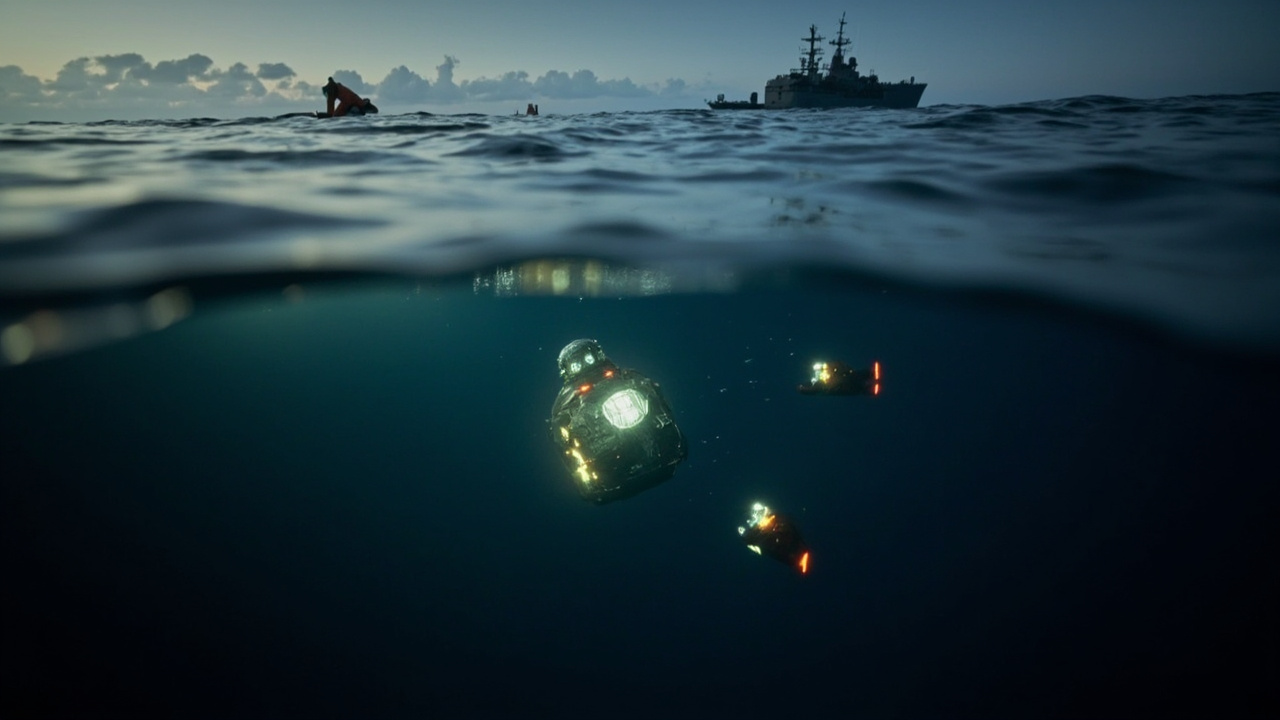
The capsule hit the water at 8:07 PM Eastern Time on Thursday, April 10, and the first voice that came through the communication loop was Commander Reid Wiseman's: "We are stable one, four green crew members." [1] In the grammar of spaceflight, "stable one" means the capsule is floating upright. "Four green" means everyone is alive and uninjured. It is the kind of language that compresses an almost incomprehensible amount of relief into six words — words spoken by a man who, seventeen minutes earlier, had been falling through a sheath of ionized plasma at Mach 33, the windows outside glowing white with heat, the radio silent, the outcome genuinely uncertain.
They came home. All four of them. From 252,756 miles away — the farthest distance any human being has ever traveled from the planet on which our species evolved. [1] [2]
The number is worth sitting with. Two hundred and fifty-two thousand, seven hundred and fifty-six miles. Farther than the Apollo astronauts who walked on the lunar surface. Farther than Gene Cernan and Harrison Schmitt when they drove the rover across the Taurus-Littrow valley in December 1972, the last time human beings left low Earth orbit. At that distance, Earth is not a marble and not yet a dot — it is a vivid blue-and-white disk, continent-shaped and cloud-wrapped, small enough to cover with an outstretched thumb but bright enough to make you squint. Christina Koch, who saw it from that distance on April 4, described it as "impossibly beautiful." She is the farthest woman from Earth in history. She said it plainly, without performance, as if stating a measurement, which in a way she was. [1]
The Heat Shield Question
The anxiety that had threaded through every day of Artemis II's ten-day mission was not about the crew, or the trajectory, or the service module. It was about the heat shield. During Artemis I, the unmanned test flight in 2022, engineers discovered more than one hundred small cracks in Orion's AVCOAT heat shield after splashdown — cracks in the charred outer layer that was supposed to ablate away in controlled fashion during re-entry. [1] NASA spent two years analyzing the anomaly, modified the shield's formulation, ran computational models, and concluded the cracks were cosmetic, not structural. On Thursday night, four human beings tested that conclusion at 24,500 miles per hour.
The heat shield held.
It held through a re-entry profile that NASA calls "skip entry" — the capsule dipping into the atmosphere, generating lift to skip back out briefly, then re-entering for a final descent. The technique reduces peak heat load on any single point of the shield and allows for a more precise splashdown location. [3] It is one of those ideas in engineering that sounds alarming — the capsule bounces off the atmosphere — but is in fact more conservative than the alternative. The crew experienced the first phase as a gradual increase in vibration and a faint orange glow outside the windows that deepened to white as the plasma sheath enveloped them. For approximately five minutes during each atmospheric pass, they lost all communication with mission control — the plasma too hot and too ionized for radio signals to penetrate. Flight directors call these intervals "the quiet time." Thursday night's quiet time lasted from approximately 7:49 PM to 7:54 PM Eastern. Five minutes in which no one on Earth knew whether the shield was holding, whether the crew was alive, whether the cracks had returned.
Then Wiseman's voice: stable one, four green.
The Crew
Their names deserve the specificity that numbers alone cannot provide. Reid Wiseman, 49, a Navy test pilot from Baltimore who had logged 165 days in space aboard the International Space Station and who, as mission commander, bore the weight of every decision from launch to splashdown. Victor Glover, 49, a Navy aviator from Pomona, California, who in 2020 became the first Black astronaut to serve on a long-duration ISS mission and who is now the first Black astronaut to orbit the Moon. [1] [2] Christina Koch, 47, an electrical engineer from Grand Rapids, Michigan, who holds the record for the longest single spaceflight by a woman — 328 days — and who, before Artemis II, had already been part of the first all-female spacewalk. And Jeremy Hansen, 49, a Canadian fighter pilot from London, Ontario, who had never been to space before this mission and who is now the first Canadian to leave low Earth orbit. [3]
Glover's achievement is worth dwelling on. Fifty-four years passed between Apollo 17 and Artemis II — more than half a century in which no human being left low Earth orbit, in which the Moon receded from destination to symbol. During those fifty-four years, the composition of the astronaut corps changed profoundly: women flew, people of color flew, international partners flew. But they flew only to low Earth orbit, to the Space Station, to a tin can circling 250 miles above the surface. The Moon remained, in practice, the exclusive province of white American men, not by policy but by the simple fact that nobody went back. [1] Glover's orbit of the Moon does not erase that history. But it closes one chapter of it.
Hansen's presence is its own quiet revolution. Canada has had astronauts since 1984, when Marc Garneau flew on the Space Shuttle. Chris Hadfield commanded the International Space Station. But no Canadian had ever left Earth's gravitational neighborhood. Hansen, who was selected as a Canadian Space Agency astronaut in 2009 and waited seventeen years for a flight assignment, spent the mission with the wide-eyed seriousness of a man who understood how improbable his presence was. He described the craters on the far side of the Moon as "violence frozen in time" — billions of years of asteroid impacts preserved in perfect detail because there is no atmosphere to erode them, no water to fill them, no life to soften their edges. [4]
Fifty-Four Years
The last human beings to return from the Moon were Gene Cernan, Ron Evans, and Harrison Schmitt, who splashed down in the Pacific on December 19, 1972, and were recovered by the USS Ticonderoga. [1] In the fifty-four years between that splashdown and Thursday night's, the human species built the Internet, mapped the human genome, created artificial intelligence systems that can write poetry and diagnose cancer, sent robotic probes to every planet in the solar system and a helicopter to Mars — and did not send a single person beyond the altitude of a commercial aircraft's cruising height measured in multiples of a hundred.
The gap is one of the strangest facts in the history of technology. We had the capability. We had the vehicles, or could have built them. What we did not have was the political will, the funding consensus, or the institutional patience to sustain a program that produces results on timescales longer than an election cycle. The Space Shuttle was supposed to make spaceflight routine; instead it made it expensive and dangerous. The International Space Station was supposed to be a waypoint to deeper space; instead it became a destination. The Constellation program was supposed to return us to the Moon by 2020; it was cancelled. The Space Launch System, the rocket that carried Artemis II, was derided for years as the "Senate Launch System" — a jobs program for congressional districts that kept the aerospace workforce employed without ever quite getting around to flying.
And then, on Thursday night at 8:07 PM, it flew. And it worked. And four people came home.
The Recovery
The USS John P. Murtha, an amphibious transport dock of the San Antonio class, had been on station in the Pacific recovery zone since Tuesday. [3] Her crew had practiced the recovery sequence fourteen times in the preceding six months, using a boilerplate capsule weighted to match Orion's mass. When Orion splashed down — within 1.2 miles of the predicted impact point, a precision that itself represents an engineering achievement — Navy divers approached in rigid-hulled inflatable boats, attached a sea anchor to prevent drift, and secured a tow line. The capsule was winched into the Murtha's well deck, a flooded compartment at the ship's stern that was then drained to leave Orion sitting on dry steel.
The hatch opened at 10:32 PM Eastern. Wiseman emerged first, blinking in the floodlights, visibly unsteady from ten days of microgravity but grinning in a way that transcended the formality of the occasion. Koch followed, then Glover, then Hansen. NASA flight surgeon Dr. Steven Gilmore conducted initial medical assessments on the deck. All four crew members were ambulatory. All four were, in the clinical language of aerospace medicine, "nominal." [4]
Jared Isaacman, the billionaire commander of the Polaris Dawn mission who has become one of commercial spaceflight's most prominent voices, posted on X within minutes of confirmation: "America is back in the business of sending astronauts to the Moon and bringing them home safely." [5] It was a sentence that managed to be triumphant, nostalgic, and forward-looking simultaneously — a quality it shared with the mission itself.
What They Brought Back
Artemis II carried no lunar samples. The crew did not land. They flew around the Moon and came home, as Apollo 8 did in 1968, as Apollo 10 did in 1969 — scouting missions, proof-of-concept flights, rehearsals for the landing that Artemis III is supposed to attempt in 2028. But they brought back something that samples cannot provide and landing cannot replicate: proof that the heat shield works with human beings behind it, that the skip-entry profile is survivable, that the life-support systems function for ten days in deep space, that the navigation and communication systems can maintain contact across a quarter-million miles, and that the human body — already well understood in low Earth orbit — can function in the deeper radiation environment beyond the Van Allen belts. [1] [2]
They brought back something else, too. On April 6, the crew watched a total solar eclipse from behind the Moon — an event no human eye had ever witnessed. The Sun disappeared behind the lunar far side, its corona visible for seven minutes as a ring of incandescent plasma framing a disk of absolute black. Koch described the corona as "structured fire," which is both scientifically imprecise and poetically exact. [4]
They brought back Hansen's names for craters on the far side. They brought back a recreation of the opening credits of Full House filmed inside the Orion capsule with handheld cameras and a spirit of absurdity that seemed, from 252,756 miles away, like an act of defiance against the void. They brought back ten days of radiation data that will inform every crewed mission to the Moon and Mars for the next generation.
And they brought back the simple, overwhelming fact of return. Four people, falling through fire at Mach 33, aiming for a patch of ocean where a ship was waiting, trusting a heat shield that had cracked once before. The physics were merciless. The engineering was meticulous. The outcome was, for the first time in fifty-four years, human beings coming home from the Moon.
It is, by a wide margin, the best news of 2026.
-- KENJI NAKAMURA, San Diego