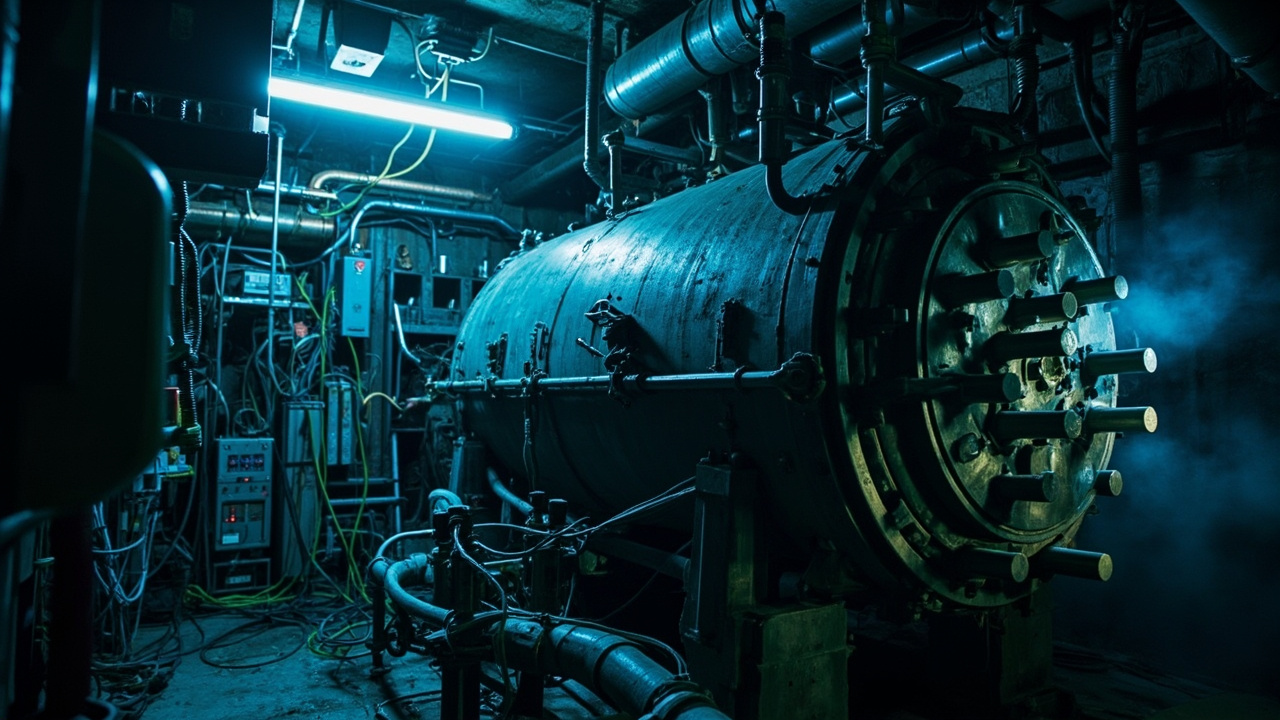
The SuperCDMS experiment at SNOLAB — the world's deepest underground physics laboratory, located two kilometers beneath Sudbury, Ontario — has successfully cooled its detectors to operational temperature, one-thousandth of a degree above absolute zero [1]. The milestone positions the experiment to begin scanning for the lightest dark matter particles ever targeted, in the mass range of 1 to 10 GeV/c².
Dark matter accounts for approximately 85% of all mass in the known universe. It has never been directly detected. SuperCDMS sits inside a four-meter-tall, four-meter-diameter cylindrical enclosure of ultra-pure lead, designed to shield its germanium and silicon crystal detectors from every source of background noise except, potentially, a passing dark matter particle [2].
"Getting to base temperature is a major milestone," said Priscilla Cushman of the University of Minnesota [1]. The experiment uses machine learning algorithms developed specifically to extract faint dark matter signals from noise. A months-long detector commissioning phase lies ahead before data collection begins in earnest.
The language from researchers remains deliberately cautious — dark matter particles "may be lurking" at these low masses. Previous experiments optimized for heavier dark matter candidates found nothing. SuperCDMS is the first experiment cold enough and sensitive enough to search the lighter end of the spectrum. If the universe's missing mass interacts with ordinary matter at all, the coldest machine on Earth may finally be able to notice.