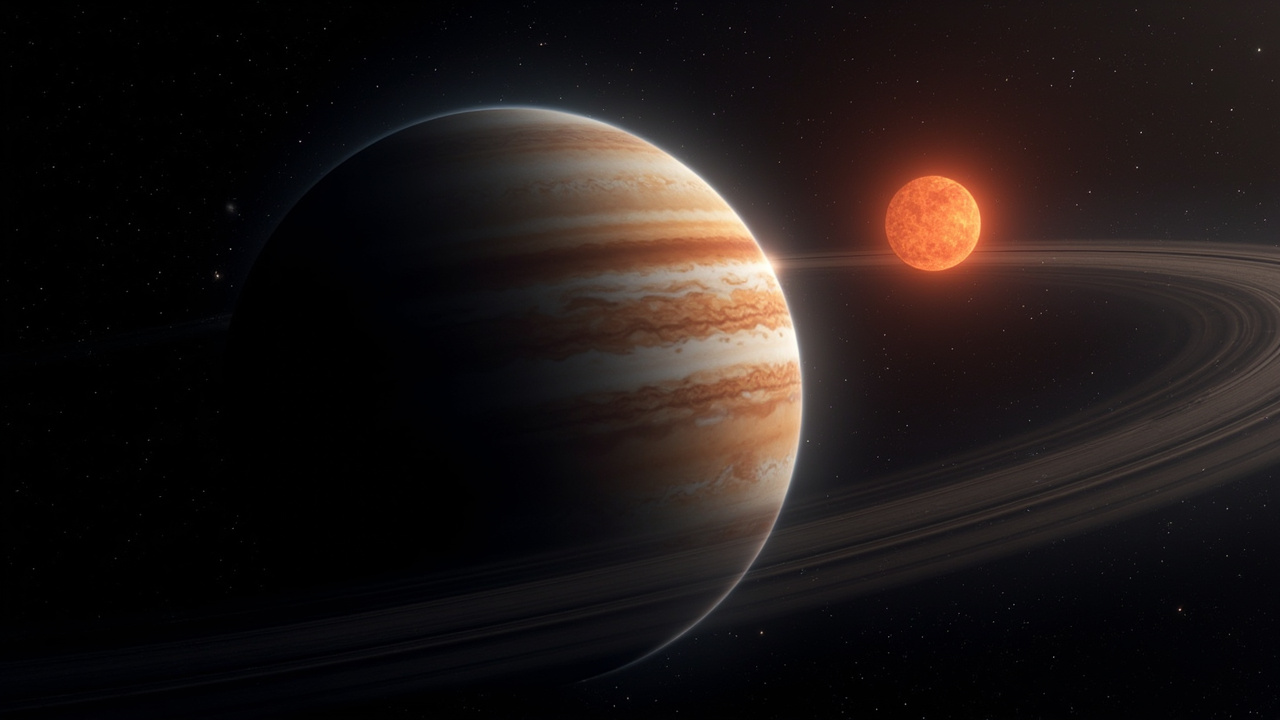
The James Webb Space Telescope has observed TOI-5205 b, a Jupiter-sized exoplanet 282 light-years away that standard formation models say should not exist, and found an atmosphere that deepens the mystery. The planet's atmosphere is unexpectedly metal-poor — lower in metallicity than its own host star — while its interior is roughly 100 times more metal-rich [1]. Heavy elements appear to have migrated inward, leaving an atmosphere of methane and hydrogen sulfide with a carbon-rich, oxygen-poor composition.
The planet is classified as "forbidden" because its host star has only 40% the mass of our Sun. Conventional models of planet formation hold that M-dwarf stars this small cannot accumulate enough disk material to produce a gas giant roughly four times Jupiter's size [2]. TOI-5205 b orbits in approximately 1.6 days, impossibly close and impossibly large.
Lead author Caleb Cañas of NASA Goddard published the findings in the Astronomical Journal in April 2026 as part of the GEMS survey, informally called "Red Dwarfs and the Seven Giants" [1]. The program is specifically designed to study massive planets around small stars — objects that current theory struggles to explain.
JWST keeps producing results that break models. The atmospheric-interior mismatch on TOI-5205 b suggests planet formation is more complex than the neat core-accretion framework allows. Something built this planet, gave it a metal-rich core, and left its atmosphere stripped of the heavy elements found in the star that formed it. No existing model explains how.