On Good Friday, April 10, a Moscow court ordered investigative journalist Oleg Roldugin into pre-trial detention until May 10. [1] He stood in the glass defendant's box at Tverskoy District Court and told the room that jailing "a clearly innocent man on Good Friday is not a very good omen." [2] Hours earlier, the Kremlin had announced a 32-hour Easter ceasefire in Ukraine, ordering Russian forces to halt combat operations from 4 p.m. Saturday until the end of Sunday. [3]
Mainstream outlets treated these as separate stories. Reuters filed the ceasefire from its Moscow bureau and the Roldugin detention from a courthouse stringer. [1][3] CNN ran the Easter truce as a diplomatic beat piece and never mentioned Novaya Gazeta. [4] But on X, users collapsed the timeline and noticed the obvious: the same government declaring peace abroad was waging war on its own press at home, on the same holy day. Brian McDonald, a Russia-based journalist, noted both events in the same dispatch: "Russia has announced an Easter ceasefire... RIA reports that Journalist Oleg Roldugin of Novaya Gazeta has been detained during an ongoing raid." [5]
The juxtaposition is the story, and it is a story about what the Kremlin means when it says "peace."
The Raid
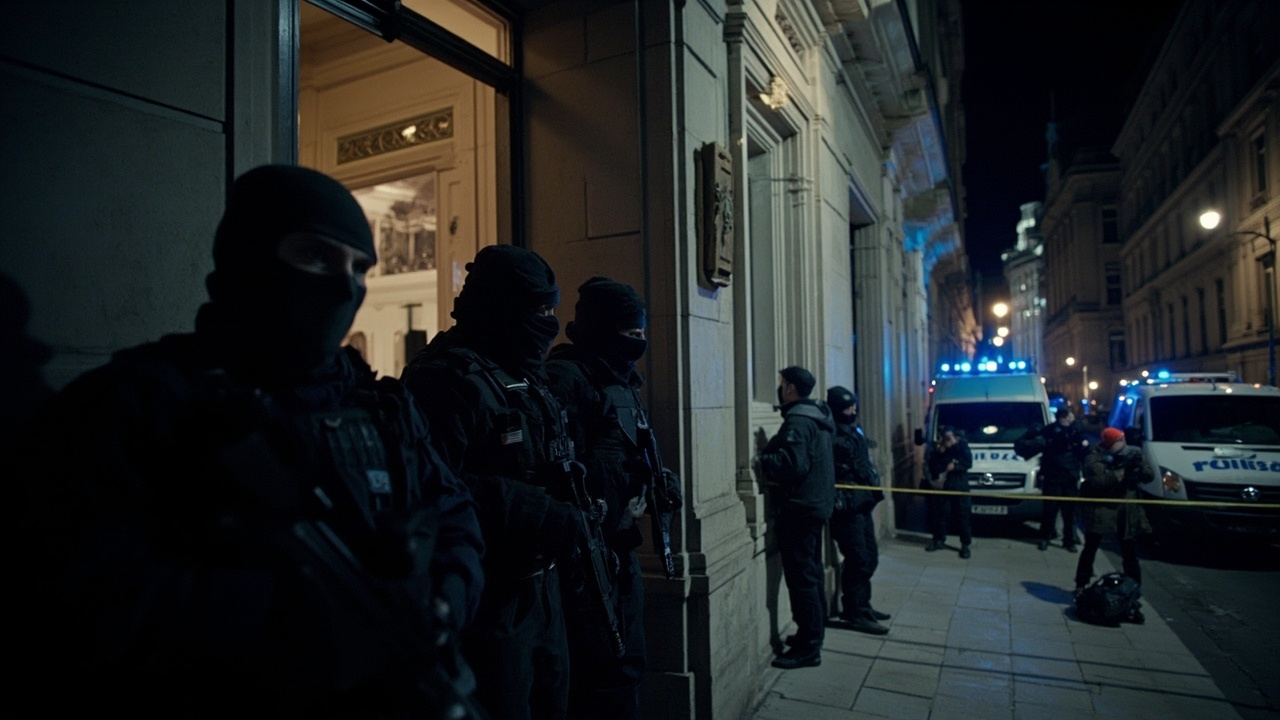
Masked security officers arrived at Novaya Gazeta's offices at 3 Potapovsky Lane in central Moscow around noon on Thursday, April 9. [6] They did not explain the reason for the search. More than ten staff members were locked inside, and the newspaper's lawyers were turned away at the door for seven hours. [7] Defense attorney Kaloy Akhilgov posted on Telegram that officers told him he was "too notorious to be allowed inside." [6]
Former editor-in-chief Dmitry Muratov, the 2021 Nobel Peace Prize co-laureate, was outside the building and was not permitted to enter. [2] The search continued for 13 hours. Two vans of security personnel eventually drove away after midnight, carrying seized computers, hard drives, documents, and Roldugin's press credentials. [7][8]
Russia's Interior Ministry confirmed the raid was tied to a criminal case opened on March 10 under Article 272.1 of the Criminal Code, which covers "illegal use, transfer or storage of information containing personal data." [7] The ministry alleged that journalists at the outlet had accessed personal data to produce "articles and materials of a negative character about Russian citizens." The ministry did not initially name the outlet. TASS later confirmed it was Novaya Gazeta. [6]
The Journalist
Roldugin is an investigative reporter and co-founder of the now-shuttered independent newspaper Sobesednik, which was labeled a "foreign agent" and forced to cease publication in 2024 after running a front-page story on the death of Alexei Navalny in a penal colony. [1] At Novaya Gazeta, he had been working the corruption beat.
In February 2026, Roldugin published an investigation headlined "Penki Obshchestva" (Cream of Society), detailing how Ruslan Alisultanov, a former aide to a nephew of Chechen leader Ramzan Kadyrov, had purchased an ultra-luxury penthouse on the Moscow River worth an estimated 3.5 billion rubles, roughly $35 million. [9] Alisultanov had been listed as a low-ranking state employee. Roldugin's reporting traced how a man recorded in associates' phones under nicknames like "Ruslan Security" acquired one of the most expensive residential properties in the Russian capital. [9]
When Reuters asked Roldugin in court whether he believed that investigation triggered his arrest, he said he doubted it, but added that he did not know which of his articles had gotten him into trouble. [1] His lawyer, Marina Andreyeva, told the court she and Roldugin did not know whose personal data he was accused of misusing. The judge rejected her request for house arrest. [1]
The Ceasefire
Putin's Easter ceasefire decree, announced late on April 9, ordered Defense Minister Andrei Belousov and Chief of the General Staff Valery Gerasimov to halt combat operations on all fronts from 4 p.m. Moscow time on Saturday, April 11, until the end of Sunday, April 12. [3] Kremlin spokesman Dmitry Peskov confirmed the truce had not been coordinated in advance with Ukraine or the United States. [3] Ukraine's President Volodymyr Zelensky said Kyiv had already proposed an Easter ceasefire through American intermediaries and would "act accordingly." [4]
This is the fourth such holiday pause since the full-scale invasion began in 2022. Last year's Easter truce was declared for 30 hours and both sides accused each other of violations. [10] Analysts at the Institute for the Study of War described Putin's decree as another unilateral signal designed to project humanitarian concern while maintaining operational readiness. [10]
The Irony
The Committee to Protect Journalists, calling from Berlin, demanded Roldugin's immediate release. CPJ's Chief Programs Officer Carlos Martinez de la Serna called the raid "the latest escalation in years of pressure" on Novaya Gazeta, an outlet where at least six journalists have been killed in connection to their work since its founding in 1993. [7]
On the same day as the raid, Russia's FSB announced it had detained a freelance journalist in Siberia on suspicion of treason. And Russia's Supreme Court ruled that leading human rights group Memorial constituted an "extremist movement," opening the door to prosecuting anyone who supports or donates to it. [1]
Three press freedom events in 24 hours. One ceasefire. All on the Christian holy weekend. Roldugin, from the glass box, understood the calendar better than the wire services. Locking up a journalist on Good Friday, he observed, is bad luck. He did not need to add: declaring peace while doing it is something else entirely.