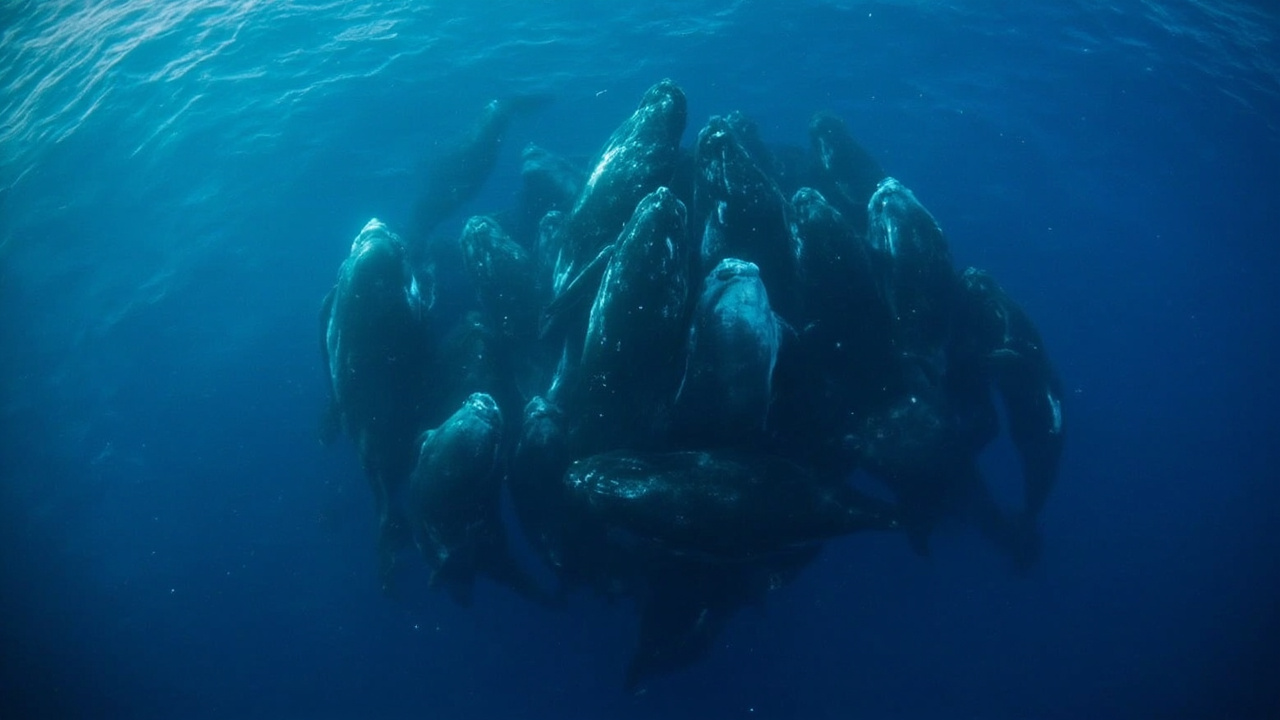
On July 8, 2023, approximately one mile off the coast of Dominica in the eastern Caribbean, eleven sperm whales from two unrelated family groups converged around a mother giving birth. Researchers from Project CETI captured the event using overhead drones, underwater hydrophones, and computer vision systems, producing what two peer-reviewed papers published March 26, 2026, describe as the most detailed scientific observation of a sperm whale birth ever recorded [1].
The birth lasted 34 minutes. The mother, a whale known to researchers as "Rounder" from a matriline designated Unit A, had been tracked by the Dominica Sperm Whale Project since 2005 [2]. Three generations of her family were present: Rounder herself, her mother Lady Oracle, and her daughter Accra. But what made the event unprecedented was not the family reunion. It was the participation of whales from Unit B — a genetically unrelated group that had no kinship obligation to assist.
The lead paper, published in Science under the title "Cooperation by non-kin during birth underpins sperm whale social complexity," presents quantitative evidence that cooperative birth attendance in sperm whales extends beyond family bonds [1]. A companion paper in Scientific Reports, titled "Description of a collaborative sperm whale birth and shifts in coda vocal styles," documents the acoustic changes in the whales' communication patterns during the event [3].
Lead author Alaa Maalouf, a robotics and machine learning researcher at MIT who serves as Project CETI's technical lead, described the observation as singular. "This is the most detailed window we've ever had into one of the most important moments in a whale's life," Maalouf said [1]. Co-author Shane Gero, a National Geographic Explorer and founder of the Dominica Sperm Whale Project, has studied these specific whale families for nearly two decades and had never witnessed a birth directly.
The data reveals a structured division of labor. Eight adults and three calves were present — eleven whales total. After Rounder delivered her calf, four whales provided 96 percent of the post-birth support time, taking turns lifting the newborn to the surface to breathe [2]. Those four were Rounder herself, Aurora (Rounder's half-sister from Unit A), Atwood (an older relative), and Ariel — a juvenile female from Unit B with no genetic relationship to the mother or calf.
Ariel's participation is the finding that elevates this from remarkable footage to evolutionary significance. Cooperative breeding and birth assistance have been documented in humans, some primates, and a handful of social carnivores. Among toothed whales, cooperative lifting of newborns has been observed in only three other species: bottlenose dolphins, killer whales, and beluga whales [1]. But in each of those cases, the helpers were kin. Ariel was not.
The researchers estimate that cooperative birth behavior in sperm whales is at least 36 million years old, based on the divergence time between sperm whales and other toothed whale species that exhibit similar behavior [3]. The trait appears to have evolved independently of the primate lineage, suggesting that the social pressures of deep-ocean life — where predation risk is high and calves are vulnerable at the surface — selected for cooperation regardless of genetic relatedness.
The technological apparatus that captured the event reflects Project CETI's broader ambition to decode sperm whale communication using artificial intelligence. Drones provided continuous overhead footage of the whales' positions and movements. Underwater microphones recorded the codas — patterned clicks that function as sperm whale communication — throughout the birth [2]. Computer vision algorithms tracked individual whales by their unique fluke markings, allowing researchers to assign specific behaviors to specific animals with precision that was impossible in previous cetacean birth observations.
The companion paper in Scientific Reports documents a shift in coda patterns during and after the birth. The whales' click sequences changed in tempo and structure, with certain codas appearing almost exclusively during the lifting phase when helpers were pushing the newborn to the surface [3]. Whether these codas represent coordinating signals or emotional expression remains an open question, but the correlation between acoustic change and behavioral phase is statistically significant.
Prior to this observation, only four sperm whale births had been scientifically documented in 60 years of research [1]. Sperm whales dive to depths exceeding 1,000 meters, spend the majority of their lives underwater, and give birth in deep water far from shore. The convergence of Project CETI's sensor network, the Dominica Sperm Whale Project's 20-year relationship with these specific families, and the birth happening within drone range created a window that may not open again for decades.
Other species were drawn to the scene. Pilot whales and Fraser's dolphins approached the group during the birth, though their role — if any — remains unclear [2]. The researchers noted that the interspecies gathering may reflect acoustic curiosity, as the intense coda exchanges during the birth would have been audible for miles underwater.
Rounder's calf survived. It was observed nursing within hours of birth and has been tracked by Project CETI researchers in the months since [3].