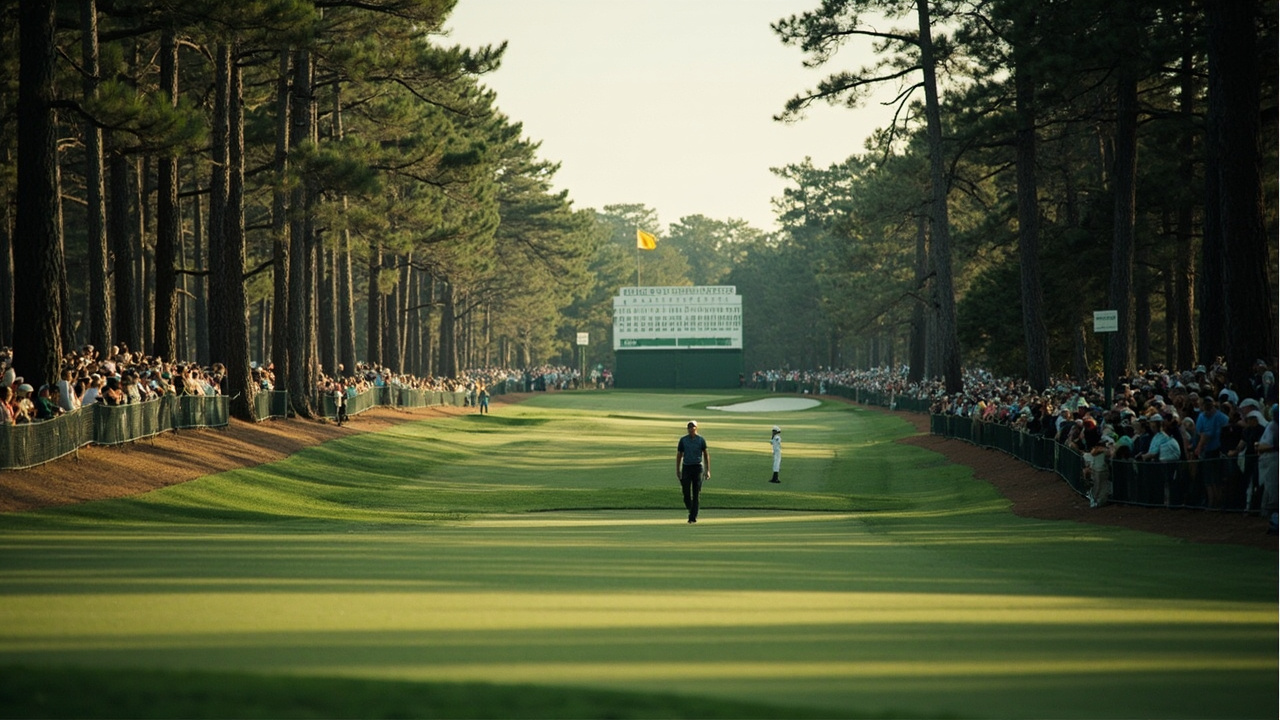
AUGUSTA, Ga. — Rory McIlroy walked to the range after Saturday's third round without stopping for the extended media session that tradition requires of a tournament leader. This was not the act of a man who believed he was in control. It was the act of a man trying to figure out what had gone wrong, and whether it could be fixed in the 18 hours before Sunday's final round.
The numbers tell the story in its starkest form. McIlroy began Saturday with a six-shot lead — the largest 36-hole advantage in Masters history. He shot a 1-over 73 on the lowest-scoring day in Augusta National history (field average 70.63). Cameron Young, who started the day eight shots behind, fired a 7-under 65. They are tied at 11-under par. [1]
The lead did not erode gradually. It collapsed in a stretch of three holes — the 11th, 12th, and 13th — that Augusta National calls Amen Corner and that McIlroy's biographers may call something less pious.
The Sequence
McIlroy had navigated the front nine with the controlled anxiety of a man carrying a lead he could feel shifting beneath him. He made five consecutive pars, scrambling twice, before a birdie on the 10th briefly restored the illusion of command.
Then the 11th happened. His approach missed left, bounced once, and rolled into the pond. He missed the five-foot putt that would have limited the damage. Double bogey. On the 12th, the 155-yard par three that has destroyed more Masters dreams than any other hole at Augusta, he pulled his wedge over the green, duffed his chip, and missed a 15-footer for par. Bogey. On the 13th, a par five he had birdied in the first two rounds, his drive sailed into the trees for the third consecutive day. He scrambled for par where birdie was the minimum acceptable result. [2]
In three holes, the six-shot lead became zero. Young, playing ahead, had already posted his 65 and was watching from the clubhouse.
The back nine had already signaled trouble before Amen Corner delivered it. McIlroy's tee shots had drifted right all day — he found only four fairways in 14 attempts, the worst accuracy of anyone in the top twenty. On the par-five second, he drove into the trees and scrambled for par where the field averaged 4.3. On the sixth, his approach spun off the front of the green and he needed a deft chip to save par. On the eighth, he three-putted from 40 feet for the first bogey. The front nine went out in 37 — one over par on a morning when the scoring average was 34.8. The lead was still four shots. It felt like two. [3]
"Didn't quite have it today," McIlroy said in his abbreviated remarks. He was last in fairways hit among the top ten on the leaderboard. He had not hit a single fairway on the four par fives all week — and had been getting away with it until Saturday, when the misses finally compounded. [3]
Young's Assault
Cameron Young's round deserves its own paragraph in the tournament's history. He made up eight shots on the leader in a single round — the largest deficit ever overcome to share a 54-hole lead at the Masters. He did it with a combination of power and patience that McIlroy himself identified as the tournament's necessary currency.
Young, 28, had won the Players Championship in his most recent start and arrived at Augusta in a rare state of competitive readiness. His 65 was constructed with surgical precision: birdies on the second, fourth, sixth, eighth, and ninth gave him a front-nine 31 that erased half the deficit before McIlroy had reached the turn. He chipped in for birdie on the fourth from a buried lie in the greenside bunker — a shot that drew the first sustained roar of the afternoon from the patrons lining the dogleg. His tee shot on the par-five 13th crashed into the trees and kicked back into the fairway — the kind of break that Augusta bestows on those it favors. He two-putted for birdie there, then rolled in a 27-foot birdie putt on the 16th that broke four feet left-to-right across the green to briefly take the outright lead. A bogey on 17 — his only blemish — dropped him back into a tie. [2]
The historical echoes of Young's round are worth noting. No player had ever made up eight shots on the 36-hole leader to share the 54-hole lead at the Masters. The previous record belonged to Jack Burke Jr., who trailed amateur Ken Venturi by eight shots entering the final round in 1956 and won by a stroke. Young's achievement came in the third round, not the fourth — meaning the story is not yet finished.
"I'm owed nothing," Young said. "My past results don't dictate what I do tomorrow. I've got to go earn whatever I get."
The Field Behind Them
The collapse opened a door that half the leaderboard walked through. Sam Burns is one shot back at 10-under after a bogey-free 68. Shane Lowry, who made a hole-in-one on the fourth, sits at 9-under. Justin Rose and Jason Day are tied at 8-under. [4]
And Scottie Scheffler, the world's number-one player, shot a 65 of his own — his lowest ever at Augusta — to reach 7-under, four shots back. He started the day 12 shots behind McIlroy. "I don't feel like I'm out of the tournament," Scheffler said, with the quiet certainty of a man who has won the green jacket twice. [1]
Nine players are within five shots of the lead. The top eight includes five major champions. The coronation has been canceled.
What Sunday Means
McIlroy has been here before, and that is precisely the problem. In 2011, at age 21, he held a four-shot lead going into the final round and shot 80, losing by ten. That collapse took him four years to metabolize and fourteen more to overcome. His victory at the 2025 Masters — when he finally completed the career Grand Slam — was explicitly framed as an exorcism of that day.
Now the demon has returned wearing different clothes. McIlroy is not leading by four; he is tied. He is not 21; he is 36. He is not pursuing his first major; he is defending his fifth. The stakes are different but the pattern is achingly familiar: McIlroy at Augusta, holding a lead, watching it dissolve.
The question for Sunday is not whether McIlroy can win. He is tied for first, in the final pairing, at the tournament he won twelve months ago. The question is whether the man who walks to the first tee is the 2025 champion who plays with freedom, or the 2011 version who played with fear.
Only Jack Nicklaus, Nick Faldo, and Tiger Woods have ever successfully defended the Masters. McIlroy has a chance to join them. He also has 18 holes to survive.
The career Grand Slam narrative — which consumed McIlroy for eleven years before last April's breakthrough — has given way to a different kind of pressure. Defending a Masters is not the same as winning one. The first victory answered a question that had defined his career: could he win at Augusta? The second would answer a question that defines his legacy: is he a great champion, or a great talent who won the tournament that haunted him and never reached that height again? Nicklaus won six green jackets. Woods won five. Faldo won three. The players who defended successfully did so because Augusta held no remaining terror for them. McIlroy's Saturday suggests the terror has not fully departed.
"I still have a great chance," McIlroy said. "I'm in the final group. I just need to go to the range and try to figure it out a little bit."
The range will not be enough. Whatever McIlroy needs to figure out is not in his swing. It is somewhere between his chest and his temples, and Augusta National has a way of finding it.
-- AMARA OKONKWO, Augusta