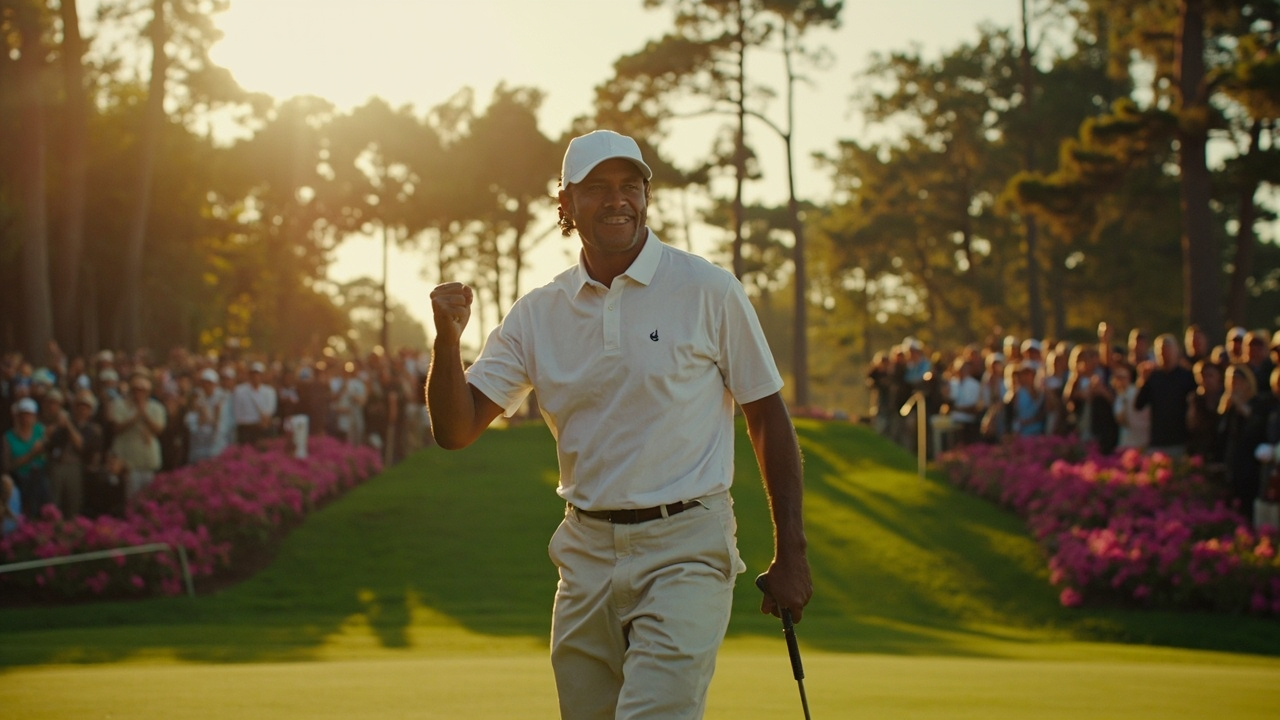
Rory McIlroy finished at twelve under par on Sunday at Augusta National, one shot clear of Scottie Scheffler, to win his second consecutive Masters and become only the fourth man in the tournament's ninety-year history to win back-to-back green jackets. [1] The others are Jack Nicklaus (1965-66), Nick Faldo (1989-90), and Tiger Woods (2001-02). [2] It is McIlroy's sixth major championship. The number does not begin to capture what happened on the course.
This paper covered Saturday's disintegration of McIlroy's six-shot lead as the story of a man repeating the pattern that had defined his Augusta career — brilliant starts followed by unraveling. Today's story is the opposite: a man who survived the pattern and broke it.
McIlroy posted rounds of 67-65-73-71 for a 276 total. [3] The 65 on Friday gave him a six-shot lead — the largest 36-hole advantage in Masters history. [1] No one had ever been that far ahead at Augusta after two rounds and failed to win. McIlroy came close to being the first. His Saturday 73, a round of grinding mediocrity punctuated by errors he had not made in months, erased the entire cushion. Cameron Young shot 65. Scheffler shot 65. McIlroy entered Sunday tied with Young at eleven under, his fortress reduced to rubble. [4]
The final round was worse before it was better. McIlroy made a double bogey on the par-three fourth hole and a bogey on the sixth. By the time Justin Rose birdied his way to a two-shot lead on the front nine, McIlroy was two shots behind in a tournament he had led by six forty-eight hours earlier. [1] The Augusta patrons, who had spent two days watching a coronation, were now watching something closer to a confession. The narrative had already been written in preview pieces across every sports outlet: McIlroy, the most talented golfer of his generation, could not close at Augusta. The 2011 collapse — when he shot 80 in the final round as a twenty-one-year-old — was the wound that never healed. Even last year's Masters victory, secured in a playoff over Justin Rose, had required surviving his own wobble on the back nine.
Sunday's back nine rewrote that narrative in two holes.
At the par-three twelfth — the Golden Bell, the most terrifying shot in major championship golf, where Rae's Creek swallows ambition and swirling winds mock certainty — McIlroy hit a tee shot to seven feet. [1] The putt was never anywhere else. He told reporters afterward: "That was a really good golf shot at the right time. Huge shot in the tournament." [1] It was the understatement of the week.
At the par-five thirteenth, the Azalea, where McIlroy had found the trees in each of the previous three rounds, he blistered a 350-yard drive down the center of the fairway. [5] The birdie that followed gave him a three-shot cushion. In the space of thirty minutes and two holes — the heart of Amen Corner — McIlroy had gone from two behind to effectively three ahead. The tournament was his again.
It nearly slipped away one final time. On the eighteenth, McIlroy's tee shot sailed so far right it ended up closer to the tenth fairway than the eighteenth. [1] He drilled an eight-iron around the trees into a greenside bunker, blasted out to twelve feet, and two-putted for bogey. The margin held. One shot. "I'd say walking off the 18th tee not knowing where my ball was, that was the moment of greatest stress," he said, managing a grin that looked more like relief than joy. [1]
Scheffler, who started Sunday twelve shots back, made the final result closer than the afternoon felt. He played his last 36 holes without a single bogey — the first golfer since World War II to accomplish that at the Masters, according to Olympics.com. [6] His weekend 65-68 was the best closing surge by a runner-up in the tournament's modern era. But Scheffler's brilliance was quiet. McIlroy's was chaotic, sentimental, and impossible to look away from.
The career arc matters. McIlroy is thirty-six. He won his first major at twenty-two (the 2011 U.S. Open at Congressional, by eight shots). He won his fourth at twenty-five (the 2014 PGA Championship at Valhalla). Then came a decade of near-misses, injuries, and the Augusta question — the tournament that stood between him and the career Grand Slam. Last year's playoff victory at Augusta answered that question and completed the Slam, making him only the sixth man in history to hold all four major trophies, alongside Gene Sarazen, Ben Hogan, Gary Player, Nicklaus, and Woods. [7]
This year's victory is different. Completing the Grand Slam is an achievement measured against history. Defending the Masters is an achievement measured against yourself. McIlroy had to survive not one collapse but two — the Saturday unraveling that destroyed his six-shot lead and the Sunday front nine that left him two shots behind with twelve holes to play. The fact that he won anyway, through the most pressure-laden stretch of holes in golf, speaks to something that statistics cannot capture.
"I thought it was so difficult to win last year because of trying to win the Masters and the Grand Slam," McIlroy said in the Butler Cabin, the green jacket draped across his shoulders for the second time. "And then this year I realized it's just really difficult to win the Masters." [1]
Augusta National Chairman Fred Ridley placed the jacket on McIlroy, following the protocol established when the defending champion wins again — the same procedure used when Hootie Johnson did the honors for Woods in 2002. [2] The record first-place prize of $4.5 million is the largest in Masters history. [8]
President Trump, flying back to Washington from Florida, congratulated McIlroy on social media: "With each year, Rory is becoming more and more a LEGEND!" [1] It was, for a Sunday afternoon, a rare point of agreement between a president ordering a naval blockade and the millions of Americans who had spent the day watching a man from Northern Ireland fight his way through azaleas and pines to prove that talent, when it finally meets nerve, does not need a story of effortless dominance. It needs a story of surviving itself.
The leaderboard behind McIlroy and Scheffler told its own story. Tyrrell Hatton, Russell Henley, Justin Rose, and Cameron Young shared third place at ten under. [3] Rose's collapse was the mirror of McIlroy's resurrection — he held a two-shot lead entering the back nine and made four bogeys around Amen Corner, undone by the same stretch that saved the champion. Young, who had been tied for the lead entering Sunday, shot a final-round 73 that was all the more painful for having started with such promise.
Collin Morikawa and Sam Burns finished at nine under. Max Homa and Xander Schauffele shared ninth at eight under. [3] The depth of the leaderboard confirmed what has been true of McIlroy's generation: the margin between the best players in the world is vanishingly thin. One shot separated first from second. Two shots separated second from a four-way tie for third. In that compressed field, the difference was not talent but nerve — specifically, the nerve McIlroy summoned on the twelfth and thirteenth holes while everyone around him was faltering.
The commercial dimension of the victory is substantial. The record $4.5 million first-place prize barely registers against the endorsement and appearance fee implications. [8] McIlroy is now the most marketable golfer in the world by a margin that did not exist before last year's breakthrough. Back-to-back Masters victories, a career Grand Slam, and a narrative of resilience that Hollywood screenwriters would reject as too neat — the package is complete in a way that transcends sport and enters the realm of cultural property.
The 2027 Masters is eleven months away. No golfer has ever won three in a row. McIlroy, who spent a decade failing at Augusta before winning it twice in succession, will arrive as the man everyone expects to lose. He has been that man before. He was that man on Sunday morning, two shots behind with the lead in his rearview mirror. By Sunday evening, he was wearing the jacket again.
-- AMARA OKONKWO, Lagos