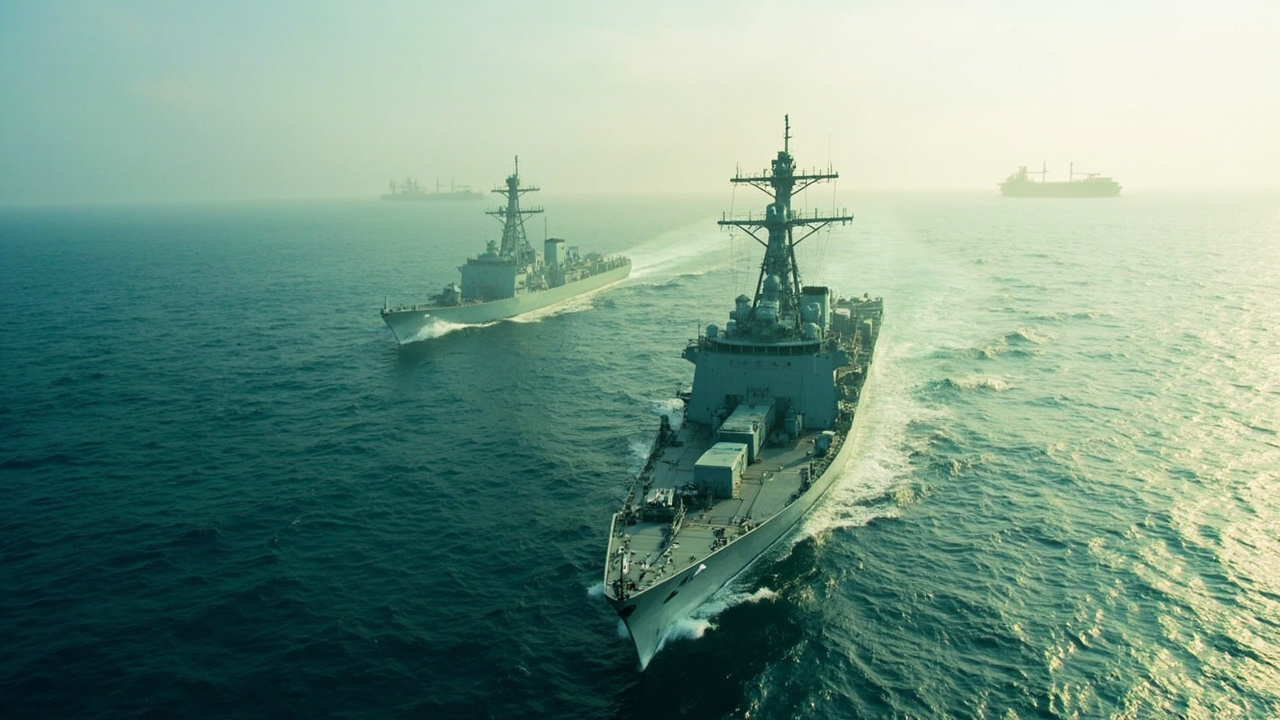
At 10:00 a.m. Eastern Time on Monday, the United States military began enforcing a naval blockade of all Iranian ports. [1] The order came less than thirty-six hours after Vice President JD Vance departed Islamabad without a deal, having spent twenty-one hours in the highest-level face-to-face negotiations between American and Iranian officials since the 1979 revolution. [2] Between those two events — the failed talks and the blockade — sits a contradiction that neither the White House nor the Pentagon has resolved: the United States is simultaneously observing a two-week ceasefire and imposing a naval blockade on the nation it is theoretically not fighting.
This paper's Saturday account of Vance's departure from Islamabad after twenty-one hours of fruitless negotiation ended with the vice president leaving a "final offer" on the table and warning that failure would be "bad news for Iran much more than it's bad news for the United States." The bad news arrived within hours. And the paper's analysis of the three deadlines converging on the April calendar — the April 19 sanctions snap-back, the April 22 ceasefire expiration, and the April 29 War Powers vote — now has a fourth pressure point: a blockade that began six days before any of those deadlines arrive.
The sequence matters. At dawn Sunday in Islamabad, Pakistani mediators believed a third round of discussions had concluded and that talks would resume after a break. Then Vance held a three-minute press conference, announced there was no agreement, and left for the airport. [2] Eight hours later, President Trump — who had been in Miami, not the Situation Room, during the negotiations — posted on Truth Social: "Effective immediately, the United States Navy, the Finest in the World, will begin the process of BLOCKADING any and all Ships trying to enter, or leave, the Strait of Hormuz." [3] He added: "Any Iranian who fires at us, or at peaceful vessels, will be BLOWN TO HELL!" [3]
But the blockade that CENTCOM announced Sunday evening was not the blockade Trump described. Trump's language targeted "any and all Ships" in the Strait. CENTCOM's statement, posted hours later on X, said something notably different: "The blockade will be enforced impartially against vessels of all nations entering or departing Iranian ports and coastal areas, including all Iranian ports on the Arabian Gulf and Gulf of Oman." And then the critical sentence: "CENTCOM forces will not impede freedom of navigation for vessels transiting the Strait of Hormuz to and from non-Iranian ports." [1]
The gap between those two statements is not rhetorical. A blockade of the entire Strait of Hormuz — through which twenty percent of the world's oil and liquefied natural gas flows daily — would constitute an act of war against every nation that uses the waterway, including allies like Saudi Arabia, the UAE, Kuwait, Iraq, and Qatar. [4] A blockade limited to Iranian ports affects only Iranian trade. The former would crash global energy markets and likely trigger Article 5 discussions among NATO allies whose economies depend on Gulf crude. The latter is a targeted economic weapon aimed at a nation already under comprehensive sanctions.
AP was among the first wire services to note the discrepancy, describing CENTCOM's version as "a step down from the president's earlier threat to blockade the vital waterway." [1] The BBC's Anthony Zurcher called it "a different set of conditions than in Trump's earlier proposed action." [5] Al Jazeera's Heidi Zhou-Castro was more direct on air: "Trump said the blockade would target any and all ships trying to enter or leave the Strait of Hormuz. But CENTCOM is saying this would only target ships going to or from Iranian ports." [6] Consortium News went furthest, running the headline "Trump Overruled on Hormuz Blockade." [7]
The question of who actually decides the scope of military operations — the commander-in-chief's social media posts or the combatant command's operational directives — remains unanswered. No Pentagon spokesperson has been asked on camera about the divergence. CENTCOM's X post was itself the clarification, issued without reference to the president's broader language. Whether Admiral Brad Cooper, Defense Secretary Pete Hegseth, or National Security Council staff made the call to narrow the scope has not been reported by any outlet.
What is reported, extensively, is the market reaction. Brent crude surged approximately eight percent to $102.29 per barrel. West Texas Intermediate rose eight percent to $104.24. [8] But those futures prices obscure a far more alarming development in the physical crude market. Reuters reported in early April that European and Asian refiners were already paying "record-high prices of near $150 a barrel for some crude oil grades, far exceeding prices for paper futures." [9] The WTI May-June spread hit $16.70 per barrel — the largest backwardation in the contract's history — signaling that traders are willing to pay an enormous premium for barrels they can receive now rather than later. [9]
The blockade puts up to two million barrels per day of Iranian exports at direct risk. [8] Iran was exporting an average of 1.85 million barrels per day through March, according to Kpler data cited by CNN. [8] Marine trackers indicate that over forty commercial ships have crossed the Strait since the ceasefire began around April 8. [1] What happens to those ships — and to the vessels that were en route to Iranian ports when the blockade took effect at 10:00 a.m. Monday — is an operational question that CENTCOM's statement does not address.
The Iranian response arrived swiftly and in maximalist terms. The Islamic Revolutionary Guard Corps Naval Command posted on X in Persian: "All traffic is under the full control of the armed forces." [10] The statement continued: "The enemy will become trapped in a deadly vortex in the Strait if it makes the wrong move." [10] A separate IRGC public relations statement declared that "any military vessels that intend to approach the Strait of Hormuz under any pretext will be considered in violation of the ceasefire and will be dealt with severely." [6]
This is the crux of the legal and strategic absurdity. The ceasefire, brokered by Pakistan and in effect since approximately April 8, was meant to create space for the Islamabad talks. It expires April 22. [2] The blockade order came during this ceasefire window. The IRGC has explicitly said that the approach of military vessels constitutes a ceasefire violation. The United States has not formally withdrawn from the ceasefire. So the American position, as of Monday morning, is that a ceasefire is in effect and a naval blockade is also in effect — simultaneously, against the same adversary, in the same body of water.
International law offers no clean framework for this. Under the UN Charter, a blockade is traditionally considered an act of war. The San Remo Manual on International Law Applicable to Armed Conflicts at Sea requires that a blockade be declared, notified, effective, and non-discriminatory — conditions that CENTCOM's statement appears to meet. But the manual also presumes a state of armed conflict, not a ceasefire. [5] The United States cannot easily argue that it is both at ceasefire and at blockade without one condition negating the other.
Trump's Truth Social posts added further layers of escalation. Beyond the blockade, he instructed the Navy "to seek and interdict every vessel in International Waters that has paid a toll to Iran. No one who pays an illegal toll will have safe passage on the high seas." [3] This refers to the IRGC's toll regime, established in late March at a checkpoint near Larak Island, where ships transiting Iranian-controlled waters were required to pay up to two million dollars per vessel, often in Chinese yuan. [11] AP documented the regime in detail: ships submitted their details to "approved intermediaries" of the Revolutionary Guard, received transit codes, and were escorted through. [11]
The toll regime was itself a product of the war's strange economics. After the Strait was effectively closed to unescorted traffic in early March, the IRGC offered a paid alternative — protection money that simultaneously funded the Iranian war effort and kept a trickle of global shipping moving. Trump's order to interdict toll-paying ships in international waters goes beyond the blockade itself, asserting a right to punish vessels that complied with Iranian demands anywhere on the open ocean. The legal basis for interdicting foreign-flagged commercial vessels in international waters for having paid a fee to a third party is, to put it diplomatically, novel.
The broader strategic picture now looks like this: the April calendar that this paper identified on Saturday has not simplified. It has compressed. The blockade adds an immediate military escalation to a week already loaded with the April 19 sanctions deadline, the April 22 ceasefire expiration, and the April 29 War Powers vote in the Senate. [2] The blockade is operational now. The ceasefire still theoretically holds. Iran says the blockade breaks the ceasefire. The United States says it does not.
Saudi Arabia has quietly restored its East-West pipeline to seven million barrels per day of capacity, providing a partial bypass of the Strait. [12] OPEC+ agreed last week to increase production by 206,000 barrels per day starting in May. [8] Neither measure comes close to replacing the twelve million barrels per day that normally transit the Strait of Hormuz. [12]
On Fox News Sunday morning, Trump was asked whether the blockade would be total. "It's going to be all or none, and that's the way it is," he said. [3] CENTCOM, apparently, chose "none" — or at least, something considerably less than "all." The distance between those two positions is where this story lives. It is the distance between a president's rhetoric and his military's operations, between a ceasefire and a blockade, between a paper declaration and the steel reality of warships in warm water.
The talks in Islamabad lasted twenty-one hours. The decision to blockade took less than eight. The ceasefire that was supposed to make both possible expires in nine days. And somewhere in the Strait of Hormuz, forty-plus commercial ships that crossed during what was supposed to be a pause in hostilities are now caught between an American blockade and an Iranian threat to trap anyone who enters in a "deadly vortex."
No one in Washington or Tehran has explained how all of these things can be true at once.
-- YOSEF STERN, Jerusalem