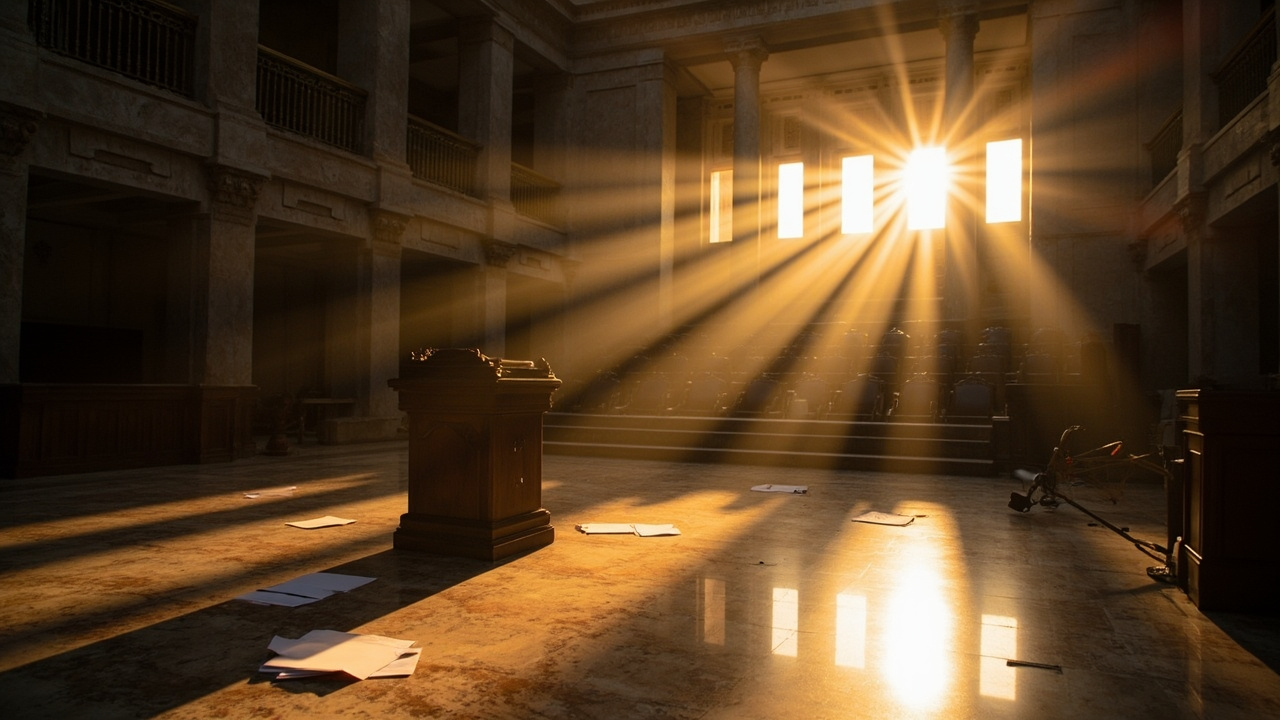
ISLAMABAD — The sun rose twice over Islamabad's diplomatic quarter before Vice President JD Vance stepped to a podium on Sunday morning and delivered the shortest press conference of his career. Three minutes. No questions. The talks were over.
As this paper wrote on Friday, the architecture was crumbling before the architects arrived. The enrichment gap — Iran enriching at 60 percent, the United States demanding a return to 3.67 percent — was never a difference that could be bridged in a single session. It was a geological fault line dressed up as a negotiating position. Twenty-one hours confirmed what the numbers already said.
Vance spoke for 189 seconds. He used the word "agreement" five times, each time preceded by "not." He used the phrase "final and best offer" once, in a formulation that will now define the collapse: "We leave here with a very simple proposal — a method of understanding that is our final and best offer. We'll see if the Iranians accept it." [1]
Then he boarded Air Force Two and flew east into the daylight, leaving Islamabad to the 70-member Iranian delegation, the Pakistani mediators, and the wreckage of the most significant direct engagement between Washington and Tehran since 1979.
The Gap That Could Not Close
The core sticking point was nuclear, and it was irreconcilable in the form both sides presented it. The United States arrived with a demand that Iran commit to never pursuing a nuclear weapon and surrender the tools that would allow rapid breakout — effectively, all highly enriched uranium above the 3.67 percent threshold permitted under the defunct JCPOA. [2]
Iran arrived with a counter-position that treated its enrichment capacity as a fait accompli. Its delegation, led by Parliament Speaker Mohammad Bagher Ghalibaf and Foreign Minister Abbas Araghchi, insisted that the right to enrich was non-negotiable — that the question was not whether Iran would enrich, but at what level, under what verification, and with what security guarantees in return. [3]
This is the gap the paper identified on April 11: not a negotiating posture, but a structural incompatibility. The JCPOA took two years of grinding multilateral work to produce a framework that managed this exact tension. The Islamabad format — bilateral, time-pressured, conducted during an active war — had no mechanism for managing it at all.
The Iranian delegation arrived wearing black, in mourning for what state media described as the casualties of Operation Epic Fury. The symbolism was unmistakable. These were not people who came to concede.
Three War Aims in One Weekend
What made the 21-hour collapse particularly revealing was the dissonance emanating from Washington while Vance was still at the table.
President Trump, speaking to reporters on the South Lawn before departing for a UFC event in Miami, offered a formulation that will haunt the diplomatic record: "Whether we make a deal or not makes no difference to me. The reason is because we've won." [4]
He elaborated: "We're in very deep negotiations with Iran. We win regardless. We've defeated them militarily."
This was not a throwaway. It was the third distinct war aim articulated by the administration in 72 hours. On Friday, Trump said "no nuclear weapon — that's 99 percent of it." On Saturday morning, as Vance sat across from Ghalibaf, Trump posted on Truth Social about clearing the Strait of Hormuz and taking oil. By Saturday evening, the objective had shifted again to outright military victory, rendering the talks themselves optional.
The timeline deserves examination. At approximately 4:00 p.m. Eastern on Saturday, while Vance and the Iranian delegation were deep in what CNN described as the most substantive exchange of positions, Trump told reporters the outcome was irrelevant. At approximately 7:00 p.m. Eastern, Trump was photographed at a UFC event in Miami, pumping his fist to the crowd while his vice president negotiated through the Pakistani night. [5]
Secretary of State Marco Rubio was also at the UFC event. The optics were not subtle.
What Iran Said — and Did Not Say
The Iranian response came through two channels, and they diverged in instructive ways.
Iran's state-affiliated Tasnim News Agency blamed the failure on "excessive" American demands, stating that Washington's position "prevented a common framework and agreement." [6] This was, by the standards of Iranian diplomatic communication, restrained. It blamed the demands, not the process. It did not close the door.
The Foreign Ministry spokesperson went further, calling the talks "intensive" and urging Washington to refrain from "excessive demands and unlawful requests." Again, the language was notable for what it did not contain: no declaration that talks were finished, no withdrawal from the ceasefire framework, no threat of escalation.
Iran's lead negotiator told state media that Tehran has "no plan for a next round of negotiations" — but this formulation left open the possibility that plans could change. The signal, decoded by veteran Iran watchers, was that Tehran was waiting for the "final and best offer" to arrive in writing, through Pakistani intermediaries, before responding.
This is consistent with Iranian negotiating behavior stretching back decades. Tehran does not make concessions at summits. It makes them in back channels, weeks later, after the public performance of rejection has satisfied domestic audiences. The question is whether the Trump administration has the patience — or the interest — to wait.
The Enrichment Arithmetic
The numbers deserve precision, because they define the physical reality underneath the diplomatic language.
Iran currently enriches uranium to approximately 60 percent purity — a level that has no civilian application and sits perilously close to the 90 percent threshold required for a weapon. Under the JCPOA, Iran was permitted to enrich to 3.67 percent using a limited number of centrifuges at declared facilities.
The gap between 60 and 3.67 is not a negotiating range. It is the distance between a country that has nuclear latency and one that does not. Closing it requires either physical destruction of centrifuges and stockpiles, or a verification regime so intrusive that it amounts to the same thing.
Vance's "final and best offer" reportedly included provisions for international monitoring and a phased drawdown, but the timeline and scope were unacceptable to Tehran. The Iranians wanted guarantees that sanctions would be lifted simultaneously with any enrichment concessions — a linkage the United States rejected because it would, in effect, pay Iran to comply with its own prior obligations. [7]
The IAEA, which retains some monitoring capacity despite the war, has confirmed that Iran's stockpile of highly enriched uranium continues to grow. Director General Rafael Grossi, who had reportedly made progress in pre-war consultations, was not present in Islamabad. His absence was itself a signal: the technical process that might have built a bridge had been sidelined in favor of a political confrontation.
The Ceasefire Question
The two-week ceasefire, announced on April 8, was always fragile. It now hangs by a thread.
Vance did not explicitly declare the ceasefire void. His language was carefully hedged: "The question is, 'Do we see a situation where the ceasefire holds?' And the answer to that is, 'We're going to have to wait and see.'" [1]
But the logic is stark. The ceasefire was understood — at least by Washington — as a confidence-building measure leading to permanent terms. Without those terms, the ceasefire has no legal or diplomatic foundation beyond mutual exhaustion. Iran's continued closure of the Strait of Hormuz, which the ceasefire was supposed to address, remains in force. The IRGC Navy issued a statement on Saturday threatening to "deal severely" with any military vessels transiting the strait — a direct contradiction of CENTCOM's announcement that two destroyers had begun mine-clearance operations. [8]
The ceasefire is not dead. But it is no longer a pathway. It is a pause, and pauses in wars have a way of ending.
The Pakistani Role
Pakistan's mediation deserves more attention than it has received. Prime Minister Shehbaz Sharif personally greeted Vance upon arrival and facilitated the physical logistics of the talks — no small feat, given the security requirements of hosting delegations from two countries at war.
Pakistan's interest is geographic and existential. It shares a 959-kilometer border with Iran. It has a Baloch population that straddles the frontier. It has its own nuclear arsenal, making it exquisitely sensitive to any arrangement that might constrain or legitimize another country's nuclear ambitions.
Sharif's willingness to host the talks reflected a calculation that Pakistan's influence in the region depends on being seen as indispensable. Whether the talks succeeded or failed, Islamabad would be at the table for whatever comes next.
What the Collapse Means
The failure in Islamabad does not mean war resumes immediately. It means the war's political resolution has been deferred, and the terms of that deferral are worse than they were on Friday.
The United States has now publicly issued what it calls its "final and best offer." If Iran rejects it — and the public posture suggests it will — the administration faces a choice between climbing down from that language or escalating. History suggests this administration does not climb down.
Iran, for its part, has demonstrated that it can endure 21 hours of direct engagement without conceding its core position. This is not necessarily strength. It may be rigidity. But it means that any future deal will require either a fundamental change in American demands, a fundamental change in Iranian leadership, or a level of sustained diplomatic engagement that this White House has shown no interest in providing.
Vance's three-minute press conference was, in its brevity, the most honest statement of the weekend. There was nothing left to say. The gap between 60 percent and 3.67 percent is measured in physics. The gap between "makes no difference" and 21 hours of negotiation is measured in something else entirely.
The architects came. The architecture crumbled. The sun rose over Islamabad, and the war continued.
-- YOSEF STERN, Islamabad