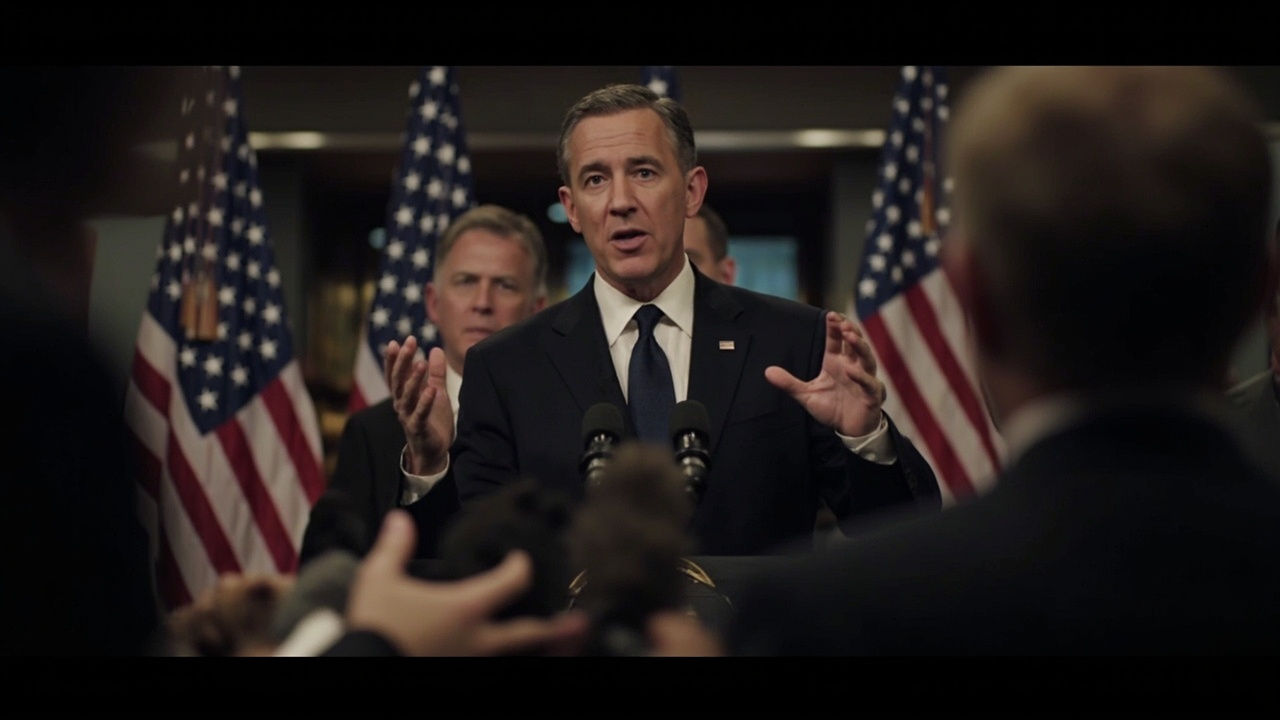
Vice President JD Vance appeared on Fox News Monday morning and described Iran's actions in the Persian Gulf as "economic terrorism against the entire world." [1] He then explained the United States' naval blockade of Iranian ports by saying: "As the President showed, two can play at that game." [1]
The sentence contains its own contradiction. If Iran's disruption of shipping through the Strait of Hormuz constitutes economic terrorism, and the United States is playing the same game, then the United States is also engaging in economic terrorism. Vance did not appear to notice the implication. His interviewers did not press it. On X, thousands of people did.
This paper reported Sunday on the blockade that CENTCOM began enforcing Monday morning, noting the gap between Trump's social media language — which threatened to blockade "any and all Ships" in the Strait — and CENTCOM's operational directive, which limited the blockade to Iranian ports only. Vance's Monday remarks add a third layer: a rhetorical framework that explicitly equates the two sides' actions while simultaneously insisting that one is justified and the other is not.
The full quote, delivered with the measured cadence that Vance has adopted for foreign policy appearances, was: "What they have done is engage in this act of economic terrorism against the entire world. They have disrupted global shipping. They have extracted tolls from vessels. They have threatened the energy security of every nation that depends on the Strait of Hormuz. As the President showed, two can play at that game. If the Iranians are going to try to engage in economic terrorism, we're going to abide by a simple principle: their ports will be closed until they stop." [1]
The argument has a surface logic. Iran's IRGC established a toll regime at a checkpoint near Larak Island in late March, extracting payments of up to $2 million per vessel — often in Chinese yuan — from ships transiting Iranian-controlled waters. [2] The regime was extortionate by design: pay or risk seizure. The toll generated revenue for the IRGC while creating a chokepoint within the chokepoint. Vance's framing casts the US blockade as a proportional response to Iranian coercion — the equivalent of a bouncer throwing out a guest who was shaking down other patrons.
The problem with the analogy is that the United States is not a bouncer. It is a participant in a military conflict with Iran, operating under a ceasefire that both sides claim to observe, and enforcing a blockade that the IRGC has explicitly described as a ceasefire violation. [3] The toll regime, whatever its moral character, operated within the space created by the collapse of normal shipping in the Strait. The blockade is a sovereign act of military coercion with no legal basis in the ceasefire framework and no congressional authorization beyond the war powers the administration has claimed under existing statutes.
The "economic terrorism" label is doing specific rhetorical work. It reframes the blockade as defensive — a response to terrorism rather than an act of aggression. This matters legally. The War Powers Resolution requires the president to notify Congress within 48 hours of introducing US armed forces into hostilities. If the blockade is a response to terrorism, the administration can argue it falls under existing counterterrorism authorities. If it is a new act of military escalation during an active ceasefire, the legal basis is considerably weaker. [2]
Vance's appearance was part of a broader Monday media blitz in which administration officials fanned out across cable news to defend the blockade. National Security Advisor Mike Waltz appeared on CNN, describing the blockade as "a measured response to Iranian provocations." [2] Pentagon spokesperson Pat Ryder told reporters at a briefing that CENTCOM was enforcing the blockade "in accordance with international law and the laws of armed conflict." [1] None of them used the phrase "economic terrorism." That was Vance's contribution — a escalation of language that went further than any other official statement.
The phrase is notable because Vance has historically been the administration's most careful communicator on Iran. During the Islamabad negotiations, he was described by Pakistani mediators as "disciplined" and "focused on specifics." His departure statement from Pakistan was measured in comparison to Trump's social media posts. [3] The shift to "economic terrorism" language on Monday suggests either a deliberate escalation of the administration's rhetorical posture or Vance's own frustration with the failure of diplomacy becoming visible in real time.
On X, the reaction split along predictable lines. Administration supporters amplified the quote as evidence of strength: the vice president was calling Iran's behavior what it is and promising consequences. Critics, particularly on the political left and among anti-war conservatives, seized on the "two can play that game" formulation as a confession. Ron Filipkowski, a former Republican who has become one of the administration's most persistent critics on X, posted the clip with the caption: "Vance admits that Trump's blockade is an act of economic terrorism against the entire world." [4] The post accumulated hundreds of thousands of views within hours.
The deeper issue is not what Vance said but what his language reveals about the administration's theory of the conflict. "Economic terrorism" is not a legal category. It is not defined in international humanitarian law, the UN Charter, or US statutory law. It is a political term that borrows the moral weight of "terrorism" and attaches it to economic behavior. The effect is to delegitimize Iran's actions while legitimizing identical actions when performed by the United States. This is not hypocrisy in the conventional sense. It is the normal operating procedure of great-power rhetoric: the rules apply to them, not to us.
The question is whether the rhetoric has operational consequences. If the administration has internalized the "economic terrorism" frame, it may be less inclined to seek a negotiated off-ramp — because you do not negotiate with terrorists, you defeat them. The Islamabad talks collapsed. The blockade is in place. The ceasefire expires April 22. And the vice president of the United States has just described the adversary's behavior in terms that make de-escalation harder to justify to his own base.
"Two can play that game" is a phrase from a schoolyard, not a foreign policy. But it is an honest description of what is happening in the Strait of Hormuz: two sides, each using economic coercion against the other, each calling the other's version illegitimate. The difference is that one side has a carrier strike group and the other has speedboats and mines. The rhetoric makes them sound equivalent. The military balance does not.
-- SAMUEL CRANE, Washington