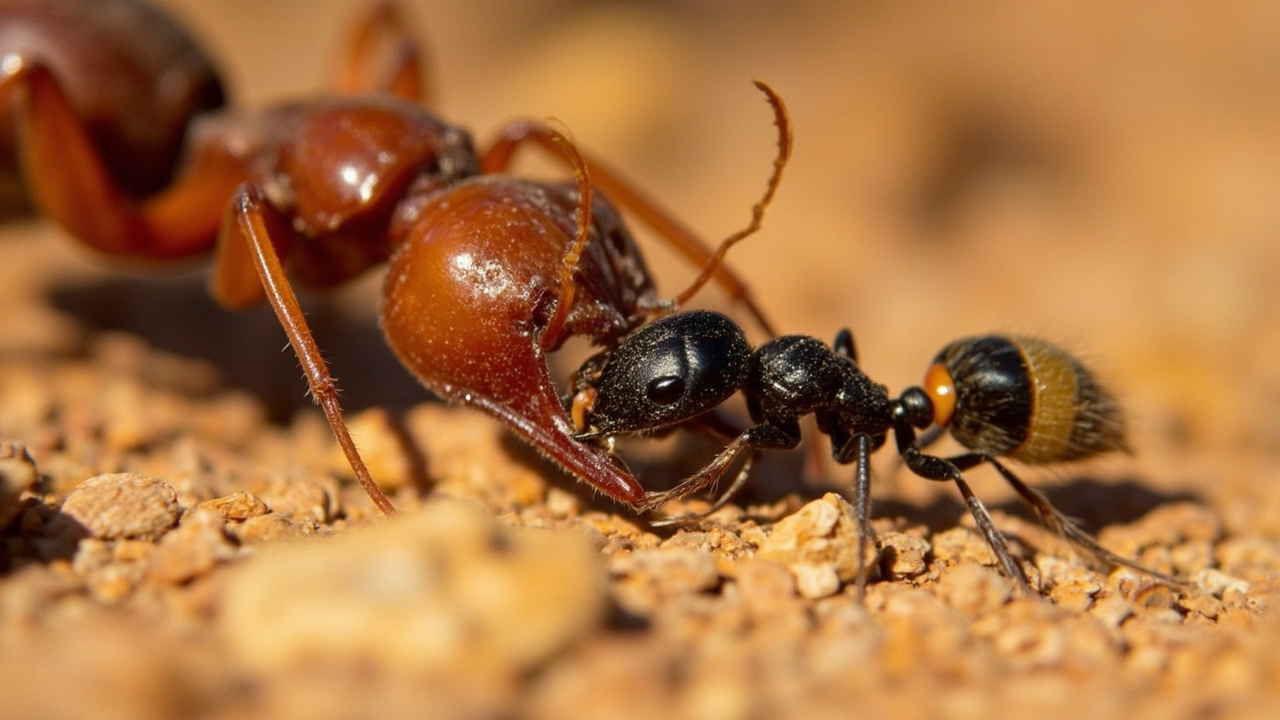
In Arizona's Sonoran Desert, giant harvester ants — insects that can reach 14 millimeters long — have been observed doing something unexpected: traveling to the nests of much smaller cone ants and presenting themselves for cleaning. [1]
The discovery, published this week and reported by ScienceDaily, documents what researchers are calling a cleaning station analogous to those found at coral reefs, where small cleaner wrasse fish remove parasites from larger fish that queue up and hold still. The parallel in an entirely different kingdom of life suggests that interspecies grooming stations may be a convergent evolutionary strategy. [1]
What makes the Arizona case startling is the intimacy of the service. The cone ants — a fraction of the harvester's size — groom not just the outer body but venture inside the harvester's mandibles, the powerful crushing jaws that could snap them in half. The harvester ants, for their part, hold their mandibles open and wait. [1]
The behavior rewrites assumptions about ant social organization. Ant colonies are models of same-species cooperation, but interspecies grooming implies a negotiated relationship — something approaching mutualism — between unrelated colonies in the same habitat. Researchers are now examining whether the cone ants receive any benefit in return, or whether the harvester ants' restraint is itself the payoff. [1]
Oliver Sacks once wrote that nature's most revealing moments are the ones that seem to violate the rules — until you realize the rules were written too narrowly. A tiny ant inside the open jaws of a giant qualifies.
-- KENJI NAKAMURA, Tokyo