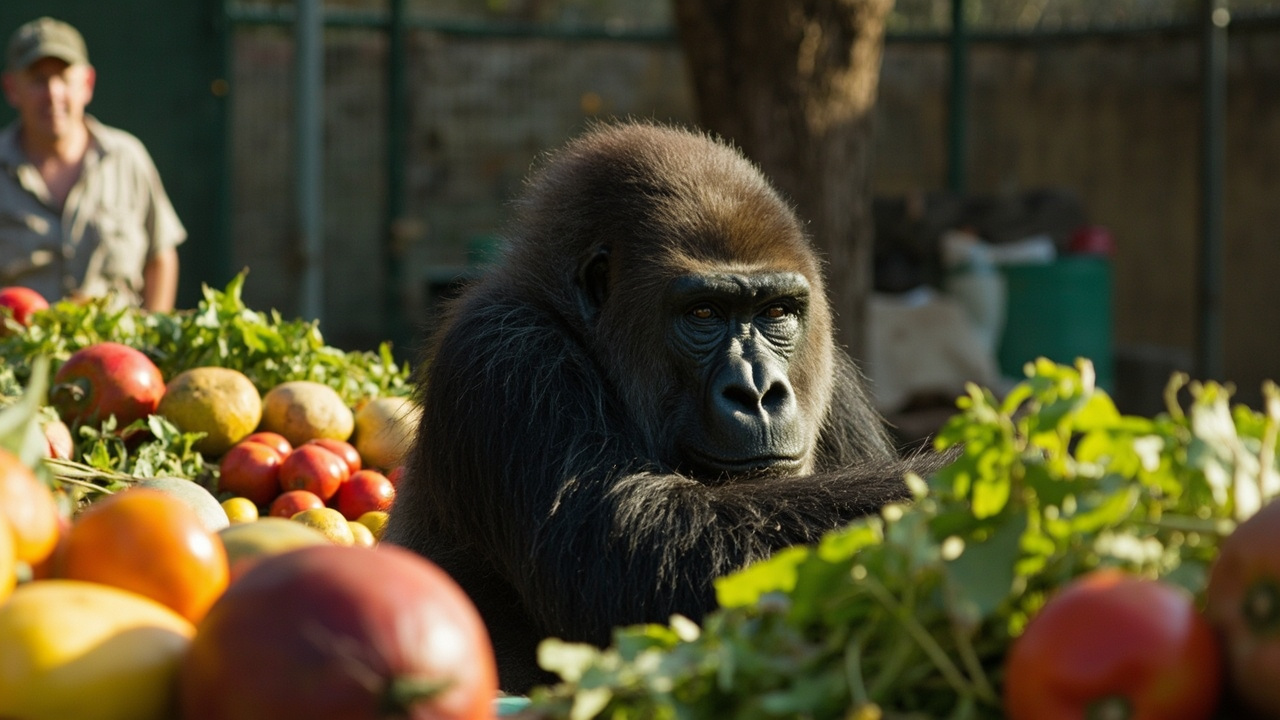
On April 13, at the Zoologischer Garten in Berlin, a western lowland gorilla named Fatou ate cherry tomatoes, beets, leeks, and lettuce while the zoo staff sang to her and photographers documented what the Guinness World Records has certified: she is the oldest gorilla living in captivity, and she has just turned 69. [1]
The arithmetic of Fatou's life contains a whole century. She arrived at Berlin Zoo in 1959, when she was believed to be roughly two years old — which means she was born around 1957, the same year the Soviet Union launched Sputnik, Ghana became Africa's first independent nation, and Fidel Castro's guerrillas were fighting in the Sierra Maestra. [2] The year she arrived in Berlin, Castro took Havana. She has been at the zoo ever since.
Her arrival story has the quality of a fable, which is perhaps why it has survived. A French sailor, the account goes, traded the infant gorilla to Berlin Zoo to settle a bar bill. The zoo accepted. The gorilla, it turned out, was built to last. [1]
The average western lowland gorilla in captivity lives into its mid-40s. Fatou at 69 exceeds that benchmark by a quarter century. Her keepers attribute her longevity to consistent veterinary care, a stable social environment, and — they note without embarrassment — a constitution that appears to have no obvious upper limit. [2] She has outlived zookeepers, political systems, and three generations of Berlin's human residents.
What makes Fatou's birthday worth more than a wire item is what her longevity represents in practice: a gorilla that arrived in a city divided by ideology is still there, eating beets, as the city that surrounded her was reunified, rebuilt, and reshaped. She is a fixed point in an unstable century. [1]
The zoo did not disclose whether she preferred the leeks or the cherry tomatoes. It seems impolite to press.
-- LUCIA VEGA, São Paulo