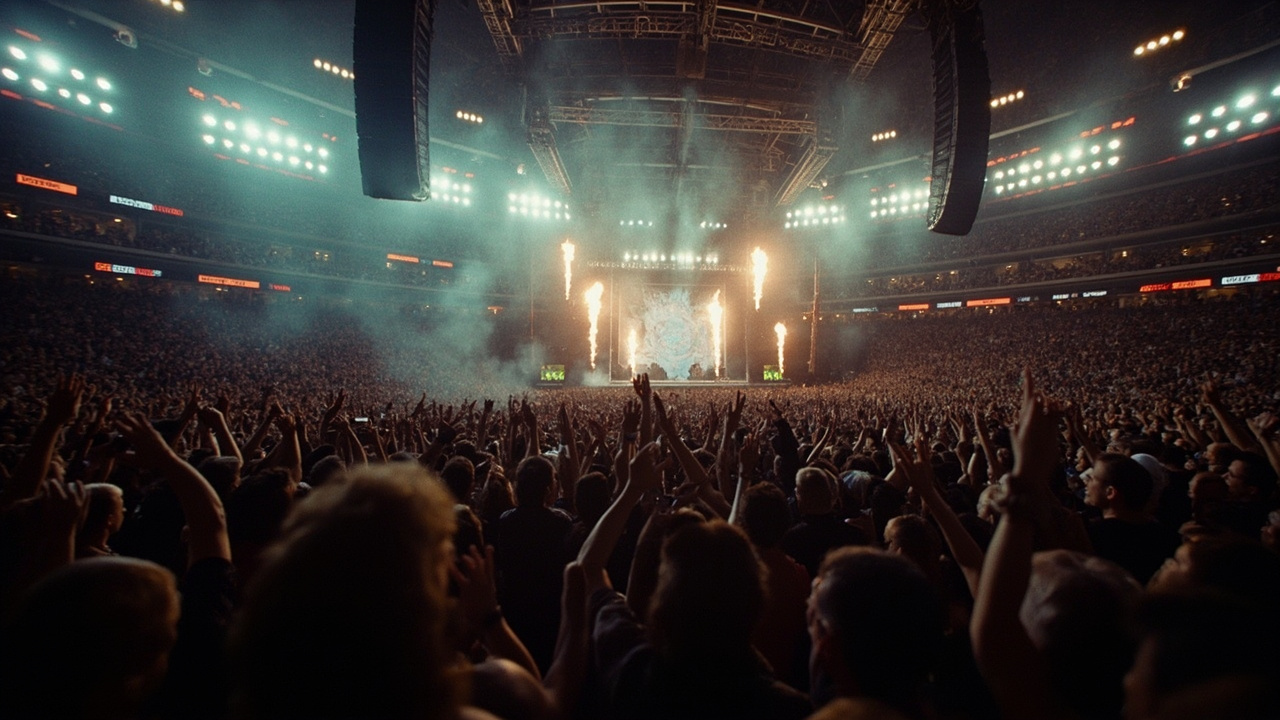
The Rock and Roll Hall of Fame announced its 2026 inductee class on Wednesday. Iron Maiden is on the list. The band first became eligible 21 years ago. [1]
The 2026 class — Iron Maiden, Oasis, Phil Collins, Billy Idol, Joy Division/New Order, Sade, Luther Vandross, and Wu-Tang Clan — will be inducted at a ceremony in Los Angeles on November 14. [1] The announcement resolves one of the Hall's more conspicuous oversights, and it raises an obvious question: will Bruce Dickinson, who has described the institution with varying degrees of contempt over the course of two decades, actually show up?
Dickinson's position on the Rock Hall has evolved from dismissive to outright hostile to, apparently, resigned acceptance. In his most quoted statement on the subject, he called it "an utter, complete load of bollocks" — a characterization he has not publicly retracted. [2] The band's manager Rod Smallwood issued a statement on behalf of Iron Maiden accepting the induction, which suggests institutional participation. Whether Dickinson himself will appear is a separate matter.
The timing of the induction is worth noting. Iron Maiden has been eligible since 2005 — the year that eligibility kicks in is 25 years after a band's first commercial release, which for Maiden was 1980. In those 21 years of eligibility and non-induction, the band sold an estimated 100 million albums, headlined every major festival circuit multiple times, and built one of the most loyal global fan bases in the history of rock music. The Hall's voting body declined to induct them annually while inducting a substantial number of acts whose commercial and cultural footprint was considerably smaller. [2]
The institutional logic of the Rock Hall has always been opaque. Its voting body is drawn primarily from journalists and music industry figures, weighted toward artists who received critical attention in certain American markets during certain decades. Iron Maiden's core fanbase was built in British working-class communities and then exported globally — precisely the demographic that has historically been underweighted in American critical taste-making. [1]
The band's response to non-induction has been to decline to campaign for it and to continue performing to enormous crowds on multiple continents. Dickinson's bollocks comment was not a plea for recognition. It was contempt for an institution he judged to have contemptible selection criteria. [2]
What changes when a band that has publicly rejected an honor accepts it? The cynical answer is: nothing important. The ceremony will happen, the plaque will be given, and Iron Maiden will continue to be Iron Maiden regardless of what the Rock Hall says about them. The more interesting answer is that acceptance represents a kind of reconciliation with the mainstream music establishment that Maiden has spent its entire career defining itself against.
The 2026 class itself is notable for its breadth. Oasis's induction is complicated by the ongoing Gallagher brothers reunion — the band currently on tour is the same band being inducted, which removes the symbolic weight that usually attaches to posthumous or long-dormant reunions. Sade, who has released music on her own schedule and largely ignored the industry's promotional apparatus for four decades, is an inductee whose acceptance or absence will be read closely. [1]
For Iron Maiden, the November ceremony in Los Angeles will be the first time in 21 years of eligibility that the institution has formally acknowledged what the audience already knew. That acknowledgment comes about 21 years late. It is still acknowledgment.
-- CAMILLE BEAUMONT, Los Angeles