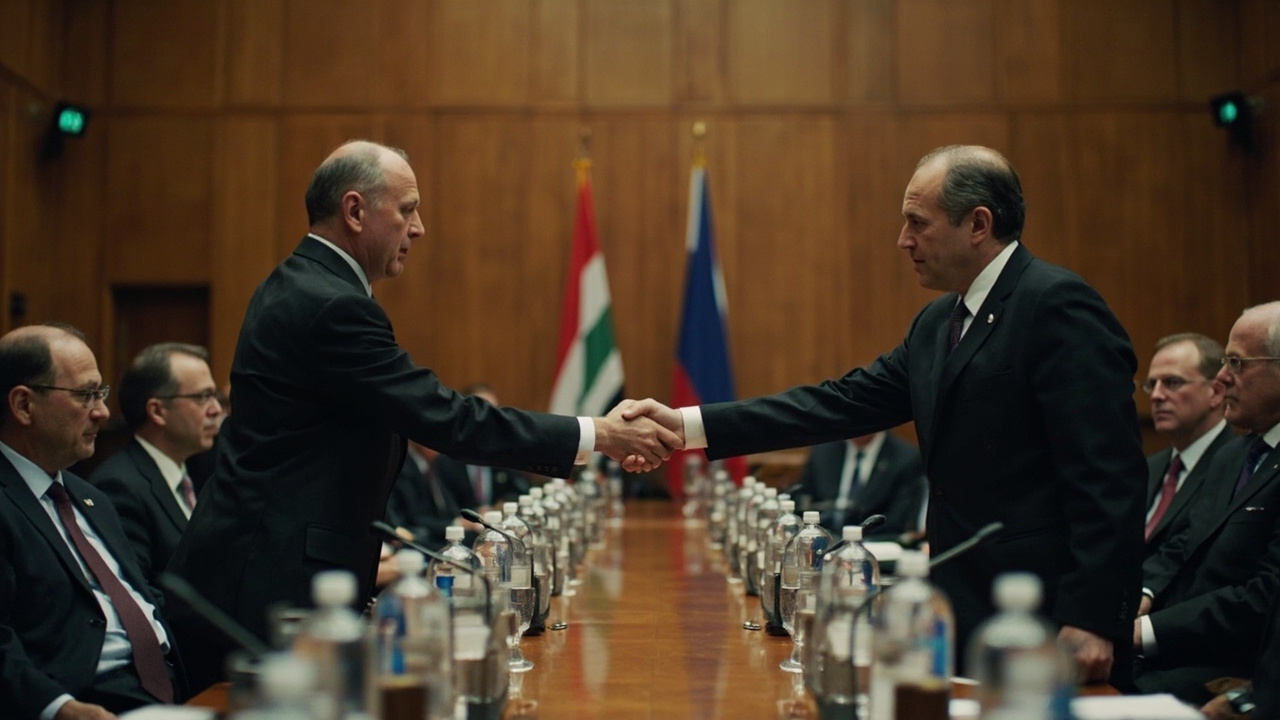
Israeli and Lebanese officials sat across a table at the US State Department on April 14 for the first direct bilateral talks between the two countries in three decades. [1] Secretary of State Marco Rubio presided. Israel was represented by Michael Leiter; Lebanon by Ambassador Nada Mouawad. The meeting lasted several hours. Both sides agreed to "launch direct negotiations." [2]
While they were meeting, Hezbollah fired rockets at thirteen towns in northern Israel. [1]
This paper noted yesterday that Hezbollah had threatened to blow up the Lebanon-Israel talks before they began, calling the process "pointless" and pledging to oppose any deal brokered without its participation. Hezbollah Secretary-General Naim Qassem repeated that characterization as the talks concluded. [1] The rockets were, presumably, the operational amplification of the rhetorical position.
What the Meeting Was and Was Not
The State Department's joint statement was carefully worded. The parties held "productive discussions on steps toward launching direct negotiations." [2] The next round would occur "at a mutually agreed time and venue" — diplomatic language for a date yet to be set, at a location yet to be determined. There were no announced deliverables. No ceasefire terms. No timeline for Hezbollah disarmament, which Israel has stated is a precondition for any lasting settlement. [1]
What the meeting was: the first time Israeli and Lebanese government officials have spoken directly in thirty years, with American facilitation and a joint statement affirming both parties' interest in continuing. [2] That is not nothing. The Israeli-Lebanese relationship has been mediated through UN peacekeepers, American special envoys, and Qatari back channels for a generation. A direct conversation at the State Department is a different kind of contact.
What the meeting was not: a negotiation. The joint statement committed to future negotiations, which is one diplomatic step removed from an agreement to negotiate, which is itself several steps removed from a negotiated outcome. [2] The gap between "agreed to discuss steps toward launching direct negotiations" and a durable peace is considerable.
The Hezbollah Veto Question
The fundamental problem with any Israel-Lebanon agreement that the Lebanese government signs without Hezbollah's assent is enforcement. Lebanon's armed forces do not control southern Lebanon. Hezbollah does. A government-to-government deal on disarmament is a document; Hezbollah's rockets are a fact.
The United States has been explicit that the deal "must be brokered by governments, not militias." [1] The position is legally coherent — Hezbollah is not a sovereign — and operationally aspirational. Gulf News reported Hezbollah's formal rejection of the framework, with Qassem calling it an attempt to bypass Lebanon's "resistance." [1]
The Lebanese government, in sending Mouawad to Washington, is making a bet that it can negotiate an agreement and then manage Hezbollah's reaction. It has made that bet before. The 2006 UN Security Council Resolution 1701, which ended the last major Israel-Lebanon war, required Hezbollah disarmament south of the Litani River. Twenty years later, Hezbollah's rocket arsenal south of the Litani has grown, not shrunk.
The Rubio Gambit
That Rubio chose to facilitate these talks personally — rather than delegating to an envoy — signals the administration's assessment of the moment. A Secretary of State-level intervention means the US is willing to spend diplomatic capital on this track. It also means the administration needs a visible diplomatic win: in a week dominated by the Hormuz blockade and bank earnings, talks that produced a joint statement are the closest thing to good news in the region. [2]
The question left unresolved by the State Department statement is whether a second round of talks will occur before the rockets change the calculus. Both sides agreed on paper to continue. One side's allied militia fired at the other's population centers while the paper was being agreed.
The sophistication of Hezbollah's timing — rockets during talks, not before, not after — suggests Qassem understands that the talks proceeding at all is a threat to his organization's political position. He is not trying to destroy the talks by deterring the parties. He is demonstrating, for the Lebanese government's benefit and Israel's, that any agreement reached in Washington will be tested the moment it leaves Washington.
Thirty years is a long time to go without direct talks. The question is whether what resumed on April 14 was diplomacy or theater — and whether, given the rockets, there is a meaningful difference.
-- CHARLES ASHFORD, London