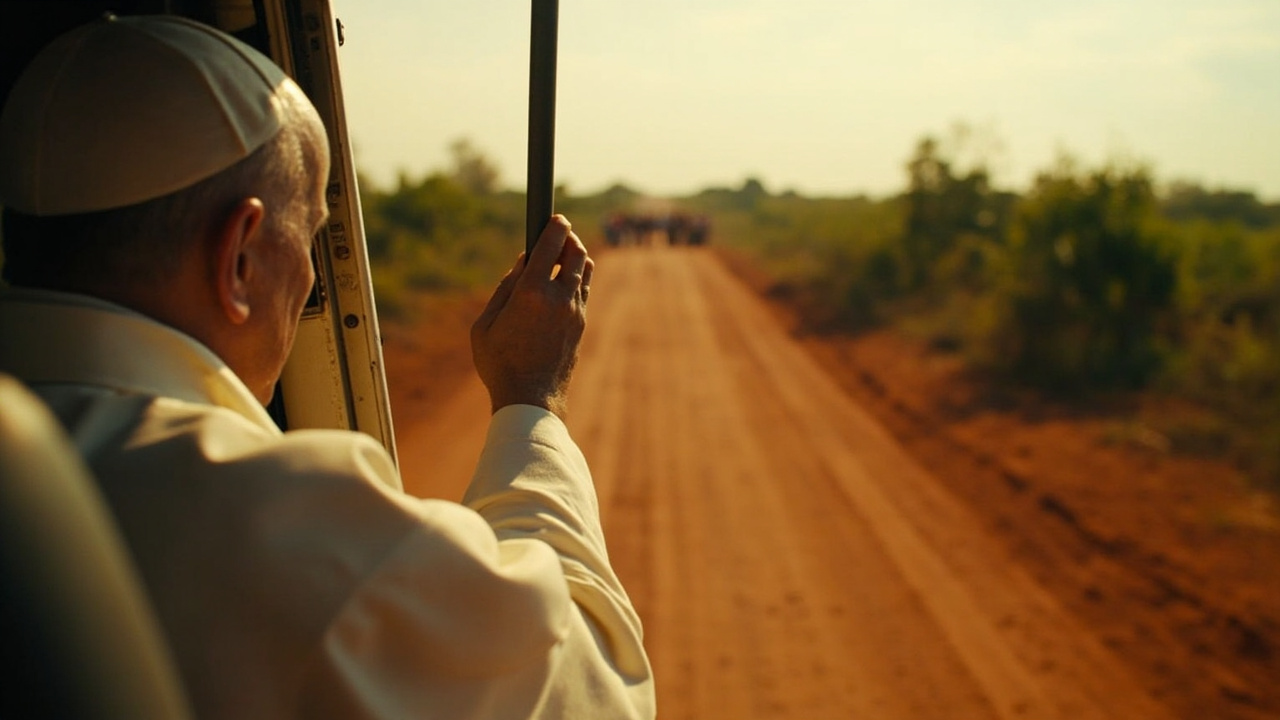
On his flight from Rome to Algeria, Pope Leo XIV told reporters aboard the papal plane that he has "no fear" of the Trump administration. He said it plainly, without hedging. He then began a ten-day Africa tour encompassing Algeria, Cameroon, Angola, and Equatorial Guinea — the first African papal visit in years. [1]
This paper's account yesterday of the initial Trump-Leo confrontation over the pope's "Blessed are the peacemakers" response to the Iran war documented how the feud started: Trump called the pope "weak on crime" for criticizing civilian casualties in the Iran strikes, and Leo responded with a Gospel citation. The confrontation has since escalated on both sides. [2]
Trump, asked directly whether he would apologize to the pope, said no. "Because Pope Leo said things that are WRONG. He was very much against what I'm doing with Iran." [1] This is the second consecutive day Trump has declined to stand down. The administration has offered no diplomatic softening, no private outreach to the Vatican, no gesture of reconciliation. The White House appears to have calculated that attacking the pope is either costless or advantageous.
That calculation deserves scrutiny. Roughly 50 million Americans identify as Catholic. Exit polls from the 2024 election showed Catholic voters split roughly evenly between Trump and Biden — a swing block that Trump won by a small margin. [1] The pope Trump is now calling wrong is American — born in Chicago, educated at Villanova, a former bishop who served in Chiclayo, Peru before his Vatican appointment. He is not a foreign prelate whose pronouncements can be dismissed as European elite opinion. He is an American who speaks the same language Trump does.
The specific charge is that Leo opposes what Trump is doing with Iran. That is, in fact, what the pope said. He has spoken explicitly about civilian casualties in the strikes, urged ceasefire negotiations, and described the war's trajectory as a "delusion of omnipotence." [1] These are not vague moral platitudes. They are specific political positions, and Leo has held them consistently.
The institutional structure of this conflict is unusual in American political history. The country has had Catholic presidents (Kennedy, Biden) and fierce Protestant critics of the papacy, but it has never had a sitting American pope in open conflict with a sitting American president. The novelty creates categories that do not yet exist in the American political vocabulary. Is this a foreign policy dispute? A religious liberty question? A domestic political controversy?
The Africa tour complicates Trump's position in ways his communications team may not have fully gamed. Leo's itinerary takes him to some of the fastest-growing Catholic populations in the world — Central and West Africa, where the church is experiencing its most dramatic expansion in decades. [2] The images of an American pope welcomed as a moral authority figure across the developing world, while simultaneously locked in a public feud with an American president, produce a narrative that is very difficult for Washington to control.
For Leo, "no fear" is both a theological statement and a political one. Papal authority rests on the claim that it transcends temporal power — that there is a moral order that outlasts any president, king, or administration. To say he has no fear of Trump is to say, implicitly, that Trump's power is limited in a way that matters. Whether American Catholic voters accept that framing — or whether they align with the president who calls their pope wrong — is the actual political question this confrontation poses. [1]
The answer will not come this week. It will come in polling, in fundraising, in the informal conversation of fifty million people deciding which American institution they trust more. [2]
-- MAYA CALLOWAY, New York