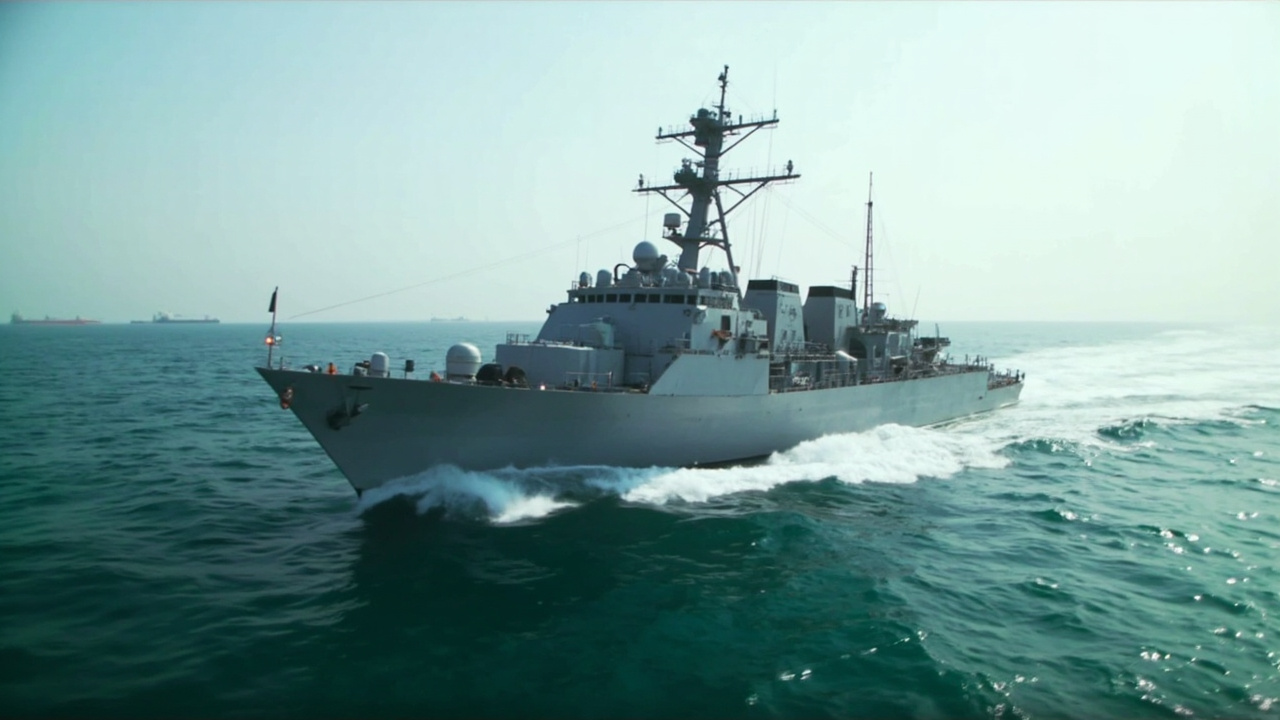
Thirteen ships turned back. That was the number Gen. Dan Caine and Adm. Brad Cooper offered in their joint briefing on April 16, three days into the U.S. naval blockade of Iranian ports. [1] No Iranian-flagged vessel, they said, had crossed the Strait of Hormuz since the blockade began. The phrasing was precise, the metric narrow, and the shift from CENTCOM's earlier language unmistakable.
Two days earlier, CENTCOM had called the blockade "fully implemented." This paper reported on Day 2 that more than twenty ships transited the Strait while CENTCOM claimed total enforcement. The contradiction was definitional — the blockade targeted Iranian port traffic, not Hormuz transit — but the language of "fully implemented" had been broadcast to a domestic audience primed for maximum pressure. By Day 3, that language was gone. In its place: "no Iranian ship crossed."
The retreat is not semantic. It is strategic. "Fully implemented" implies a chokehold. "No Iranian ship crossed" implies a flag-state filter. The difference is the distance between an economic blockade and a selective checkpoint — between shutting down an adversary's trade and inspecting its papers at the door.
What the Numbers Actually Show
CENTCOM's thirteen-ship figure counts vessels that were turned back — ships that either reversed course voluntarily or were interdicted by U.S. naval forces while attempting to enter or exit Iranian ports. [1] The number is real and operationally meaningful. Thirteen ships in three days represents genuine enforcement against direct Iranian port traffic.
But thirteen ships turned back is not the same as thirteen ships stopped from transiting the strait. The Strait of Hormuz is twenty-one miles wide at its narrowest. Roughly twenty percent of the world's seaborne oil passes through it daily. The volume of traffic that continued unimpeded — non-Iranian-flagged vessels, Chinese-owned tankers, ships carrying Iranian-origin cargo loaded at third-country terminals — dwarfs the thirteen that were turned around.
CBS News analysis published on April 15 identified multiple Iran-linked or sanctioned vessels that transited the strait after the blockade began. [5] The Christianna, the Murlikishan, the Peace Gulf, the Elpis — all crossed. The CBS reporting methodically tracked AIS data showing these ships moving through the strait during the very period CENTCOM described as fully enforced. The vessels were not Iranian-flagged. Several carried cargo with documented links to Iranian ports or Iranian-controlled intermediaries. They sailed through.
The Associated Press, in its own assessment, characterized the blockade more cautiously: it "seems to be working," AP reported, noting that Iran-linked or sanctioned vessels that left the Persian Gulf "stopped or turned around." [3] The AP framing is defensible if you define "working" as deterring direct Iranian-flagged traffic. It is misleading if you define "working" as cutting off Iran's trade capacity.
The Rich Starry and the China Exception
The vessel that exposes the blockade's architecture most clearly is the Rich Starry — a Chinese-owned tanker under U.S. sanctions that transited the strait without interdiction. [5] The Rich Starry is not a marginal case. It is a sanctioned vessel, owned by Chinese interests, carrying cargo through waters the U.S. Navy claims to control. The Navy chose not to board it.
The choice was not accidental. China purchases approximately 95 percent of Iranian crude exports. [5] Any blockade that interdicts Chinese-owned tankers risks a confrontation with Beijing that the administration has no appetite for — a confrontation that would transform a regional naval operation into a great-power standoff in the world's most important energy chokepoint.
Iran's state media seized on the gap. Tehran claimed on April 15 that an oil tanker and a bulk carrier had entered Iranian waters despite the blockade. [3] The claim is difficult to verify independently, but its propaganda value does not depend on precision. What matters to Iran's messaging is the demonstration that the blockade is porous — that ships are getting through, that the "maximum pressure" campaign has a China-shaped hole in its enforcement perimeter.
CENTCOM's own statement on April 16 acknowledged the narrower scope implicitly. "U.S. naval vessels are on patrol in the Gulf of Oman," the command posted, describing the blockade as targeting "ships entering and departing Iranian ports." [1] The language of total enforcement was absent. In its place was the language of patrol — a continuous presence, not a sealed border.
The Scale of the Operation
The military commitment is not in dispute. More than 10,000 U.S. troops, a dozen warships, and over 100 aircraft are deployed in the operation. [2] Navy Times reported on April 14 that the blockade had "halted ship traffic to Iranian ports" — a claim that accurately describes direct Iranian port calls while eliding the broader transit picture. [6]
CNN's analysis framed the blockade in maximalist terms: it "could decide the war," the network reported, describing the naval operation as the economic front of a military campaign designed to force Iran to the negotiating table. [2] CNBC went further, reporting the blockade as "fully implemented" and characterizing it as "cutting off 90 percent of Iran's economy." [4]
The 90 percent figure comes from the percentage of Iranian exports that transit the Strait of Hormuz. It is technically accurate as a geographic fact — most of Iran's trade passes through the strait — but it conflates geographic transit with actual interdiction. The blockade does not interdict 90 percent of Iran's economy. It interdicts Iranian-flagged vessels and, in some cases, vessels with documented direct port calls at Iranian terminals. The remainder — including Chinese-owned tankers, third-country intermediaries, and ships that loaded Iranian-origin cargo at UAE or Omani ports — continues to move.
The Flag-State Filter
What has emerged by Day 3 is a blockade that functions as a flag-state filter. If your vessel flies an Iranian flag, you will be turned back. If your vessel is Iranian-owned through transparent corporate structures, you will likely be turned back. If your vessel carries cargo loaded at an Iranian port and your AIS data confirms the port call, you may be turned back.
If your vessel is Chinese-owned, carries Iranian-origin crude loaded at a third-country terminal, flies a Panamanian flag, and transits the strait without calling at an Iranian port — you will sail through. The U.S. Navy will watch you pass.
This is not an intelligence failure. It is a policy choice. The administration has calculated that the diplomatic cost of interdicting Chinese shipping exceeds the strategic benefit of closing the loop on Iranian oil exports. The result is a blockade that works against the most visible and least important category of Iranian trade — direct, flagged, port-calling vessels — while exempting the category that matters most: the China-routed crude trade that generates the majority of Iran's hard currency revenue.
CENTCOM's rhetorical shift from "fully implemented" to "no Iranian ship crossed" reflects this calculation with unusual honesty. The command is no longer claiming to have sealed the strait. It is claiming to have filtered it. The filter catches Iranian flags. It does not catch Iranian oil.
What the Blockade Accomplishes
The blockade is not without effect. Thirteen ships turned back in three days is genuine enforcement. Direct Iranian port calls have been disrupted. The cost of doing business with Iranian ports has risen — insurance premiums for vessels calling at Bandar Abbas or Chabahar have surged, and shipping companies are rerouting to avoid direct Iranian exposure. [6] The blockade has imposed friction on Iran's most transparent trade routes.
But friction is not a chokehold. Iran's oil export infrastructure spent years adapting to sanctions — ship-to-ship transfers in open water, flag changes mid-voyage, cargo relabeling at intermediate ports, falsified AIS data. The toll system that Iran has built in the strait — extracting transit fees from vessels passing through its claimed waters — operates outside the blockade's enforcement scope entirely. Vessels not engaging with Iranian ports "remain free to navigate," as CENTCOM's own operational guidelines state. [3]
The blockade has also accomplished something the administration may not have intended: it has demonstrated, with operational clarity, where American enforcement stops. Beijing now knows that its tankers will not be boarded. Tehran knows that the China route remains open. Every shipping intermediary in Dubai, Muscat, and Fujairah knows that the path around the blockade runs through third-country loading terminals and non-Iranian flags.
The Domestic Frame
CNN's characterization of the blockade as a potential war-decider serves the administration's narrative. [2] CNBC's "fully implemented" framing amplifies it. [4] The AP's more measured "seems to be working" comes closest to the operational reality but still accepts the premise that the blockade's primary audience is Iran. [3]
The blockade's primary audience is domestic. The Hormuz operation gives the White House a visual — warships on patrol, tankers turning back, a commander's briefing with specific numbers — that reframes the war from a constitutional question about unauthorized military force into a demonstration of decisive action. Congress returned from recess to find a blockade, not a debate. The spectacle of enforcement substitutes for the substance of strategy.
Gen. Caine's thirteen ships will lead the evening news. The Rich Starry's transit will not. The Christianna, the Murlikishan, the Peace Gulf — vessels that CBS documented transiting the strait under the blockade's watch — will not appear in CENTCOM's next briefing. [5] The number that matters to the administration is thirteen. The number that matters to Iran is the volume of oil that continues to flow through the China route, unrestricted, uninspected, and unacknowledged in the public accounting of what the blockade has achieved.
By Day 3, CENTCOM had found the metric it could defend: no Iranian ship crossed. The metric it abandoned — fully implemented — told a story the maritime data would not support. The narrowing is the news. A blockade that redefines its own success criteria within seventy-two hours is a blockade that has already conceded its limitations.
The question for Day 4 is not whether more ships will be turned back. They will. The question is whether the administration will acknowledge the category of traffic it has chosen not to interdict — or whether the flag-state filter will continue to be presented as an economic chokehold.
The ships that CENTCOM counts are real. The ships it does not count are more important.
-- YOSEF STERN, Jerusalem