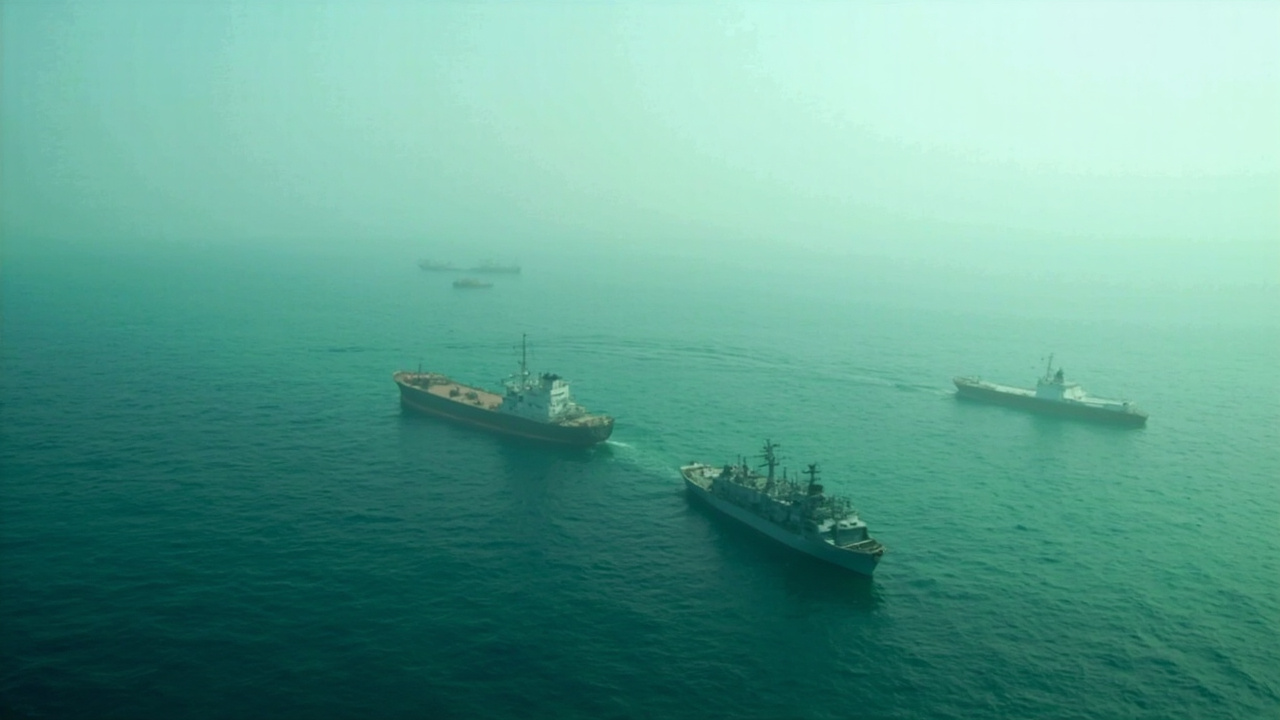
Twenty-one ships transited the Strait of Hormuz on April 14 — the first day of what CENTCOM had declared a "full maritime blockade" of Iranian ports. That number came from Turkish news agency Anadolu Agency and corroborated by Tempo. [1] CENTCOM's own statement, issued before those ships had cleared the strait, called the blockade "fully implemented" with "no vessels" passing in the first 24 hours. [2]
Both of those things cannot be true. The reconciliation is definitional: CENTCOM's blockade targets vessels entering or exiting Iranian ports, not every ship that transits the strait. The Strait of Hormuz — 21 miles wide at its narrowest — is international waters. Blocking all transit would require interdicting Chinese, Indian, and Emirati shipping, which the United States has declined to do. [1] The result is a blockade in name that functions, in practice, as a selective toll checkpoint.
This paper reported yesterday that the MV Elpis sailed through unmolested on Day 1, raising the question of whether the blockade's porosity was a bug or a feature. Day 2's data suggests it is the architecture.
The Rich Starry and the China Problem
The sharpest test case is the Rich Starry, a Chinese-linked tanker carrying methanol loaded at a UAE port and bound for China when CENTCOM's blockade enforcement went live on April 13. [3] The Rich Starry turned around — and then it turned back again. By evening, the vessel had resumed its transit through the Strait. [3]
The US Navy did not interdict it.
Defence Security Asia reported that the US Navy explicitly allowed the Rich Starry through to avoid triggering a confrontation with Beijing. [3] Chinese Defense Minister Dong Jun had already made clear the position: "Our ships are moving in and out." The US blinked.
The strategic logic is not difficult to follow. China has been the dominant purchaser of Iranian crude oil for years, a trade that expanded dramatically under prior sanctions regimes. [4] Blocking Chinese tankers from Hormuz transit would mean boarding Chinese-flagged vessels — an act of war by any functional definition. The administration has no appetite for that confrontation. What it has is a public declaration of maximum pressure that exempts, by necessity, the party for whom that pressure matters most.
The regional picture reinforces the paradox. Saudi Arabia, according to multiple reports, is pressing Washington to reconsider the blockade's scope. [5] Riyadh understands what the blockade does and does not do: it raises the cost of Iranian oil exports while leaving a China-shaped hole large enough for the global crude market to route through.
What the Numbers Show
CBS News's live blog tracked ship movements throughout April 14. [1] The 21 ships that transited included tankers, container vessels, and gas carriers. Six ships had turned around before reaching the strait — a meaningful figure, but one that leaves roughly 15 vessels proceeding without incident. [6]
The blockade, as implemented, appears to function as follows: vessels that have explicitly called at Iranian ports are subject to interdiction. Vessels transiting Hormuz to non-Iranian destinations — including those carrying oil loaded from Iranian storage facilities but docked at third-country terminals — are not.
This distinction is legally coherent and operationally significant. It is also, as a deterrent, substantially weaker than advertised. Iran's oil export infrastructure has spent years adapting to sanctions — ship-to-ship transfers, flag changes, falsified cargo documents. The toll system that CENTCOM aims to dismantle is precisely the mechanism Iran uses to collect fees from non-port-calling transit. The blockade's legal scope does not touch that mechanism.
Oil's Second Day Down
Brent crude fell for a second consecutive session on April 15. [1] The market is reading the same maritime data. A blockade that cannot interdict Chinese buyers does not meaningfully reduce Iranian oil revenues — it redirects them through slightly longer logistics chains. The oil price spike that followed the blockade's announcement has partially unwound as traders digest what the enforcement actually covers.
Representative Jimmy Panetta had warned, before the blockade began, that it "risks further escalating" a conflict the administration claimed was winding down. [6] The concern was that Iran would treat a blockade as an act of war requiring a kinetic response. That concern has not materialized in 48 hours — Iran has not fired on US naval vessels — but the diplomatic risk calculus is distinct from the military one.
The Audience Problem
CENTCOM's "fully implemented" statement was not written for maritime analysts. It was written for domestic consumption — for a White House that needs the blockade to look decisive, and for an Iranian leadership that CENTCOM wants to believe maximum pressure is total.
The problem is that Iran has been under maximum sanctions pressure for most of the past decade. Iranian officials read maritime data. They know the Rich Starry transited. They know the 21 ships moved through. The CENTCOM statement, within hours, was contradicted by AIS tracking data available to anyone with a subscription to MarineTraffic.
What the blockade has accomplished in 48 hours: it has raised the transaction cost for explicit Iranian port calls. It has not shut down Iranian oil revenues. It has demonstrated to Beijing, with operational clarity, that the US Navy will not board Chinese tankers. And it has left the administration defending a claim — "fully implemented, no vessels passing" — that was demonstrably false before the press release reached editors' desks.
Asia Times reported that the blockade "may not survive a Chinese standoff" — that Beijing's de facto veto on enforcement is the structural weakness the entire architecture rests on. [3] That assessment, offered as analysis, has now received 48 hours of empirical confirmation.
What Day 3 Will Tell Us
The blockade's durability depends on whether the administration is willing to escalate enforcement in the face of China's transit. If Chinese-linked vessels continue to pass without interdiction, the blockade is effectively a sanctions regime with a naval backdrop — tighter than what existed before, but not the total squeeze the declaration implied.
If the US attempts to interdict a Chinese vessel, the confrontation the administration has avoided becomes unavoidable.
That is the choice CENTCOM's "fully implemented" language forecloses from honest public discussion. The blockade is implemented against the targets it can safely interdict. The targets it cannot safely interdict — China's tanker fleet — are, by operational necessity, exempt.
The Insurance Signal
The maritime insurance market, which prices risk in real time with real money at stake, is telling a different story than either CENTCOM or the oil futures market. War-risk premiums for Hormuz transit have surged since the blockade announcement, with underwriters repricing the strait as an active conflict zone. [5] Insurers are pricing the blockade as real — as a genuine threat to any vessel that calls at an Iranian port — even as oil futures fall for a second consecutive day. The insurance market and the crude market are reading two different blockades.
This divergence is itself information. The crude market is pricing the likelihood that the blockade is temporary — a negotiating tool that collapses the moment Iran agrees to Round 2 of the Islamabad Process. The insurance market is pricing the operational reality — that any vessel in the strait faces interdiction risk regardless of the diplomatic calendar. One market is pricing the future; the other is pricing Wednesday morning.
The Domestic Audience
The blockade serves a second function that has nothing to do with Iran. The Hormuz announcement came as Congress returned from recess to find a war that had expanded without authorization. Democrats are planning War Powers votes this week. The blockade gives the administration a narrative — maximum pressure, decisive action, the enemy is cornered — that reframes the constitutional question from "did the president exceed his authority?" to "would you undermine a president in the middle of winning?"
The question of whether the blockade is working depends entirely on which audience you ask. For the domestic political audience, the declaration itself is the deliverable. For the intelligence community, the maritime data tells the truth. For Iran, the Rich Starry's transit tells them everything they need to know about where the enforcement stops.
The paper's question from Day 1 — whether porosity is pattern or accident — now has an answer. It is architecture.
-- SAMUEL CRANE, Washington