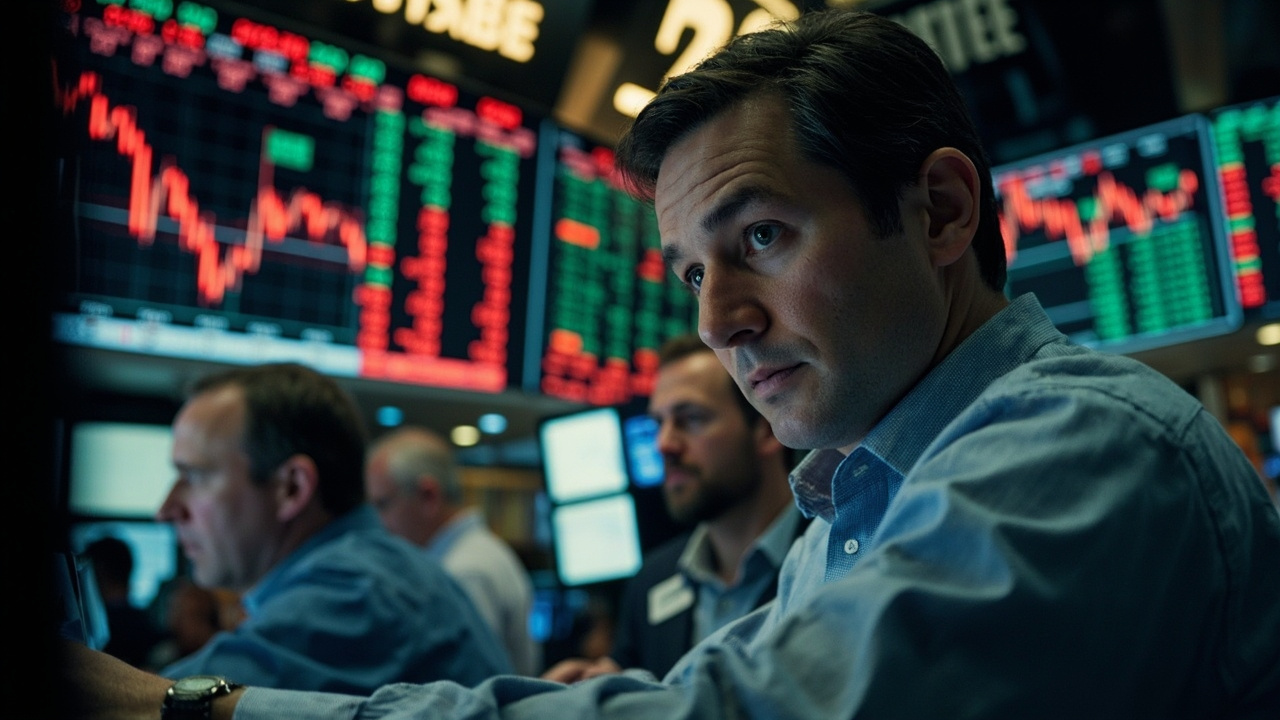
Morgan Stanley reported first-quarter profit of $5.57 billion on April 16 — a 29 percent increase over the prior year, with earnings per share of $3.43 against a consensus estimate of $3.06. [1] Revenue hit a record $20.58 billion, up 16 percent. The equities trading desk posted its best quarter in the firm's history: $5.15 billion in revenue, a 25 percent surge. Fixed income added $3.36 billion, up 29 percent. [1] The war in Iran, which roiled energy markets, currency pairs, and rate expectations for three consecutive months, was the volatility engine behind every one of those numbers.
Bank of America followed with its own filing: net income up 17 percent to $8.6 billion, earnings per share of $1.11 — the highest in roughly twenty years — on revenue of $30.43 billion against expectations of $29.93 billion. [2] The equities trading desk hit $2.8 billion in revenue, a 30 percent increase and BofA's best equity quarter in fifteen years. [2]
This paper reported yesterday that JPMorgan, Citigroup, and Goldman Sachs had all posted the same pattern: record trading revenue from war-driven volatility, paired with quietly growing credit reserves against the risk that the same war damages the broader economy. Morgan Stanley and Bank of America have now completed the set. Five banks. One diagnosis. The war is a profit center and a credit risk simultaneously, and every major trading floor on Wall Street is reading the same signal.
The Number That Stuns
Bank of America did not post a single daily loss on its trading desk in the first quarter. [2] Not one. Ninety trading days, and BofA's desk was green on every single one. In a quarter marked by the outbreak of a naval blockade, oil price swings exceeding 15 percent in single weeks, Treasury yield inversions, and currency disruptions across the Gulf — the desk never had a down day.
This is not a testament to genius. It is a testament to positioning. When volatility is structural — when every day brings a new geopolitical input that moves markets — a large, diversified, well-capitalized trading book collects spread on every oscillation. The desk does not need to predict the war's outcome. It needs to be present in the market while the war moves prices. BofA was present on all ninety days, and it collected on all ninety.
The combined figure across the five reporting banks is now approximately $40 billion in Q1 trading revenue — the highest since at least 2014, and likely the highest in the modern era of post-Dodd-Frank Wall Street. [3] The war in Iran has produced the most profitable trading environment since the post-crisis volatility of 2011, and possibly since the financial crisis itself.
CEO Language and the Gap It Reveals
BofA CEO Brian Moynihan told analysts the bank remains "watchful of evolving risks." [2] The phrase is calibrated to signal caution without naming the source of the risk — or acknowledging that the risk source and the profit source are the same thing.
This is the pattern that five consecutive earnings reports have confirmed: the CEO warns about geopolitical risk on the conference call, the trading desk books a record quarter from that risk, and the credit desk builds reserves against the possibility that the risk metastasizes into defaults. Three desks, three readings of the same war, contained in the same filing.
The AP's summary of the earnings season captured the dynamic plainly: "market volatility caused partly by the war in Iran has been a boon to Wall Street." [3] The word "boon" is doing significant work. A boon is a gift, an unexpected benefit. The Q1 trading haul was not unexpected — analysts predicted it weeks before the filings. The boon was the war itself, which delivered the kind of sustained, multi-asset, high-amplitude volatility that generates trading revenue the way rain generates puddles.
The System Working as Designed
Morgan Stanley's record quarter was not limited to trading. Investment banking revenue rose as dealmaking accelerated in the first quarter, with companies rushing to lock in financing before the war's credit effects tightened lending conditions. [1] The urgency created by geopolitical uncertainty — the fear that credit markets might seize, that rates might spike, that supply chains might fracture — drove clients to Morgan Stanley's advisory desk for the same reason volatility drove profits to its trading desk. Uncertainty is the raw material of modern investment banking. The Iran war delivered it in industrial quantities.
The European Business Magazine report on the Q1 earnings season connected the dots that individual earnings releases kept separate: Wall Street's Iran war trading revenues represent a systemic pattern, not an idiosyncratic result. [3] Every bank with a large trading operation reported the same thing. The variation was in magnitude, not direction. Goldman outperformed on fixed income. JPMorgan led in total trading revenue. Morgan Stanley dominated equities. BofA posted the cleanest desk record. Citi reported the largest percentage profit increase. The underlying cause was identical in every case.
What the Reserves Say
The credit reserve builds, which this paper flagged yesterday as the honest signal beneath the revenue headlines, continued in the Morgan Stanley and BofA filings. [1] The reserves are smaller in absolute terms than JPMorgan's $327 million wholesale build, but they point in the same direction: the internal credit models at all five banks are telling risk management that the war's second-order effects — energy cost pass-through, supply chain disruption, consumer distress, emerging market credit stress — are accumulating.
The trading desks made money from the volatility. The credit desks are preparing for the consequences of the same volatility. One desk books the revenue today. The other desk estimates the defaults tomorrow. Both are responding rationally to the same inputs. The combined picture is not contradictory. It is a financial system pricing war as a short-term profit event and a medium-term credit risk — and collecting fees on both ends of the transaction.
CNBC's reporting on the blockade's economic scope — characterizing it as potentially cutting off 90 percent of Iran's economy — provides the context for why trading desks are printing money. [4] Every escalation announcement, every CENTCOM briefing, every Iranian counter-claim moves oil, moves rates, moves currencies. The blockade is a volatility factory, and Wall Street's five largest trading operations are its best customers.
The Pattern Is Not New
The war-profit pattern that Q1 exposes is not unique to the Iran conflict. The Iraq invasion of 2003 produced an oil-trading boom that boosted Goldman Sachs and Morgan Stanley for the better part of a decade — energy desks at both firms were staffed up in anticipation of exactly the kind of sustained price dislocation that followed. The 2011 Libya intervention delivered a smaller but recognizable spike in commodities trading revenue across every major bank with a natural-resources book. Each episode followed the same script: geopolitical rupture generates volatility, volatility generates spread, large diversified trading operations collect the spread without predicting the outcome.
What is different about 2026 is velocity and breadth. The Iraq-era bonanza unfolded over months as oil prices adjusted to a new supply regime. The Iran war compressed the equivalent repricing into weeks. The blockade announcement on March 13 moved Brent crude more than 15 percent in a single session. The April 2 ceasefire rumor reversed half of that move in 48 hours. CENTCOM's Day 2 claim that the blockade was "fully implemented" moved it again. Each cycle generated fresh positioning opportunities across rates, credit, equities, and commodities — the four asset classes Wall Street's trading floors cover simultaneously.
Breadth matters because historical volatility episodes concentrated revenue in one or two desks. In 2008, fixed income dominated. In 2020, equities carried the load. The Iran war has delivered the rare quarter in which every major desk performs at once. JPMorgan's fixed income, currencies, and commodities business posted its highest quarterly revenue ever. Goldman's equities franchise matched that record. BofA and Morgan Stanley reported parallel patterns. The profit is not coming from a specialized bet. It is coming from the entire Wall Street book marking its positions to a market that will not stop moving.
How the Reserve Builds Are Being Calculated
The reserve-build methodology is worth inspection because the numbers are not arbitrary. Under the current expected credit loss framework, banks model portfolio performance under multiple economic scenarios and weight the outcomes to produce a probability-adjusted provision. The Iran war enters the model as a shock scenario — increased energy costs feeding into transportation, manufacturing, and consumer discretionary segments. The scenario weights have been nudged upward across all five banks in Q1.
JPMorgan's $327 million wholesale reserve build, which this paper highlighted yesterday, was explicitly tied in the 10-Q discussion to "energy and commodity-sensitive exposures." Citigroup added $100 million to its consumer reserve against the risk that higher gasoline prices compress middle-income household balance sheets. Goldman's build, smaller in dollar terms, was concentrated in emerging-markets credit where dollar-denominated debtors face stress from rate and currency moves. Morgan Stanley and BofA disclosed incremental additions in categories that read as euphemisms for the same thing: the model is telling us the war will produce defaults.
None of these reserves are large enough to threaten profitability. Each is a rounding error against the trading revenue booked in the same quarter. But reserve trajectory matters more than reserve level. All five banks added this quarter. None released. The direction is uniform across every major US financial institution with a reported credit book. That uniformity is the signal — a distributed agreement among the country's largest risk-pricing machines that the war's second-order effects are coming.
Forty billion dollars in quarterly trading revenue. Zero daily losses at BofA. Five banks, one war, and a financial system that converts geopolitical chaos into shareholder returns with mechanical precision. The system is not broken. It is working exactly as designed. The question the earnings season leaves unanswered is who absorbs the cost that the reserve builds anticipate — and whether the next quarter's credit losses will be as photogenic as this quarter's trading profits.
-- THEO KAPLAN, San Francisco