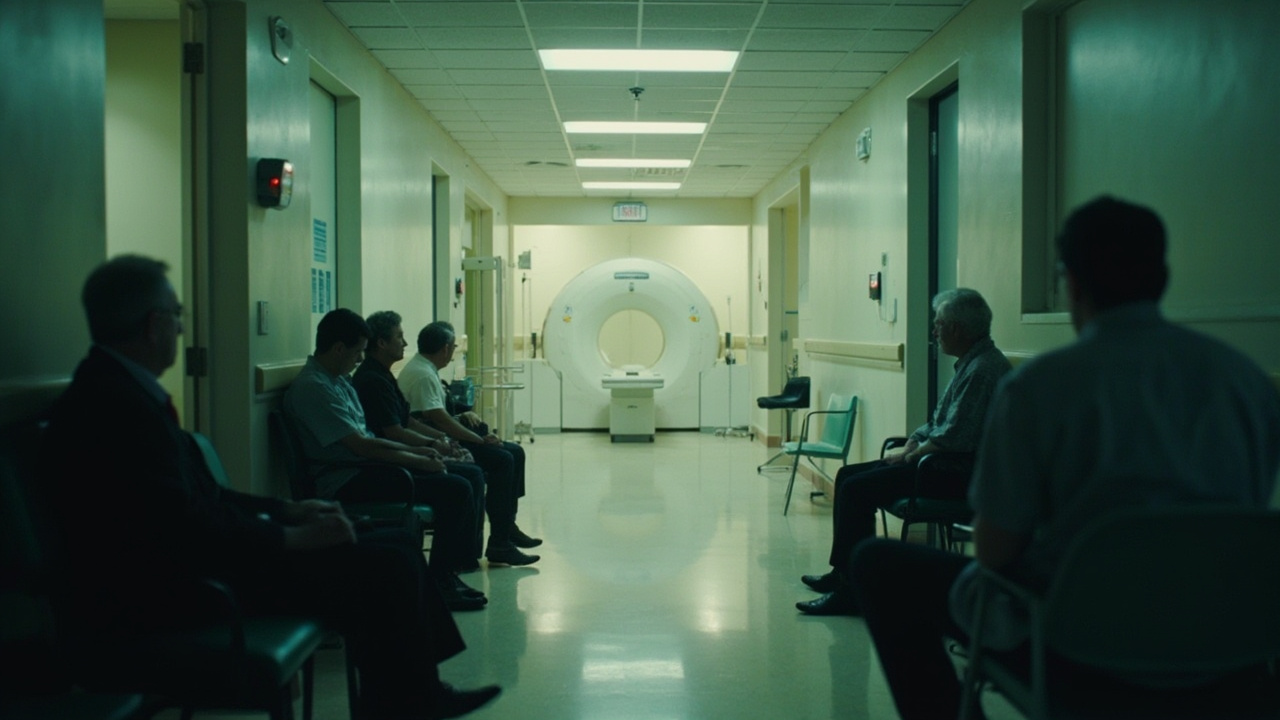
The helium shortage that this paper first tracked as a hospital-level problem has crossed a threshold. It is no longer a supply chain disruption affecting individual facilities. It is now a systemic healthcare crisis affecting hospital networks, regional diagnostic capacity, and patient outcomes. [1]
Becker's Hospital Review published an analysis Thursday identifying helium scarcity as a "rising concern across multiple healthcare systems," with MRI scheduling delays extending from weeks to months at facilities that cannot secure reliable helium deliveries. The publication surveyed 14 hospital systems across eight states and found that 11 had implemented some form of MRI rationing — ranging from prioritization protocols that bump non-urgent scans to outright suspensions of elective imaging. [1]
The mechanism is unchanged from prior reporting. Superconducting MRI magnets require liquid helium cooled to minus 269 degrees Celsius. There is no substitute gas. When helium supplies tighten, the magnet either runs on diminishing reserves or quenches — a violent boil-off event that can cost $50,000 to $100,000 to recover from and takes the machine offline for days. Hospitals facing uncertain helium deliveries are choosing to conserve rather than risk quench events. [2]
What has changed is the scale. NPR's investigation into the Hormuz closure's effect on global helium supply, published this week, identified three compounding factors that have pushed the shortage from acute to structural. [2]
First, Qatar's contribution. The country supplies roughly one-third of the world's traded helium. A plant fire in late 2025 destroyed 14 percent of Qatar's production capacity — a force majeure event with a three-to-five-year repair timeline. The Hormuz blockade has now added shipping disruptions on top of the production deficit. Qatar's helium, even the volume still being produced, cannot reliably reach customers in Europe and North America. [2]
Second, the competition for supply. Semiconductor fabrication requires helium for cooling and as a carrier gas in deposition processes. A TSMC fab pays commodity-market prices for helium without blinking. A hospital purchasing department, operating on fixed reimbursement rates from Medicare and private insurers, cannot match those bids. The same helium molecule that could cool an MRI magnet for a cancer diagnosis is instead cooling a chip fabrication chamber for a data center GPU. The market does not distinguish between these uses. It prices both at the same spot rate. [1]
Third, the absence of strategic reserves. The United States sold off its Federal Helium Reserve through a series of congressional mandates between 2013 and 2023, privatizing the reserve's operations and depleting its stockpiles. There is no helium equivalent of the Strategic Petroleum Reserve — no government buffer that can be released during a supply crisis. [2]
Euronews reported Thursday that European hospital networks are experiencing parallel shortages, with MRI services "at risk of significant disruption" across Germany, France, and the United Kingdom. The European Industrial Gases Association has called for emergency allocation protocols, though no government has yet implemented them. [3]
Al Jazeera's coverage focused on the developing world, where helium-dependent diagnostics were already scarce before the shortage. In India, MRI wait times at public hospitals have extended to three months or more. In sub-Saharan Africa, facilities that operated a single MRI machine as a regional diagnostic resource have gone offline entirely. [4]
The practical consequence is measured in delayed diagnoses. An oncologist cannot stage a tumor without imaging. A cardiologist cannot assess myocardial viability without contrast MRI. A neurologist cannot diagnose multiple sclerosis without brain imaging. Every week of MRI delay is a week of diagnostic uncertainty — and in aggressive cancers, a week can change the treatment calculus.
The blockade's architects did not intend to disrupt healthcare. Helium is a second-order effect — a consequence of a consequence of a supply chain that runs through a 21-mile strait. But second-order effects are still effects. The patient waiting three months for an MRI scan that used to take two weeks is experiencing the Hormuz blockade as directly as any oil trader watching Brent prices, even if the connection is invisible to them.
The question is no longer whether the helium shortage will affect patient care. It is how long hospitals can sustain rationing before diagnostic capacity degrades in ways that produce measurable harm. The blockade has no announced end date. The Qatar plant fire has a three-to-five-year repair timeline. And there is no strategic reserve to tap.
-- NORA WHITFIELD, Chicago