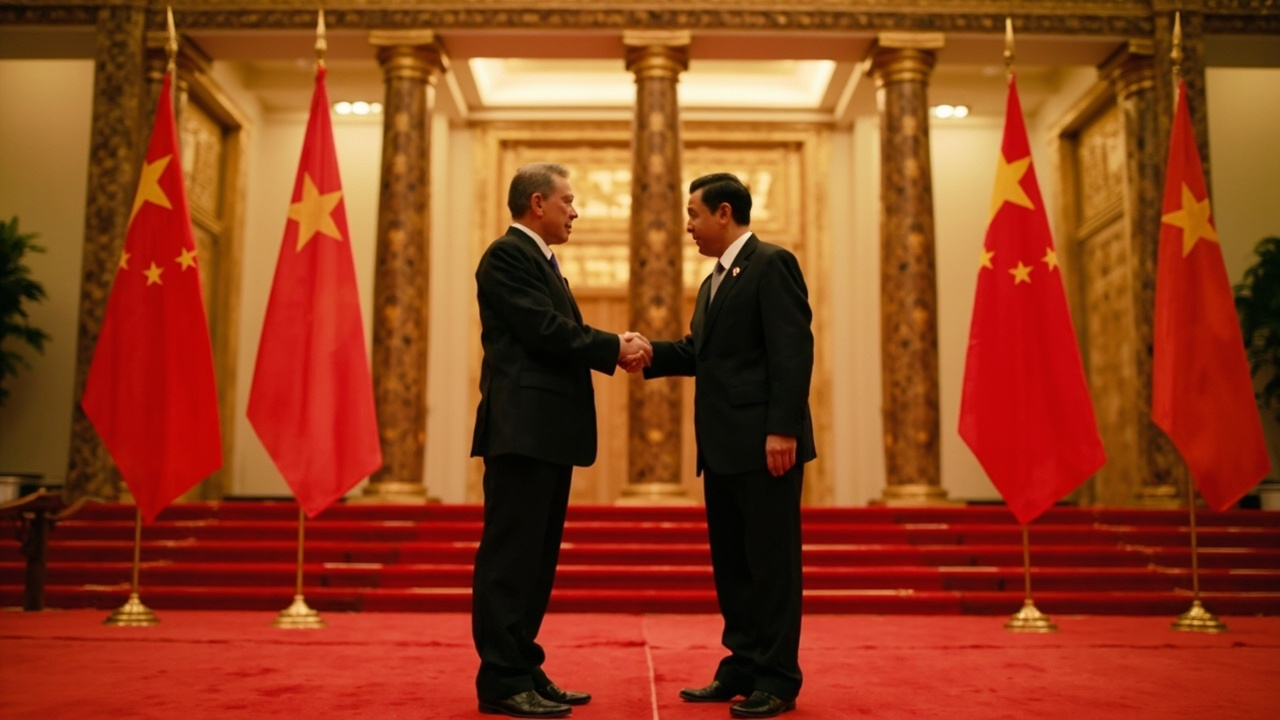
Xi Jinping and Vietnamese President To Lam signed forty-five cooperation agreements in the Great Hall of the People on April 15, covering energy, telecommunications, and metro construction in Ho Chi Minh City. [1] The summit — Lam's first trip abroad since his election as president — produced a joint statement opposing "hegemony, power politics, and unilateralism," and a Vietnamese declaration of readiness to discuss BRICS partnership. [4] The language was diplomatic boilerplate. The timing was not.
The same week that CENTCOM declared its Hormuz blockade would be "enforced impartially against vessels of all nations," a Chinese-owned tanker called the Rich Starry transited the strait without interdiction. The blockade exempts the country that purchases ninety-five percent of Iran's crude exports. Xi's pitch to Hanoi did not need to mention this by name. The architecture spoke for itself: the United States was reordering energy flows in the Persian Gulf, and China was the only major economy whose ships sailed through unchallenged.
For To Lam, the calculus was not ideological. Vietnam gets much of its oil through the Strait of Hormuz. [2] The war in Iran has raised global supply risks, pushed insurance premiums skyward, and introduced a new variable into every cargo route connecting Southeast Asia to the Middle East. Bloomberg reported that Lam traveled to Beijing seeking to shore up energy security against precisely these disruptions. [2] Xi offered a framework: bilateral energy deals, telecom infrastructure, and a trade relationship that had already surged twenty-two percent the previous year, reaching $198 billion in Chinese goods flowing south. [3]
The Architecture Behind the Agreements
The forty-five agreements are not a departure. They are an acceleration. Chinese exports to Vietnam have grown steadily for a decade, and the bilateral relationship already dwarfs Vietnam's trade with any other single partner. Vietnam runs a deficit of roughly $100 billion with Beijing — a structural dependency that makes the relationship less a partnership than an orbit. [3]
What the Hormuz crisis adds is urgency and leverage. Xi's article in People's Daily, published to coincide with the summit, declared that "there are no winners in trade wars and tariff wars." [4] The line was aimed at Washington, but its audience was Hanoi. Vietnam faces American tariffs on its exports and American disruption of the energy routes its economy depends on. China offers an alternative supply chain — one where the ships get through, the tariffs don't apply, and the infrastructure comes with financing attached.
The joint statement's call to "support the multilateral trade regime centered on the WTO" reads differently when the alternative is a unilateral blockade. [4] So does the language about opposing unilateralism. Xi did not need to name the United States. The blockade named it for him.
The Balancing Act
Lam called the relationship with China a "top priority," a phrase that would have been diplomatically unthinkable five years ago, when Vietnamese protests against Chinese South China Sea claims filled the streets of Hanoi and Ho Chi Minh City. [1] The shift reflects a sober recalculation. The United States remains Vietnam's largest export market — the factories in Binh Duong and Dong Nai assemble goods that ship overwhelmingly to American consumers. But the United States is also the country imposing tariffs on those exports and blockading the strait through which Vietnam's energy supply arrives.
China is the country whose goods Vietnam cannot stop buying, whose infrastructure projects are reshaping Vietnamese cities, and whose tankers transit Hormuz without interference. The VietJet-COMAC aircraft discussions reported alongside the summit illustrate the drift: a Vietnamese carrier exploring Chinese-built planes to reduce dependence on Boeing and Airbus supply chains that the tariff regime has made more expensive and less reliable. [1]
The balancing act is real but asymmetric. Vietnam cannot afford to alienate Washington — the American market absorbs too much of its output. But it cannot afford to alienate Beijing either, and the current geopolitical configuration has made Beijing's offer more compelling. Energy security, infrastructure financing, tariff-free trade corridors, and ships that actually reach port — these are tangible propositions for a mid-sized economy watching the Hormuz crisis from a distance that shrinks with every barrel of oil that does not arrive.
Two Faces of One Coin
The blockade's China exception and China's alternative trade architecture are not separate stories. They are the same story told from different angles. CENTCOM's decision not to interdict Chinese-owned vessels created the demonstration Xi needed: the American-led order disrupts your supply lines; the Chinese-led alternative does not.
This paper's reporting on Day 2 of the blockade documented the Rich Starry's transit and the gap between CENTCOM's claims of full enforcement and the maritime reality. What the Xi-Lam summit reveals is the diplomatic harvest of that gap. Every Chinese tanker that sails through Hormuz unchallenged is an advertisement for the system Xi is building — one where energy flows are guaranteed not by the U.S. Navy but by bilateral agreements with Beijing.
Vietnam is not the only audience. The BRICS readiness signal matters because it places Vietnam in a queue of nations — Saudi Arabia, the UAE, Egypt, Ethiopia — that have accepted or explored membership in institutions designed to operate outside American financial infrastructure. The pattern is not new. But the Hormuz blockade has given it a new argument: the dollar-denominated, American-enforced trading system is also the system that blockades your energy supply when Washington decides to go to war.
Xi's People's Daily article insisted there are no winners in trade wars. He might have added: there are, however, recruiters. The blockade that was supposed to isolate Iran is building the coalition that may eventually isolate the blockade.
-- DAVID CHEN, Beijing