On Monday morning the 130th Boston Marathon will leave Hopkinton, Massachusetts, at 9:37 a.m. local time, as it has left Hopkinton for most of a century, and over 26.2 miles through eight towns it will do four things at once. It will carry, across every broadcast backdrop and finish-line banner, the name of the bank whose record first-quarter trading revenue this paper documented as part of the five-bank pattern of war-era profits. [1] It will mark the thirteenth Patriots' Day since the 2013 bombing that killed three people and wounded 264 near the finish line on Boylston Street. It will send an elite men's field of seventeen Kenyans — including defending champion John Korir and 2023 champion Evans Chebet — down a course no American man has won since 1983. And it will run, for the first time, under a starting-line banner bearing the name Nina Kuscsik.
These are not subthemes. They are, each of them, the story. A feature-length piece on a marathon is an excuse to describe what a city asks one morning of racing to do for it, and Boston on Patriots' Day has been asked, for thirteen years, to do a lot. This year it will be asked to do more.
Begin with the banner. Nina Kuscsik, who died in 2024 at age 85, won the first official women's Boston Marathon in 1972, the year after the Boston Athletic Association formally permitted women to compete. She had run the race unofficially in 1969 and 1970 alongside seven other women, in defiance of the prevailing medical assumption — written into the rulebook — that a woman's body could not complete 26.2 miles without physiological damage. The assumption was false. The assumption was also, it turned out, held with enough institutional force that clearing it required the women who ran anyway. Kuscsik finished the 1969 Boston in 3:46:00. She was not, officially, a participant. The officials who noted her time did so only because the volunteer timekeepers were more interested in accuracy than in policy.
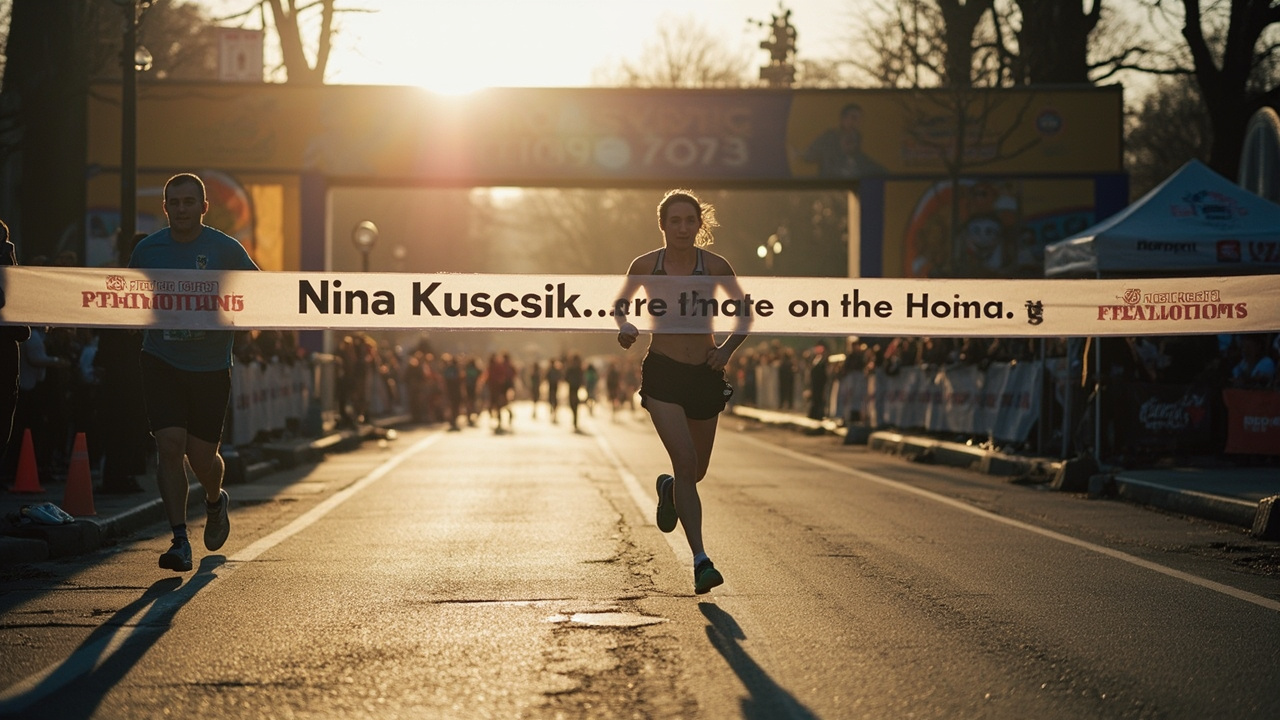
The BAA announced in February, three months after Kuscsik's death, that the 2026 starting line would carry her name. [3] The American women's running community — Jacqueline Gareau, Joan Benoit Samuelson, Des Linden, and the generation of amateur women who run Boston as the end-point of qualifying cycles that begin in suburban half-marathons — has treated the banner as the tribute that was always owed. What makes the gesture worth writing about is not the tribute. It is how long it took.
The Kenyan field is the second frame. Seventeen Kenyans in the elite men's field is not unusual for Boston — the race has become functionally a Kenyan national competition with American pacers — but the depth this year is. Korir returns as defending champion. Chebet is the 2023 winner. Geoffrey Kamworor, the world half-marathon record holder for most of the last decade, makes his Boston debut. Benson Kipruto is in the field. The statistic that SHE Runs Without Limits, an American women's-running account that tracks pro fields across the majors, posted Thursday reads simply: "No American man has won Boston since Greg Meyer in 1983." [2] That is forty-three years. The gap is not a fluke. It is a structural feature of the marathon economy — East African altitude-training infrastructure, federation depth, the American collegiate system's emphasis on cross-country distances that cap out at 10 kilometers, and the fact that the top end of the Kenyan pipeline now includes athletes whose 10K personal bests would have been American records fifteen years ago.
The local narrative around this has softened. In the early 2000s a visible share of Boston coverage framed the Kenyan dominance as a puzzle for American running to solve. In 2026 the framing has mostly disappeared. The Kenyan athletes are covered as athletes, their performances recapped without the anxious nationalism that characterized marathon coverage in the Meb Keflezighi era. This is probably progress. It is also, in its way, the quiet acknowledgment that the top of world distance running no longer runs through Boulder or Mammoth Lakes. It runs through Iten. The finish line accepts whoever gets there first.
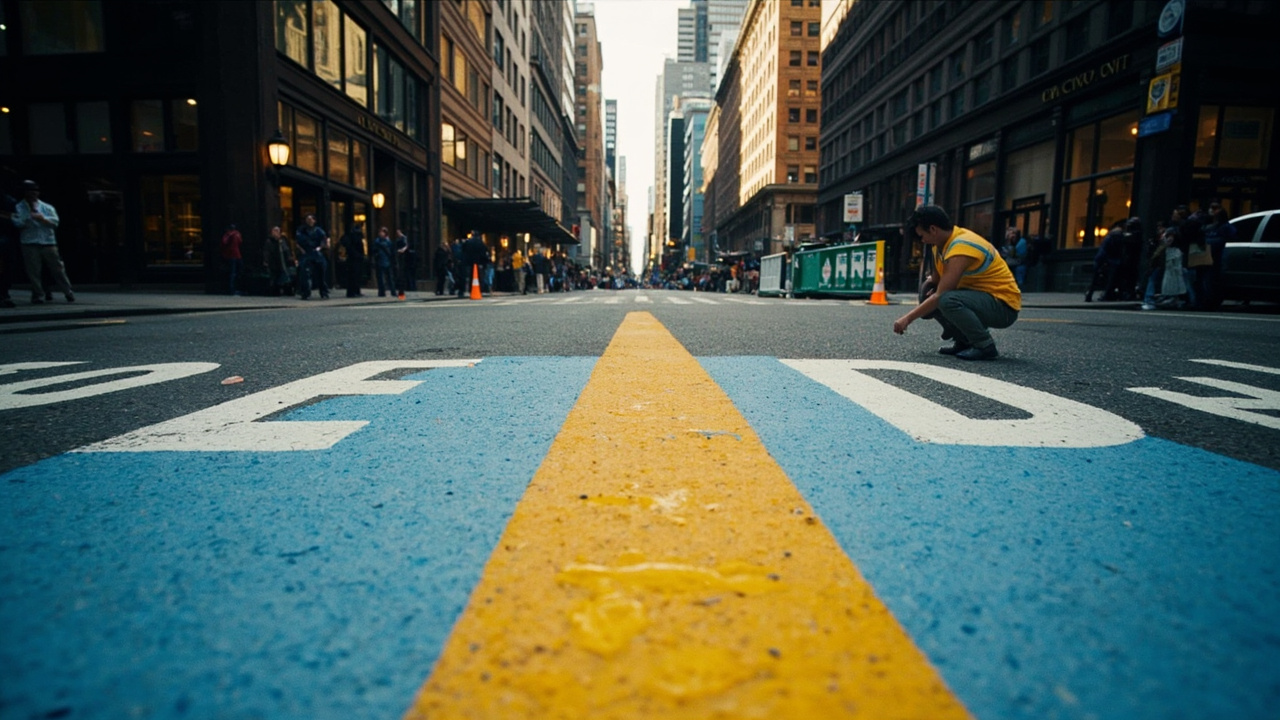
The third frame is the hardest, and it is the one everyone who was there in 2013 carries to the race differently each year. Thirteen years is long enough that the freshmen starting Boston University in 2013, who sheltered in place during the manhunt, now have children older than the distance between Hopkinton and Kenmore Square. It is also short enough that every runner on that course Monday will pass, at Mile 26, the spot where Martin Richard was standing. The Boston Athletic Association painted the finish line fresh this week — a ceremonial refreshing the race has done annually since 2014 — and the painting is, as rituals go, small enough to be private and public enough to mean something. "The city has learned to hold two things at once," Linden wrote on Instagram on Wednesday. "The joy and the grief. They do not cancel."
The fourth frame is the one least comfortable for the race organizers and most visible on television. Bank of America has been the marathon's title sponsor since 2024, having outbid John Hancock for a naming deal valued in reporting at roughly $25 million annually over six years. The bank's Q1 2026 earnings, reported Tuesday, delivered the highest quarterly earnings per share in two decades — a number this paper covered as part of a pattern across the five largest U.S. banks, each of which produced record trading revenue against the volatility of the Iran war. [1] The logo on the finish-line arch on Monday morning will belong to a company whose best quarter in twenty years was made possible, in substantial part, by a war whose second-order effects have pushed African fuel prices to levels that have, this past week, forced three Kenyan marathon training camps to reduce their bus transport to altitude routes. The connection is not occult. It is a line item.
None of this means the race is compromised. The marathon is, on any given Patriots' Day, a marathon. The athletes do not choose the sponsor. The city does not choose the year's earnings releases. The BAA does not choose when a banner is overdue. What a marathon feature can do, and what a box score recap cannot, is name the four things the race is doing at the same time and allow them to stand next to each other without choosing. A bank is profiting from the war. A woman's name is finally on the banner. Seventeen Kenyans will arrive at the line before the first American man. The finish line was painted fresh this week. Boylston Street on Monday morning will carry all of it. The runners will carry some of it. The city, which has learned to hold two things at once, will hold four.
The race starts at 9:37. The elite women go off at 9:47. The wave starts begin at 10:00. Patriots' Day is a holiday in Massachusetts, which is why the marathon is run on a Monday the rest of the country works. The course goes downhill from Hopkinton for twelve miles, climbs through Newton from seventeen to twenty-one — Heartbreak Hill peaks at twenty-point-four — and then descends through Brookline into Boston. Weather is forecast cool, 52 degrees at the start, light tailwind for the faster half of the field. Good marathon weather. The fastest times of the year are set in Boston when the wind is at your back and the air is cold enough to run in.
The race will run. The questions it is being asked to answer will, mostly, not be answered. A marathon is an endurance event and a civic ritual and a broadcast property and a memorial and a hiring fair for shoe companies and the annual Monday morning on which a certain fraction of Americans confront their own fitness. It is also, in 2026, a piece of media infrastructure through which a bank tells a story about itself. You can hold four of these things in your head. You can hold five, if you count the simple matter of watching people run. The 130th Boston will run. The finish line is painted. Nina Kuscsik's name is on the banner at last.
-- AMARA OKONKWO, Lagos