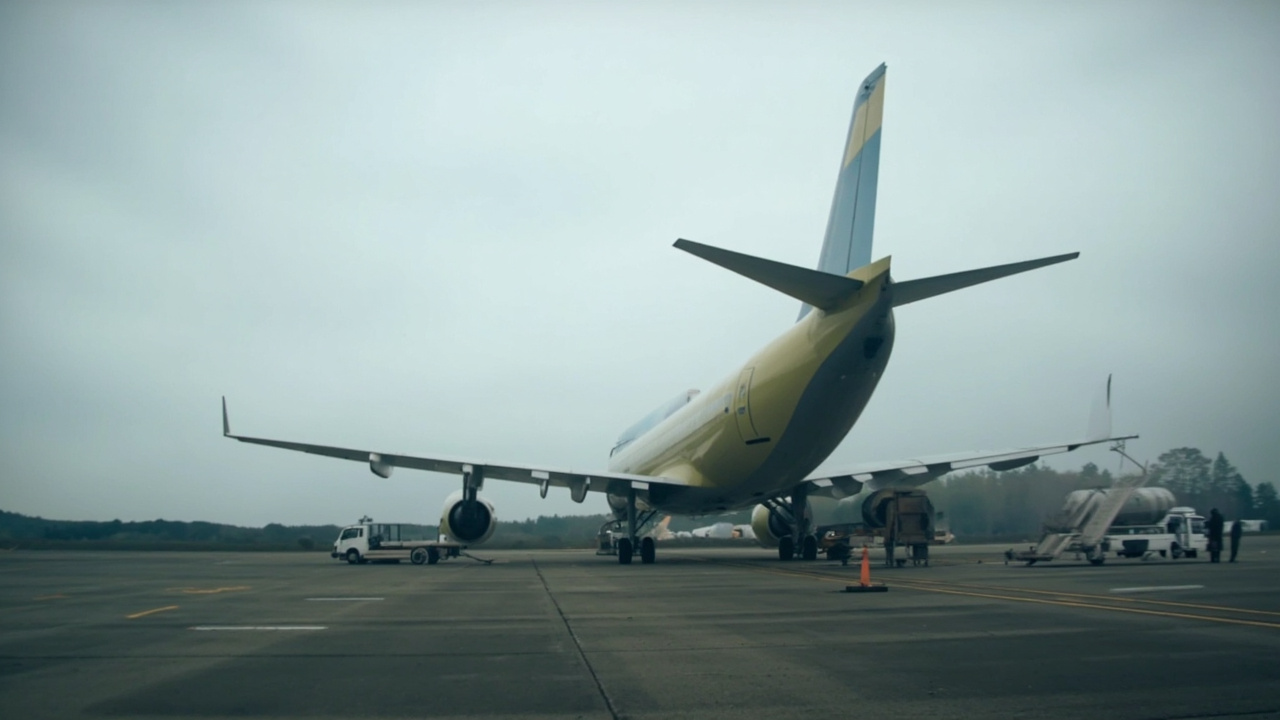
The Strait of Hormuz blockade has found its next casualty, and it runs on kerosene. International Energy Agency Executive Director Fatih Birol told the Associated Press on Thursday that Europe has "maybe six weeks or so" of jet fuel remaining before airlines begin grounding flights — a timeline he attributed directly to the Iranian blockade of the world's most consequential oil chokepoint [1]. The warning arrives as the blockade's second-order consequences cascade through European infrastructure, from hospital MRI units starved of helium to airlines now staring at empty tanks. Birol's candor was unusual for an agency that typically prefers hedged language and scenario ranges. "It's a dire strait now," he said [3].
The IEA's timeline compresses what European officials had hoped would be a months-long cushion into a matter of weeks. Jet fuel — technically Jet A-1 in European markets — is a middle distillate refined from crude, and roughly 40 percent of the crude feeding European refineries transits the Strait of Hormuz. The blockade, now in its third week, has not halted all flow — some cargoes have rerouted around Africa — but it has thinned the stream enough that the continent's jet fuel inventories are drawing down at an accelerating pace [2]. Oil markets had briefly rallied on hopes of a diplomatic off-ramp, but those hopes were premature, and the price signal Birol is now translating into a deadline was already embedded in the futures curve.
Six weeks from April 16 lands in late May, just as Europe's summer travel season begins its upward arc. The timing could scarcely be worse for an industry still repairing balance sheets after the pandemic. Lufthansa, Air France-KLM, and International Airlines Group — parent of British Airways and Iberia — have all declined to comment on contingency planning beyond stating that they are "monitoring the situation," a phrase that in aviation circles has come to mean they are not yet ready to tell passengers their holidays are at risk [2].
Birol's decision to go public with the six-week figure reflects a calculation within the IEA that quiet diplomacy with member governments has run its course. The agency has been briefing European capitals privately for over a week, according to two officials familiar with the discussions, but those briefings produced no coordinated response. Germany called for strategic reserves to be tapped; France favored rationing frameworks; Italy asked for an EU-level purchasing pool and was told by the Commission that such a mechanism would take months to stand up. The institutional architecture that Brussels spent decades constructing — the EU's energy solidarity mechanisms, the coordinated emergency response protocols — is proving too slow for a crisis measured in weeks [3].
The jet fuel problem is distinct from the broader oil supply crunch in one critical respect: it cannot easily be substituted. Airlines cannot switch to alternative fuels at scale. Sustainable aviation fuel, the industry's long-term hedge, accounts for less than one percent of European jet fuel consumption and is produced in quantities that would not move the needle even if every drop were requisitioned. Kerosene is kerosene, and if the Strait of Hormuz stays closed, Europe will run out of the particular fraction it needs to keep planes in the air.
The European Commission held an emergency meeting Thursday evening to discuss the IEA's warning. A spokesperson said afterward that Energy Commissioner Dan Jørgensen would present a "comprehensive aviation fuel contingency plan" within days, though officials privately acknowledged that the plan had been in draft form for over a week and that disagreements among member states over burden-sharing remained unresolved [3]. The Commission's track record on energy emergencies does not inspire confidence. The gas storage regulation passed after Russia's invasion of Ukraine took nine months to negotiate. REPowerEU was announced in May 2022 but did not produce measurable supply diversification until the following winter.
For passengers, the immediate question is whether to book summer flights now or wait. Several European travel agencies reported a spike in inquiries Thursday evening, though not yet in cancellations. "People are calling to ask if their July flights are safe," said a spokeswoman for a major German tour operator. "We don't have an answer for them" [1].
The airlines themselves are caught between two bad options: say nothing and risk a wave of last-minute cancellations, or announce potential disruptions now and trigger precisely the panic they hope to avoid. IATA, the global airline trade body, issued a statement calling on governments to "ensure energy security for critical transport infrastructure" — language so broad it could mean anything from releasing strategic petroleum reserves to military escort operations for fuel tankers [2].
Birol, for his part, was unambiguous about what he thinks is needed. "The sooner the blockade ends, the better for everyone," he said. "But if it continues, European governments need to act together, and they need to act now — not in six weeks, when it's too late" [1]. He stopped short of endorsing any particular policy response, but the implication was clear: the window for orderly preparation is closing, and the institutional habits of Brussels — consultation papers, impact assessments, compromises that satisfy twenty-seven member states — may not be compatible with a deadline measured in single-digit weeks.
The Strait of Hormuz has been closed before, during the Iran-Iraq war of the 1980s, but never at a moment when European aviation demand was approaching its seasonal peak and global refinery capacity was already stretched thin by years of underinvestment. The convergence is what makes this moment different, and what makes six weeks feel like both an eternity and an instant.
-- HENDRIK VAN DER BERG, Brussels