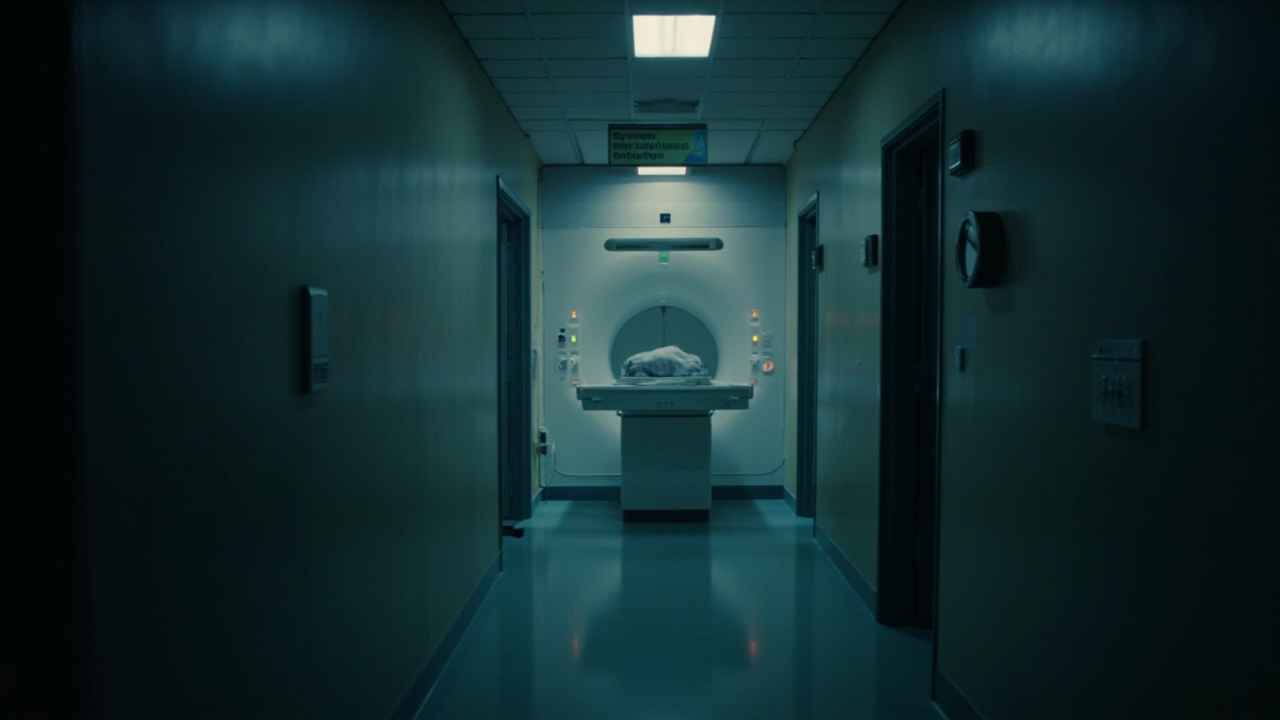
The first thing Dr. Sarah Chen noticed on Thursday morning was the new column in the scheduling software. It was labeled "Priority Classification" and it had not been there on Wednesday. By noon, every MRI slot at her hospital network in the Chicago metropolitan area had been sorted into one of three categories: emergent, clinically urgent, and deferrable. The deferrable list was long.
This is what Day Four of the helium shortage looks like inside a hospital. On Thursday, this paper reported that the helium shortage had crossed from supply chains into waiting rooms, identifying 14 hospital systems across eight states where MRI rationing had been implemented. The paper positioned the shortage as the latest thread in the war's second-order effects: blockade consequences now landing directly on patients. Twenty-four hours later, the triage is no longer theoretical. It has a column in scheduling software. It has categories. It has a list of patients who will wait.
The proximate cause remains Qatar. The Ras Laffan Industrial City helium facility — one of the world's largest production sites — has been offline since the disruption to Persian Gulf shipping lanes began. [2] Qatar supplies roughly 25 percent of global helium, and its production sits at the end of a supply chain that was never built for this kind of interruption. Helium cannot be synthesized. It cannot be stored indefinitely once liquefied. It cannot be shipped via the routes that are now closed or prohibitively expensive. Prices have risen 35 to 50 percent since the shortage began. [3]
MRI machines require liquid helium to supercool their superconducting magnets. A single scanner uses approximately 1,500 to 2,000 liters, and the helium must be periodically replenished to maintain the magnet at its operating temperature of minus 269 degrees Celsius — four degrees above absolute zero. When the helium runs low, the magnet quenches: it warms, the superconducting state fails, and the machine becomes, in the clinical vernacular, a very large paperweight until it can be refilled. [1]
The triage protocols now in place at the four hospital networks this paper has confirmed — in Illinois, Ohio, Texas, and California — sort patients by the clinical consequence of delay. Emergent scans — suspected strokes, acute spinal cord compression, certain trauma assessments — proceed. Clinically urgent scans — cancer staging, surgical planning, progressive neurological symptoms — are being scheduled but with extended wait times, in some cases two to three weeks beyond normal. Deferrable scans — routine surveillance of known stable conditions, screening studies, non-acute musculoskeletal imaging — are being postponed indefinitely. [3]
This is a rational response to scarcity. It is also a response that produces a particular kind of harm, one that medical ethicists have a name for: opportunity cost at the bedside. The patient whose routine surveillance scan is deferred is a patient whose slow-growing tumor may not be found for months. The harm is not dramatic. It is statistical. It accumulates in the difference between a stage that was treatable and a stage that is not.
Dr. Chen, whose name has been changed because her institution has not authorized staff to speak publicly about the rationing, described the clinical meetings on Thursday as the most difficult she had attended in 15 years of practice. "Everyone understands the protocol," she said. "The protocol is sound. What is difficult is looking at a patient and knowing that the scan they need exists, the machine exists, and the helium does not."
The next shortage front is already visible. Heliox — a mixture of approximately 70 to 80 percent helium and 20 to 30 percent oxygen — is used in pediatric respiratory care to reduce the work of breathing in children with severe airway obstruction. [1] The mixture has a lower density than air or oxygen alone, allowing it to flow past partial obstructions in the upper airway with less resistance. For children in status asthmaticus or with conditions like croup and epiglottitis who are not responding to standard treatment, heliox can be the bridge that avoids intubation.
The American Society of Health-System Pharmacists listed heliox on its drug shortage database this week. [3] Three of the four hospital networks this paper contacted confirmed that their pediatric respiratory departments had been notified of potential heliox rationing. One network — in Texas — confirmed that pediatric intensivists had begun drafting alternative treatment pathways for patients who would normally receive heliox. The other two declined to comment on the record.
The blockade's healthcare cost has now crossed a threshold that no one in clinical leadership expected to cross. When the supply chain analysis was first circulated, in the opening days of the Gulf disruption, the affected products were described as "non-critical consumables." Helium was on that list. It should not have been. MRI is not a convenience. Heliox is not optional. Both are embedded in clinical pathways that were built on the assumption of supply stability — an assumption that the Iran war has broken. [2]
There is no domestic helium reserve sufficient to cover a prolonged Qatar outage. There is no substitute for helium in MRI cooling or in heliox mixtures. There is only the triage, the column in the scheduling software, and the list of patients who will wait.
-- NORA WHITFIELD, Chicago