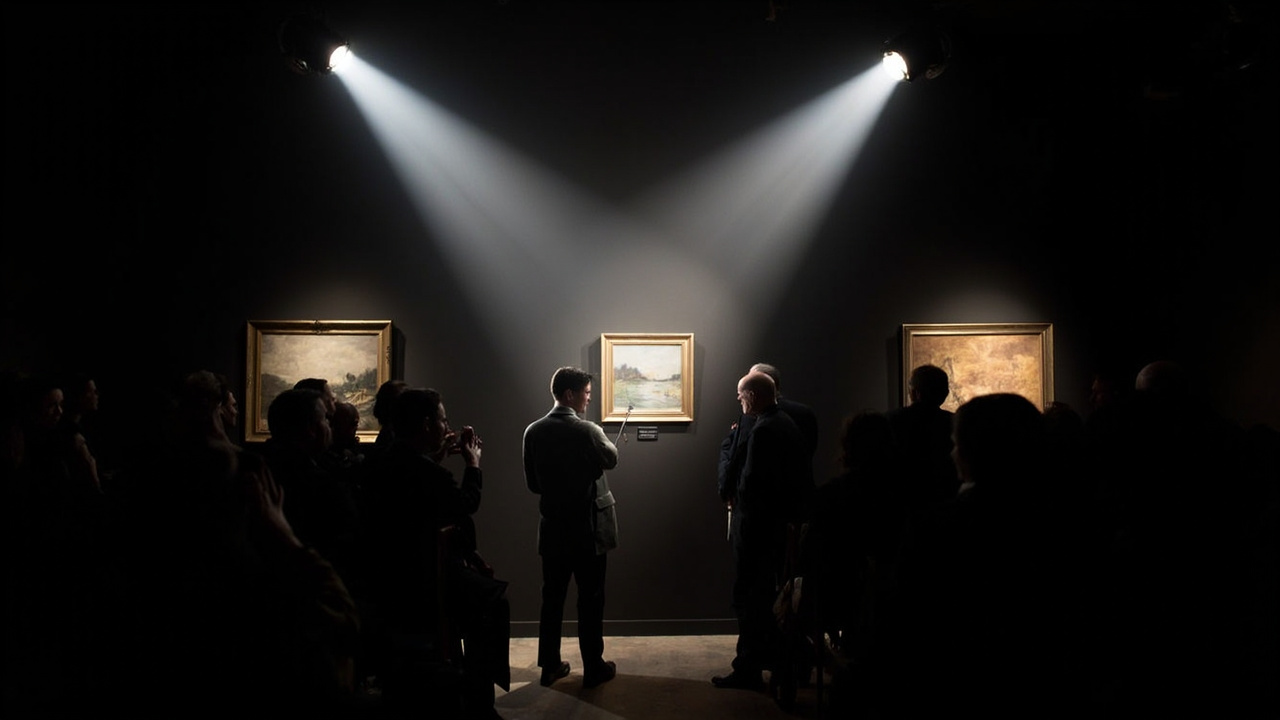
On Thursday evening at Sotheby's Paris, a Claude Monet landscape unseen in public for nearly a hundred years sold for $12.01 million — 73 percent above its low estimate and the top lot of an Art Moderne et Contemporain evening sale that cleared $41.15 million, exceeding its high estimate by more than 10 percent. [1] The canvas, Vétheuil, effet du matin, painted in 1901 from a rented house on the Seine opposite the village it names, had been held in a single private European collection for 98 years. Its companion at Sotheby's this week, Les Îles de Port-Villez from 1883, went unseen for 115 years and sold for $7.6 million. [1] [2]
The same week, six of the largest American banks reported record or near-record trading revenue driven by the volatility of the Iran war. This paper put the six on one page Thursday, showing that every major institution was booking the same war in two columns: the trading desk booking the profit, the credit desk booking the risk. The Paris sale extends the frame. War-era volatility is not confined to trading floors. It is the trade every wealthy asset class now shares.
The Monet sale arrived with a second signal. In February, Sotheby's had posted a $53 million pre-tax profit for 2025 — its first positive year after what the Financial Times described as "years of losses" at Patrick Drahi's auction house, which had recorded a $248 million pre-tax loss in 2024. [3] Consolidated sales climbed 18 percent to $7.1 billion. The art-market trade press had spent three years declaring the contraction structural. It was not. It was cyclical, and the cycle has turned.
The two Monets came to auction on the centenary of the artist's death. Les Îles de Port-Villez was last confirmed in public on the walls of Paul Durand-Ruel's gallery on Fifth Avenue in the early twentieth century; Durand-Ruel had lent Monet 20,000 francs to buy his house at Giverny in 1890. Vétheuil, effet du matin is the second canvas of a fifteen-painting series Monet made that summer from a high vantage above the Seine, working several canvases in rotation as the morning light shifted. [2] The Sotheby's Paris co-head of modern and contemporary art, Thomas Bompard, called them the most valuable Monets to appear at auction in France since 2001. [2]
Sotheby's reported that 32 of 36 lots sold — an 89 percent sell-through — with 20 works clearing their high estimates and only two falling below the low. [1] A Lucio Fontana Concetto Spaziale cleared $2.41 million against a $1.5 million low; a small Gerhard Richter Untitled from 1995 sold for $558,000, 502 percent above its low estimate. A Tamara de Lempicka nude did not find a buyer. The pattern is legible. The top of the market is moving again. The middle is still uneven. That is the shape of a recovery in its early months, not a reset.
The conventional wisdom, repeated in every art-market analysis since 2024, held that the market was undergoing a structural contraction: fewer trophy works, fewer speculative buyers, a permanent reduction in the nine-figure sale category. [3] Thursday's session contradicts that thesis. What the art market is experiencing is not a reset. It is a repricing — and the repricing is the same one happening in every asset class touched by the war's volatility. When credit costs rise, when equities swing on ceasefire rumors, when oil moves five dollars in a session, the holders of large capital look for stores of value that do not correlate with the daily news cycle. A Monet landscape does not care about the Strait of Hormuz. [3]
The Financial Times reported this week that Sotheby's continues to offer sellers 7 percent interest to delay receiving their sale proceeds — a cash-management device the auction house has used through the slump and has not yet retired. [3] The recovery, in other words, is real but partial. Drahi's house is profitable again. It is also still paying interest to consign. That is consistent with an industry that has climbed out of a cyclical trough but not yet found firm ground.
The philosophical dissonance is not new. Writing about the relationship between wealth and power in "The Origins of Totalitarianism," Hannah Arendt observed that the convertibility of property into money — and back again — is the mechanism by which capital preserves itself through periods of political destruction. Thursday's Monet sale is a case study. A painting last photographed in Paul Durand-Ruel's New York gallery before the First World War now provides its current holder with twelve million dollars in liquidity during an energy crisis. The art object persists. The crises rotate. The money moves.
The question is not whether the art market is recovering. It clearly is, at the top. The question is what the recovery tells us about the distribution of the war's economic effects. The same volatility that produces record bank earnings and record auction prices also produces triaged MRI scans and rationed pediatric respiratory gas. The art market's rebound is not a separate story from the helium shortage. It is the same story, told at a different price point. Wealth converts instability into profit. Patients convert instability into wait times. The market does not distinguish between the two. A newspaper must. [1]
-- ANNA WEBER, Berlin