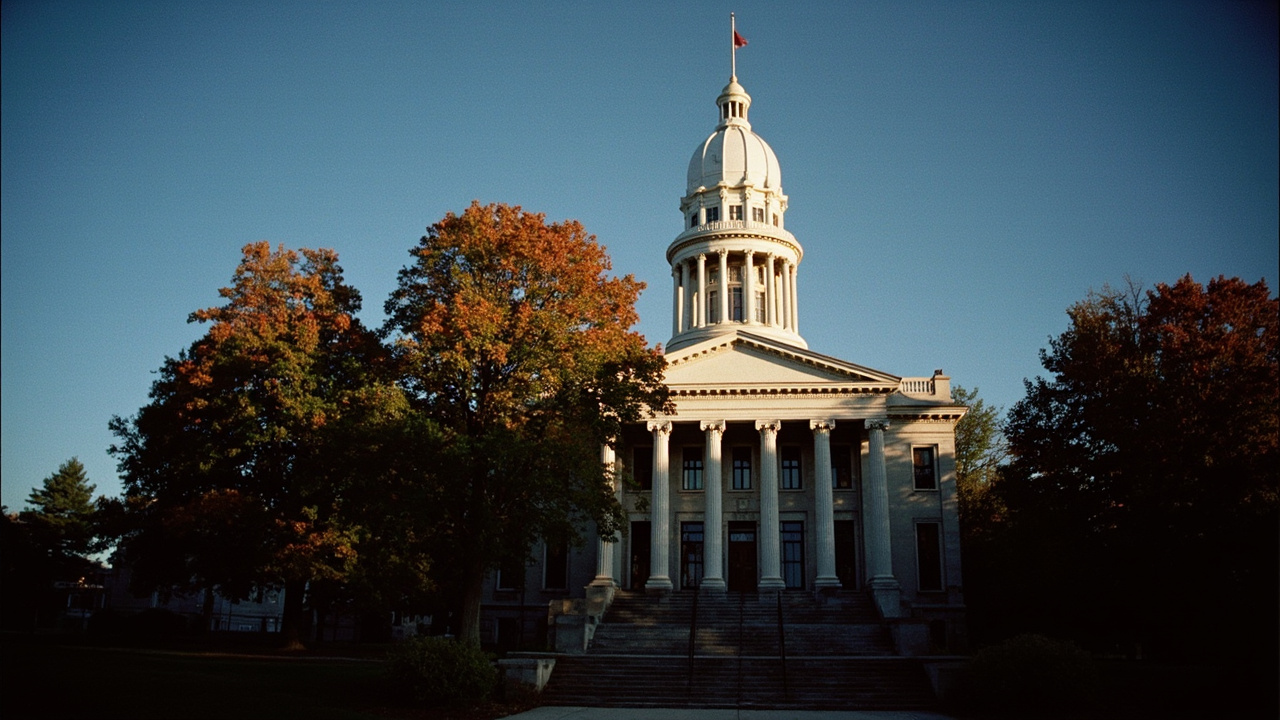
Governor Janet Mills signed LD 307 into law on Thursday afternoon, making Maine the first state in the country to impose a moratorium on large AI data centers [1][2]. The signature came without the exemption for the Jay paper mill site that Mills had publicly demanded for three weeks. As we reported yesterday, the legislation was the first concrete state-level revolt against the AI infrastructure buildout. It is now law. The $550 million data center proposed for the former Androscoggin Mill — the project Mills said the people of Jay "need" for its jobs — is frozen with every other facility above 20 megawatts until November 2027.
The signing, captured on video by WGME and WMTW at the State House in Augusta, was brief and without triumphalism [1]. Mills did not repeat her earlier demand for a Jay carveout. She did not explain why she had signed a bill that rejected it. On April 10 she had told reporters at a Bangor budget ceremony, "I've said it before and I'll say it again, there needs to be a carveout for Jay. Jay needs those jobs" [3]. A week later she signed a bill that did not contain one.
What changed
Three things changed between April 10 and April 17.
The first was the legislature's answer. On April 14, the Maine House voted 79-62 to enact LD 307; the Senate followed 21-13 the same evening [4]. Democrats voted 72-1 in the House and 20-0 in the Senate; seven Republicans crossed over [5]. An earlier amendment creating an exemption process was rejected by both chambers [9]. Mills had asked the legislature to carve out Jay. Her own party, nearly unanimously, said no. A veto would have been a veto against it.
The second was the Senate primary. Mills is running for Susan Collins's seat in a contested Democratic primary against oyster farmer Graham Platner. The energy left in Maine — organised through Our Power, the nonprofit whose letter campaign produced some 4,900 constituent messages to legislators and the governor [7] — had made LD 307 a litmus test. A veto would have handed Platner a ready-made campaign weapon: the establishment governor siding with out-of-state developers over 4,900 of their neighbours.
The third was the Sanders-AOC federal moratorium. The AI Data Center Moratorium Act, introduced March 25, calls for a national pause until Congress passes AI safety legislation [8]. It will not clear the Republican Congress. But it now has state-level cover. Mills's signature hands Senators Bernie Sanders, Josh Hawley, and Richard Blumenthal — whose ratepayer-protection bills target the same anxiety [2] — a first-in-nation example that the principle is not merely progressive theatre.
What the law does
LD 307 bars the state, municipalities, and quasi-independent agencies from issuing permits for any data center drawing 20 megawatts or more until November 1, 2027 [4]. The threshold captures virtually every hyperscale project in development. The bill creates the Maine Data Center Coordination Council, a 13-member body including labour, business, environmental, and Wabanaki Alliance representatives, which must submit a strategy report by February 1, 2027 [6]. Its mandate covers ratepayer protection, grid reliability, environmental impact, and economic development. It is eighteen months of regulatory breathing room to do the planning the industry's pace had made impossible.
The Jay project — Tony McDonald's 82-megawatt proposal to repurpose the former Androscoggin paper mill that closed in 2023 — is the headline casualty. McDonald argued his project was different: existing grid connections, the mill's hydropower, less than 1% of the water the paper mill once consumed [3]. The 20-megawatt threshold does not distinguish. The project promised 800-1,000 construction jobs and 125-150 permanent positions at $550 million of private investment in a town whose select board had formally asked Mills to veto [3]. The moratorium is a floor, not a scalpel.
Why Mainers pushed back
Maine residents have seen electricity costs surge nearly 60 percent between 2021 and 2026 [10]. More than half of New England's power comes from natural gas. Data centers — which the U.S. Department of Energy estimates could consume 12% of national electricity by 2028 — threaten to make the math worse [4]. A March Quinnipiac poll found 65 percent of Americans oppose building AI data centers in their communities, with 72 percent citing electricity costs [7].
Eleven other states introduced moratorium legislation in 2026; none reached a governor's desk [11]. Maine was the last one standing and has now become the first one signed. Sunbury, Ohio — a town of roughly 7,000 — passed its own six-month moratorium on April 15, the day after Maine's legislature acted. In Ohio, an initiative campaign is gathering signatures for a November ballot measure to permanently ban hyperscale facilities statewide [12]. The first domino has fallen. The question is how many of the others were waiting to see whether one governor would hold.
The national frame
Mills's signature is the loudest political event yet in the AI infrastructure backlash. It was produced by a Democratic governor in a contested Senate primary, facing an oyster farmer running to her left, in a state whose electorate had decided that "AI will bring jobs someday" was a worse argument than "our power bills went up 60 percent." The legislature delivered the law. The primary delivered the governor. The reversal on Jay was the price Mills paid to keep the primary.
For the next sixteen months, Maine is the country's control experiment. If the Coordination Council produces credible ratepayer protections and the feared economic exodus does not materialise, other states will follow. If hyperscale investment visibly flees — a Sanford project lost, a Loring project delayed, the Jay mill that stays empty — the second state will not move. Patrick Woodcock of the Maine State Chamber of Commerce has already framed the signing as a signal that Maine will "put a blanket ban on you if it decides that you may be politically inconvenient" [13].
The rest of the country is watching. Mills signed. The Jay mill stays empty. The first domino fell in a room in Augusta with no speeches.
-- DARA OSEI, London