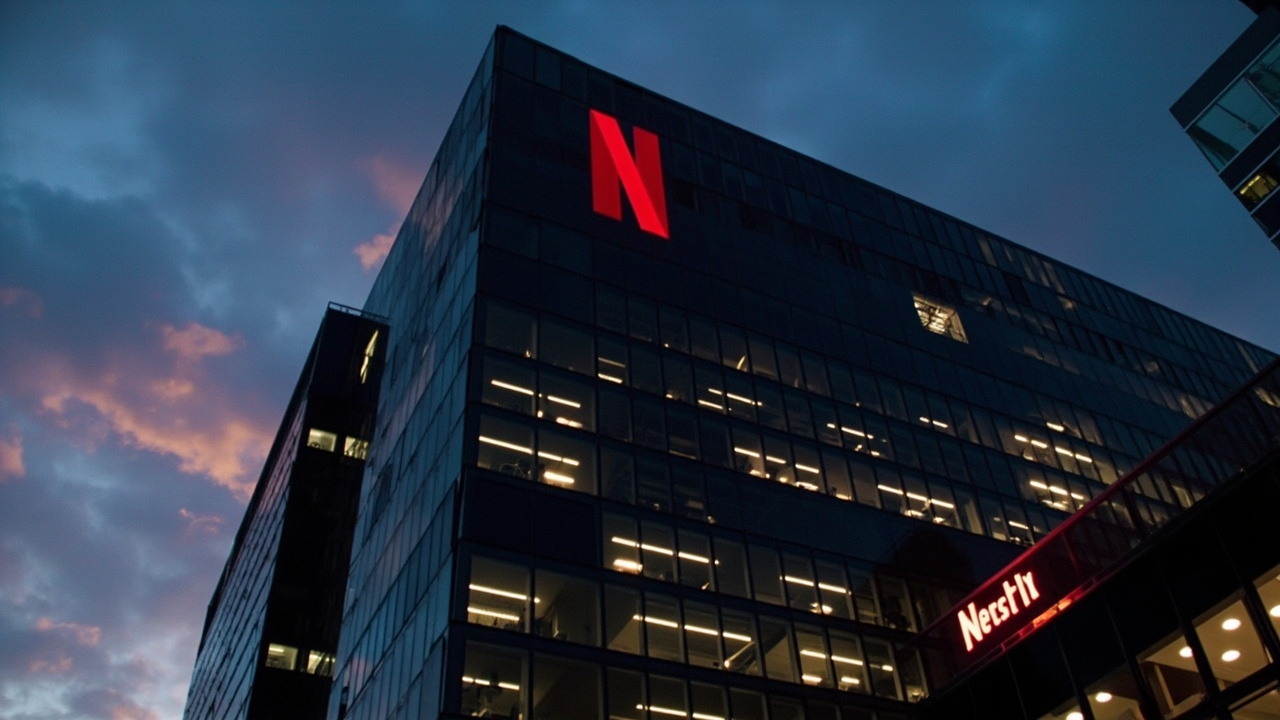
There is a particular kind of Hollywood ending where the hero wins and still looks like he lost. Netflix had one of those Thursday evening. The streaming company reported first-quarter revenue of $12.25 billion and earnings per share of $1.23 — nearly double the $0.79 consensus estimate — and the stock dropped 9 percent in after-hours trading. In a week when six of the largest American banks booked record trading revenue from war volatility, Netflix managed the opposite trick: it beat its numbers and still lost. Reed Hastings, who co-founded the company in 1997 and has been its most visible public face for nearly three decades, announced he will not stand for reelection to the board. It was the kind of quarter that rewards you for reading the headline and punishes you for reading the footnotes [2].
The headline numbers are seductive. Revenue up. Earnings up. Subscriber additions healthy. But buried in the earnings release was a line item that recontextualizes everything above it: a $2.8 billion breakup fee received from Paramount Skydance, paid after Paramount outbid Netflix for Warner Bros. Discovery and Netflix walked away. Strip that one-time payment out of the picture and the operating income tells a different story — one in which Netflix's core business is growing, but growing more slowly than the market has been pricing in [1].
This is the trouble with beats. When a company "beats estimates," the market does not always ask whether the estimates were honest. Netflix beat its numbers in part because a failed acquisition left behind a $2.8 billion parting gift. The operating margin excluding that fee would have come in below guidance. The market, which is not as stupid as it sometimes pretends to be, noticed. As the financial account @Finsee_main posted on X: "Netflix Q1 beat inflated by Paramount Skydance breakup fee windfall. Remove that and operating fundamentals soften considerably." The stock began its slide minutes later [4].
Then came the Hastings announcement. In a letter to shareholders that read more like a farewell than a corporate disclosure, the 65-year-old co-founder wrote that the time had come to "pass the baton to the next generation of leadership." He will remain a significant shareholder but will leave the board at the annual meeting in June. The departure ends a 29-year run that began with a DVD-by-mail service and ended with a $300 billion media conglomerate that reshaped how the world watches television [1].
Hastings' exit is not a surprise in the way that a plot twist is a surprise. It is a surprise in the way that an ending is a surprise — you knew it was coming, but you did not expect it now. He had been gradually reducing his role since stepping down as co-CEO in 2023, handing operational control to Ted Sarandos and Greg Peters. But his presence on the board was a kind of guarantee, a signal that the company's founder was still watching, still available, still the backstop against any strategic drift. That guarantee is now gone [3].
The timing is uncomfortable. Netflix is entering a period of strategic uncertainty that would benefit from founder oversight. The Warner Bros. acquisition fell apart. Q2 guidance came in below Wall Street expectations. And the company is pivoting toward formats — video podcasts, vertical short-form video, live events — that feel more like TikTok than the prestige television engine that built the brand. These are not desperate moves. But they are moves made by a company that is no longer certain what kind of company it wants to be [2].
The cultural stakes are higher than the financial ones, which is saying something when the stock just shed nine percent of its value in an hour. Netflix did not just disrupt the television industry. It redefined the relationship between audiences and stories. The binge-release model, the algorithmic recommendation engine, the billions spent on original content — these were not just business decisions. They were aesthetic ones. Hastings understood that. He was a technologist who treated storytelling as a systems problem, and the system he built changed the grammar of popular culture. Whether that system can survive without its architect is the question the market is now pricing in [3].
The stock's decline is not a verdict on Hastings. It is a verdict on uncertainty. Markets punish uncertainty more severely than they punish bad news, and Netflix served up both: a departing founder, a guidance miss, and a revenue beat that turned out to be partly illusory. The account @BSCNews captured the paradox in a single post: "Netflix Drops 9% After Hours Despite Q1 Beat — Hastings exits board after 29 years." The word "despite" is carrying a tremendous weight in that sentence. It implies that beats should produce gains. But beats produced by termination fees are not really beats. They are accounting events wearing beat costumes [4].
The deeper story is about what happens to a company when the person who gave it its identity leaves the room. Netflix has always been Hastings' company in the way that Apple was always Jobs' company — not because he controlled every decision, but because the culture reflected his instincts. Move fast. Spend aggressively. Trust the algorithm. These instincts produced "House of Cards" and "Stranger Things" and a stock price that multiplied fifty times over. They also produced a content spending arms race that has never fully paid for itself and a corporate culture that prized freedom and responsibility long after those words became a management cliché [1].
The post-Hastings era begins with a paradox of the winner's variety. Netflix has never been larger, never been more profitable on paper, and never been more uncertain about what comes next. The streaming wars are over. Netflix won them. The question now is what you do after you win — when there are no more enemies to fight, no more territories to conquer, and the person who started the war has left the building [2].
Hastings built a company that made the world watch differently. The company now has to figure out how to watch itself. The stock market, at least for one April evening, was not optimistic about the answer.
-- CAMILLE BEAUMONT, Los Angeles