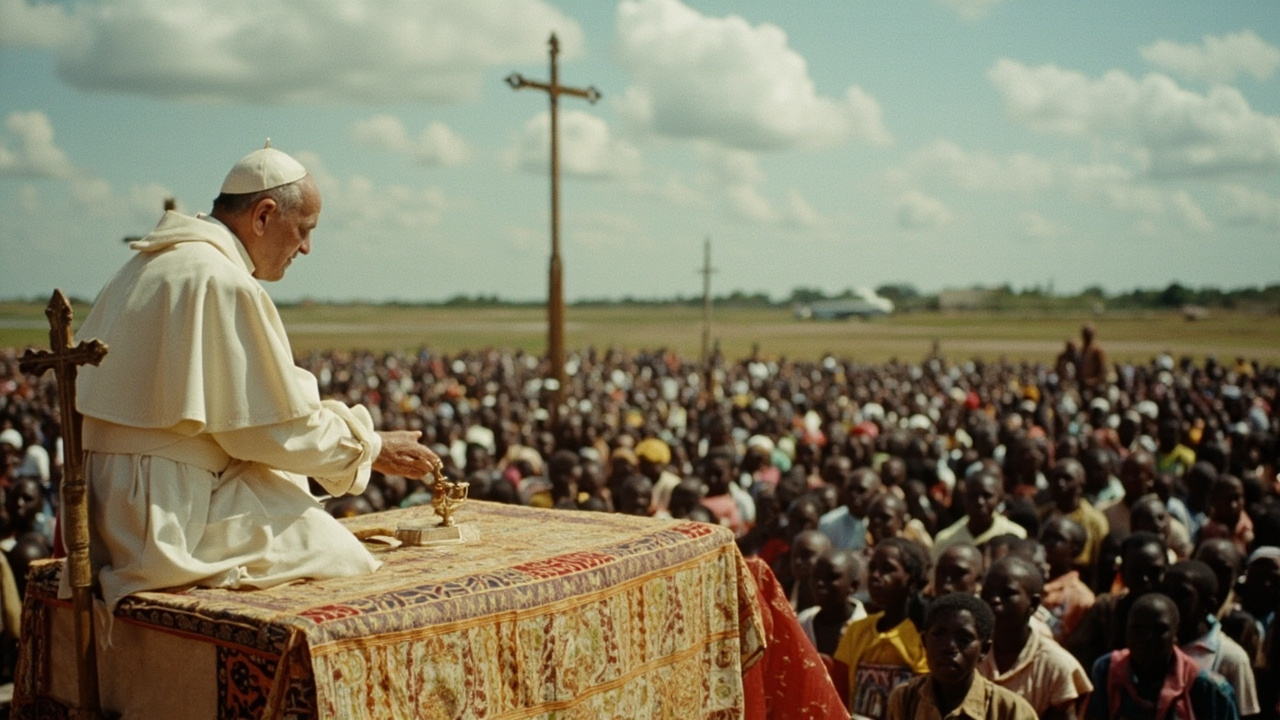
There is a particular species of moral courage that consists of saying the unsayable from a pulpit in a war zone. On Thursday, in the anglophone Cameroonian city of Bamenda — a place that has endured nearly a decade of separatist bloodshed — Pope Leo XIV did not content himself with the anodyne language of ecumenical good will. He named the sin. "The world is being ravaged by a handful of tyrants," he told the congregation at St. Joseph's Cathedral, before adding the line that ought to keep several defence ministries awake at night: "Woe to those who manipulate religion and the very name of God for their own military, economic and political gain, dragging that which is sacred into darkness and filth." [1]
This was not a general observation. The paper's account of the papal Africa tour as religious soft power argued that the Vatican was constructing an alternative international order from Lagos to Luanda. What happened in Bamenda was something sharper: a direct theological assault on the intellectual scaffolding that Secretary of Defence Pete Hegseth and his allies have erected around the Iran war. When Hegseth declared the bombing campaign was "carried out under the protection of divine providence" [2], he was not merely indulging in the ceremonial deism that American politicians affect at state occasions. He was making a specific claim — that the God of Abraham had signed off on kinetic operations against the Islamic Republic. Pope Leo, speaking from the continent that has absorbed more of war's consequences than any other, chose to demolish that claim at its foundation.
The setting was chosen with the precision of a papal encyclical. Bamenda sits in the heart of Cameroon's North-West Region, where English-speaking separatists have been fighting the Francophone government since 2017 in a conflict that has killed more than 6,000 people and displaced over 600,000 [3]. Separatist fighters announced a three-day pause in hostilities to allow the Pope safe passage. The irony — that a papal visit could achieve what years of international mediation could not — was not lost on the faithful who clogged the roads, blowing horns and dancing in scenes that gave the occasion, as the Associated Press reported, "a concert-like vibe" [3].
Inside the cathedral, the Pope presided over an interfaith peace meeting that included a Mankon traditional chief, a Presbyterian moderator, an imam, and a Catholic nun. The imam, Mohammad Abubakar, thanked God that Cameroon's crisis "has not degenerated into a religious war." Pope Leo took the cue and ran with it. His warning against those who "manipulate religion" was aimed at the Cameroonian conflict, certainly, but Vatican officials have made clear that his Africa sermons carry a global charge [3]. The "masters of war," as he called them, "pretend not to acknowledge that it only takes a moment to destroy, yet often a lifetime is not enough to rebuild" [1]. They spend billions on weapons while "the resources needed for healing, education and restoration are nowhere to be found" [1].
The timing was surgical. The Bamenda homily came on the fourth day of the American blockade of Iranian ports along the Strait of Hormuz [4], a operation that has drawn naval vessels from half a dozen nations into one of the world's most contested waterways. It also came three days after President Trump posted — and then deleted — an AI-generated image of himself in a white robe, placing a glowing hand on the forehead of a man in a hospital bed, a composition that rather strikingly resembled Christ healing the sick [5]. The President later explained that he believed the image depicted him "as a doctor," which is the sort of clarification that confirms the original suspicion. One does not accidentally post Messianic iconography during a war one has justified in explicitly religious terms. That is not how accident works.
What makes the Bamenda intervention significant is not merely its rhetorical force — popes have denounced war since Peter — but its theological specificity. Leo did not say that war is regrettable. He said that those who enlist God as a quartermaster are committing a category error so profound that it drags "the sacred into darkness and filth." This is the language of blasphemy, inverted: it is not the unbeliever who blasphemes, but the believer who puts words of conquest into the mouth of the Almighty. When a defence secretary frames bombardment as an act of divine providence, the Pope was saying, he is not speaking Christianity. He is speaking its mirror image.
The Vatican has been building towards this argument since Palm Sunday, when Leo first condemned the use of faith to justify war [2]. But Bamenda represented an escalation — from the abstract "delusion of omnipotence" he described in Douala to the concrete naming of "tyrants" who spend billions on destruction [1]. The word is not accidental in papal vocabulary. Tyrants, in the Catholic intellectual tradition, are rulers who exercise power for private gain rather than the common good. Thomas Aquinas argued that tyrannical rule is unjust by definition. Leo was not name-checking the President of the United States. He was deploying a category of moral philosophy that happens to fit him rather precisely.
Cameroon's own tragedy gave the sermon its grounding. Archbishop Andrew Nkea Fuanya told the Pope that the people of Bamenda had suffered "a situation they did not create," losing livelihoods, homes, and years of education [3]. "Most Holy Father," he said, "today your feet are standing on the soil of Bamenda that has drunk the blood of many of our children." Against that backdrop, Leo's insistence that "those who rob your land of its resources generally invest much of the profit in weapons, thus perpetuating an endless cycle of destabilisation and death" [1] resonated in two directions at once — towards the separatist war around him and the larger conflagration consuming the Persian Gulf.
The question that lingers is whether theological arguments still have purchase in a world where AI-generated Messiahs can be posted and deleted within hours. The evidence from Bamenda suggests they might. An estimated 20,000 people gathered on the airfield for the afternoon Mass [3]. Separatist fighters laid down their weapons for three days. An imam and a pope shared a cathedral. In a week when the Strait of Hormuz saw its first naval confrontation and the President of the United States briefly styled himself as a healer of nations via algorithm, the oldest institution in the Western world chose an African city to remind us that there is a difference between the sacred and the profane — and that the people who confuse the two are not prophets. They are, in the word the Pope selected with considerable care, tyrants.
-- CHARLES ASHFORD, London