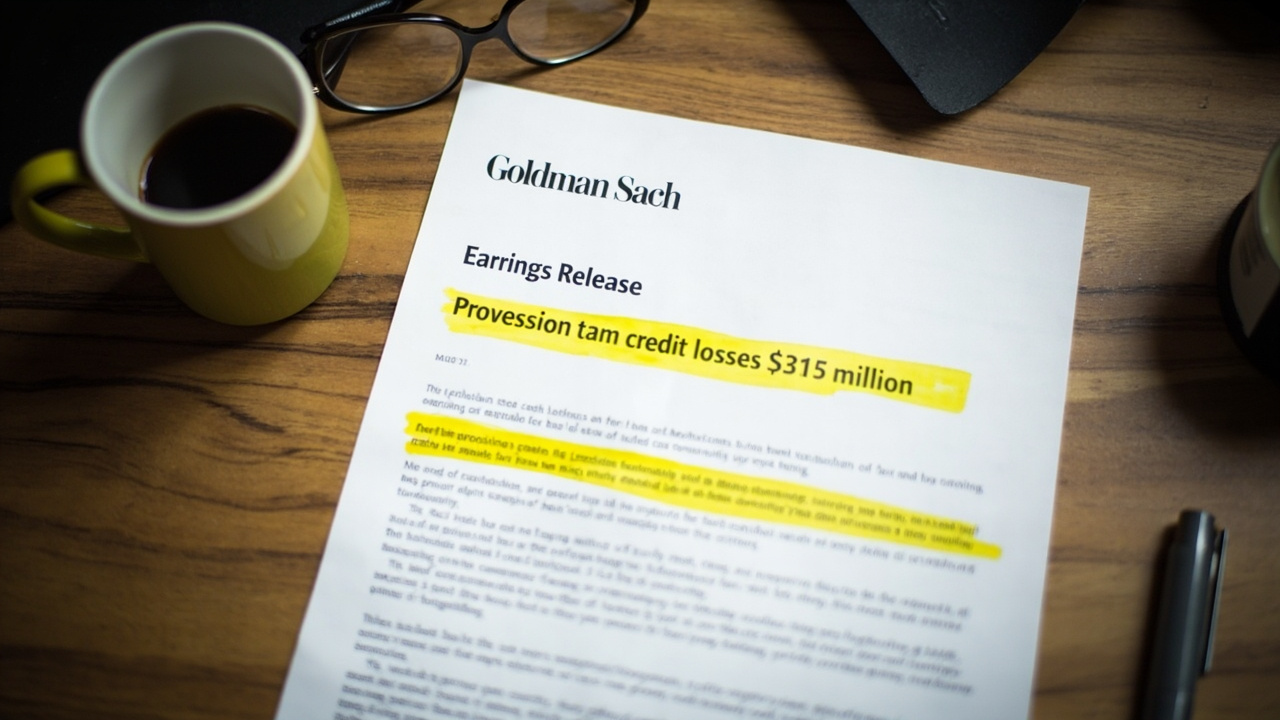
Goldman Sachs reported first-quarter results on Monday, April 13. The bank booked $17.23 billion in net revenue, $5.63 billion in net earnings, and $17.55 in earnings per share — its second-highest EPS on record. [1] The equities trading desk posted $5.33 billion, a 27 percent year-over-year jump and the largest equities quarter in the firm's history. [1] Buried in the same release was a number that, in a quieter month, would not have been buried: a $315 million provision for credit losses, more than double the $150 million StreetAccount consensus and the bank's largest reserve build since 2020. [2]
That number closed a hexagon.
Over nine trading days, the six largest U.S. banks — JPMorgan, Wells Fargo, Citigroup, Morgan Stanley, Bank of America and, finally, Goldman — have now reported the same first quarter. All six posted record or near-record trading revenue driven by the volatility of the Iran war. All six quietly added to their credit-loss reserves. The paper named the pattern at five banks on Thursday, when Morgan Stanley and Bank of America joined JPM, WFC and Citi in the ledger. Goldman's Monday filing — which for mechanical reasons of the calendar actually preceded the others — was the keystone. The six-bank set is complete. No one, except this paper, has put them all on one page.
When every major American bank tells you the same two-column story in the same two weeks, the pattern is not an earnings season. It is a disclosure.
What the six reports say when read as one document
Read bank by bank, the first quarter is a string of wins. JPMorgan beat. Wells Fargo beat. Citi beat. Morgan Stanley set records. Bank of America did not lose money on any of the 90 trading days in the quarter. [3] Goldman blew past its own equities record by more than a billion dollars. Combined trading revenue across the six is now around $45 billion for Q1 2026 — the highest nominal figure Wall Street has ever posted in a three-month period.
Read as a single document, the filings tell a different story. In every one, the provision for credit losses moved up. JPMorgan added $327 million to its wholesale reserve. Citigroup lifted its consumer reserve by $100 million. Morgan Stanley and Bank of America posted smaller builds in categories they described with words like "watchful" and "evolving." Goldman's $315 million was the headline: nearly ten percent higher than the same quarter a year earlier, and a sharp reversal of the $2.12 billion net reserve benefit the bank had released in the prior quarter. [2] The provision cost EPS roughly a dollar a share. [4]
The two columns are built from the same inputs. The war moves oil, rates, currencies, and credit spreads; the trading desk books the spread; the credit desk books the risk. Wall Street is not saying two different things about the war. It is saying one thing, in two places, because the accounting framework requires it.
The six, briefly
JPMorgan Chase reported April 11. Record revenue. The $327 million wholesale reserve build was disclosed in the 10-Q as tied to "energy and commodity-sensitive exposures" — a category that, in April 2026, translates to "companies exposed to the Iran war." [3]
Wells Fargo reported April 11. Trading revenue rose, as did lower-income consumer fuel spending as a share of budget — 25 to 30 percent for Wells' bottom consumer quartile, a figure management described on the call as "elevated." Consumer reserve was nudged higher.
Citigroup reported April 11. Largest percentage profit increase of the six. Added $100 million to its consumer reserve against the possibility that higher gasoline prices compress middle-income household balance sheets.
Morgan Stanley reported Wednesday, April 15. Net income $5.57 billion. Equities a firm-record $5.15 billion. [3] Fixed income $3.36 billion. Investment-banking revenue up on war-accelerated dealmaking. Reserves rose.
Bank of America reported Wednesday, April 15. Net income $8.6 billion. EPS $1.11, the highest in roughly two decades. Equities desk a 15-year record at $2.8 billion — and not a single down day in the quarter. [3] CEO Brian Moynihan told analysts the bank remains "watchful of evolving risks," a phrase calibrated to flag concern without naming what is producing both the profits and the risks.
Goldman Sachs reported Monday, April 13. Record equities. EPS $17.55. Fixed-income, currency and commodities revenue actually fell 10 percent to $4.01 billion on soft rates and mortgage trading. [5] And the $315 million reserve, the loudest in the group, from the bank that tells you the least about what it fears. [2] Goldman's credit book is smaller than JPMorgan's or Bank of America's; the build is disproportionate to the book. That is what makes it a signal rather than a rounding error.
The fifth corner: eleven finance ministers ask the war to stop
On Thursday, April 16, at the IMF and World Bank Spring Meetings in Washington, G7 finance ministers and central bank governors met on the sidelines of the main program. French Finance Minister Roland Lescure, whose country holds the G7 presidency, told reporters the Strait of Hormuz "needs to reopen" — "but not at any price." [6] "We need to make sure that we understand where the balance of risks is tilting in the next few weeks," Lescure said. The G7 stood "ready to act" to mitigate the war's fallout. [6]
The same day, eleven finance ministers led by Britain's issued a separate formal call for the U.S., Israel and Iran to implement the stalled ceasefire in full. [7] The statement framed the war in language usually reserved for trade disputes: its "economic damage" had become intolerable. The IMF had just cut its 2026 global growth forecast to 3.1 percent. The G7 is not a body that publicly demands a specific outcome in a live American war. On April 16, it did.
The sixth corner: all twelve Fed districts
On Wednesday, April 15, the Federal Reserve released its April Beige Book. [8] The document — a survey of business conditions across the twelve Federal Reserve Districts — contains a sentence that did not exist in any prior issue: uncertainty stemming from the Iran war was reported as a major driver of business caution in every one of the twelve districts. Not a subset. All twelve. [8]
The Atlanta Fed's contribution led with the phrase "pervasive war-related uncertainty." [9] Bloomberg's summary of the release noted that energy and fuel costs rose "sharply" in all twelve districts — again, all twelve. [10] Reuters reported that the war had pushed U.S. companies into "wait-and-see mode," with manufacturers explicitly citing the conflict as the reason capital spending decisions were being deferred. [11]
The Beige Book is not a forecast. It is a snapshot. What it is snapping in April 2026 is a national economy whose every regional cross-section is now organized around a single external variable.
The seventh corner: BlackRock took in $130 billion
On Tuesday, April 14, BlackRock reported Q1. [12] Total net inflows: $130 billion — a record, concentrated in iShares ETFs, active strategies and private markets. Assets under management: a record $13.9 trillion. Adjusted operating margin: 44.5 percent. Revenue up 27 percent.
The paper wrote on April 16 that BlackRock's inflows are the shelter trade — the sum of institutional money deciding that the war is the dominant market variable and placing itself in vehicles designed to harvest volatility without predicting its direction. The $130 billion figure confirmed it. Investors are not fleeing the war's volatility. They are paying BlackRock to sit inside it.
The eighth corner: gold never read the ceasefire
Spot gold closed around $4,797 an ounce on April 16 — in the same record range the metal has held through every ceasefire rumor, every CENTCOM narrowing, every diplomatic scatter of the Pakistan-mediated process. [13] Gold has not reacted to de-escalation announcements because gold never read them as binding. The safe-haven trade has been continuous since the blockade began.
The IMF spring meeting ran April 13 through April 18. The Beige Book came out April 15. Every major bank reported between April 11 and April 15. BlackRock reported April 14. Gold did not flinch through any of it. The market's single most price-sensitive hedge against macro catastrophe looked at the entirety of the earnings season, the G7, the Fed survey, and said: nothing I just saw changes what I already thought.
What mainstream coverage is not saying
CNBC, Reuters, the Wall Street Journal and Bloomberg have each covered each earnings release as a standalone story on its release day. None of the six reports reference the other five as a pattern. None places the six alongside the Beige Book or the G7 statement. The beat structure of financial journalism — one reporter per bank, one editor per earnings day — produces coverage that, by design, never assembles itself.
X has been closer. Traders have been posting the revenue-plus-reserves screenshot all week. "All six of Wall Street's largest banks report this week," Rufas Kamau wrote Saturday, naming the sequence before it had completed. But X fragments. The same trader posts the Goldman number on Monday, the Beige Book screenshot on Wednesday, a gold chart on Thursday. No single feed holds the shape of the hexagon long enough to be seen.
What the paper has been saying
On April 15, the paper wrote that JPMorgan's $11.6 billion trading quarter paired with its $327 million reserve build was the cleanest available read of the war's financial architecture — profits and fears, same quarter, same filing. On April 16 the frame extended to five banks with the arrival of Morgan Stanley and Bank of America, and BlackRock's $130 billion inflow was named the shelter trade.
Today it is universal. There is no major U.S. bank left to report this quarter. Every one has produced the same document: we made more money from this war than from any single macro event in our history, and we are also quietly setting money aside against what comes next.
The consequence
A single bank adding $315 million to its provision is risk management. Six banks building at once, in the same two weeks, during the most profitable trading quarter any of them has ever posted, is a distributed judgment. The country's six largest credit-pricing machines have independently concluded that the war producing their largest quarters is also the most significant medium-term credit risk they face. None of them says so on the conference call. The accounting framework says it on the 10-Q line item that sits one page later.
The paired signal has a cost. Amazon's 3.5 percent Iran-war surcharge, which hit third-party sellers on Friday, is the retail end. Europe's six weeks of jet-fuel inventory is the airline end. The helium shortage triaging MRIs in American hospitals is the industrial-gas end. The Beige Book's twelve districts are the aggregate. The G7 in Washington is the diplomatic acknowledgment. BlackRock's inflows are the institutional bet. Gold at $4,797 is the price the market attaches to a future it does not believe the ceasefire controls.
The banks, BlackRock, the Beige Book, the G7 and gold have said the same thing within seventy-two hours. Five are non-ideological accounting artifacts. The sixth is a metal. None has a political agenda. None is speculating. Each is, in its way, reporting. And what they are reporting, in unison, is that the largest beneficiaries of the Iran war are building the largest defenses against the Iran war at the same time, on the same balance sheets, in the same week.
If the people with the most information and the most to lose are hedging this hard, the reader of any single Monday earnings story has been told a fraction of the news. The hexagon closed on Monday. The paper has been walking its perimeter for a week. The perimeter is the story.
-- THEO KAPLAN, New York