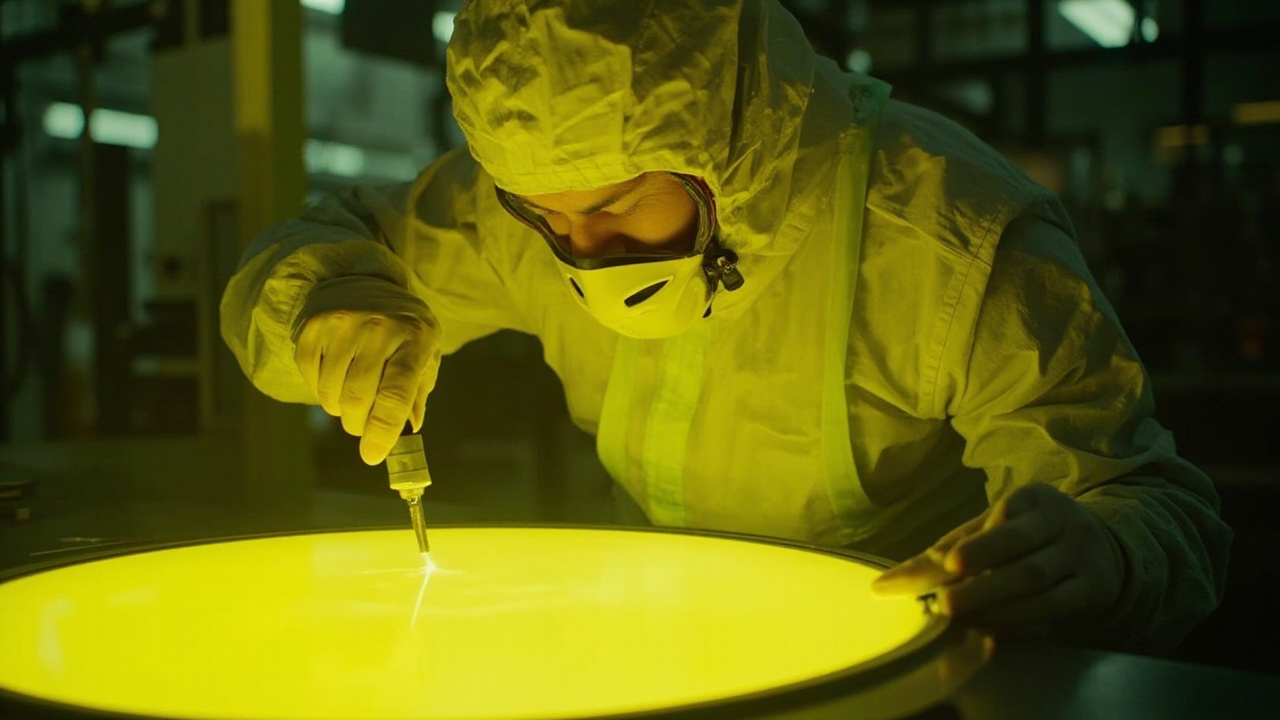
Taiwan Semiconductor Manufacturing Company's Thursday earnings call, which ran from 2 a.m. Eastern time into the early Friday morning, added two pieces of information to Wednesday's headline numbers. Full-year 2026 revenue guidance moved up to "above 30 percent" growth from the prior range. And Chief Executive C.C. Wei confirmed, in response to an analyst question, that CoWoS — the advanced-packaging process that binds logic dies to high-bandwidth memory — is "fully utilized" through 2027 and that customers are now negotiating 2028 capacity. [1] [2]
This paper wrote yesterday that TSMC's 58 percent quarterly profit jump made it a chokepoint whose prosperity is the inverse of Hormuz's crisis. The earnings-call detail sharpens the reading. The profit number was confirmation. The guidance raise and the CoWoS constraint are forward signals. A company that is "fully utilized" through 2027 and pricing 2028 contracts is not operating in a market that thinks AI compute demand is peaking. It is operating in a market where the bottleneck — TSMC — sets the pace. Everyone else fits into what TSMC can produce.
The CoWoS number is what to watch. CoWoS-S, the current production version of the packaging, runs at roughly 55,000 wafers per month across TSMC's Taiwan facilities, with a capacity expansion plan that targets 2 million wafers per year by 2027. Nvidia alone reportedly consumes more than 60 percent of that capacity. AMD, Broadcom, and Amazon's Trainium line absorb the remainder. The list of customers whose 2026 product roadmaps depend on CoWoS availability is longer than the wafer count allows. TSMC's confirmation Thursday that the packaging line is maxed is, functionally, an announcement that AI hardware availability will be TSMC-gated through the end of next year. [2] [3]
This matters because the "AI capex peak" thesis — the idea, fashionable in some equity-research circles since late 2025, that hyperscaler spending on GPUs has plateaued and will revert — requires that the binding constraint on AI hardware be demand rather than supply. TSMC's guidance raise, on a week that included a Hormuz blockade and a 72-hour FISA-lapse countdown, is the supply side telling the demand side that the constraint is still supply. Hyperscalers cannot peak their capex below the ceiling TSMC sets. The ceiling just moved up.
The Bloomberg headline — "TSMC's Profit Beats Estimates After War Failed to Dent AI Demand" — is the only major piece of Thursday coverage that named the structural reading. The paper endorsed a version of this frame yesterday: two chokepoints, two fates. The Hormuz chokepoint produces crisis because its operator — the Strait itself — has no alignment with anyone. The TSMC chokepoint produces prosperity because its operator — a publicly traded company with contractual relationships to every major Western hyperscaler — has every incentive to deliver. The geographic concentration is the same. The commercial incentives are opposite. [3]
What the call also made clear, in Wei's characteristically cautious delivery, is the A16 node ramp. A16 — TSMC's 1.6-nanometer process, the successor to the current N2 generation — is on schedule for volume production in the second half of 2026. First customer tape-outs have already occurred. The competitive significance of A16 is that it introduces a backside power delivery network, which both Intel and Samsung have promised but not yet shipped in volume. If A16 ramps as scheduled, TSMC's node-leadership over its peers extends by at least another twelve months, and with it the pricing power that drives the 66.2 percent gross margin. [1]
The geopolitical risk sits underneath all of this and did not surface on the call. TSMC's management does not discuss the Taiwan-China question on quarterly earnings. Analysts do not ask about it, by convention. The company's Arizona fab, its Japan fab, its planned Germany fab are all discussed as diversification — valuable in the long run, incapable of matching Taiwan production volume at any node finer than N3 in the medium term. The irreplaceability that produces the 66.2 percent gross margin is also the single-point-of-failure that every strategic planner in Washington and Beijing has on a whiteboard somewhere. No one is going to solve that problem in 2026. No one is going to solve it in 2027.
For now, what matters is the operational reality Thursday's call described. TSMC is the compute central bank through 2028, and the central bank just raised its supply. Hyperscaler AI spending is capacity-constrained, not demand-constrained. The earnings cycle that started with the banks' trading-revenue pattern continues with a chip company whose guidance raise on a week of geopolitical chaos is the most unambiguous signal the AI-spend trajectory has given the equity markets in six months.
The second chokepoint's crisis is oil. The first chokepoint's quarter is TSMC. Both are running the same structural logic. Only one of them is profitable.
-- DAVID CHEN, Beijing