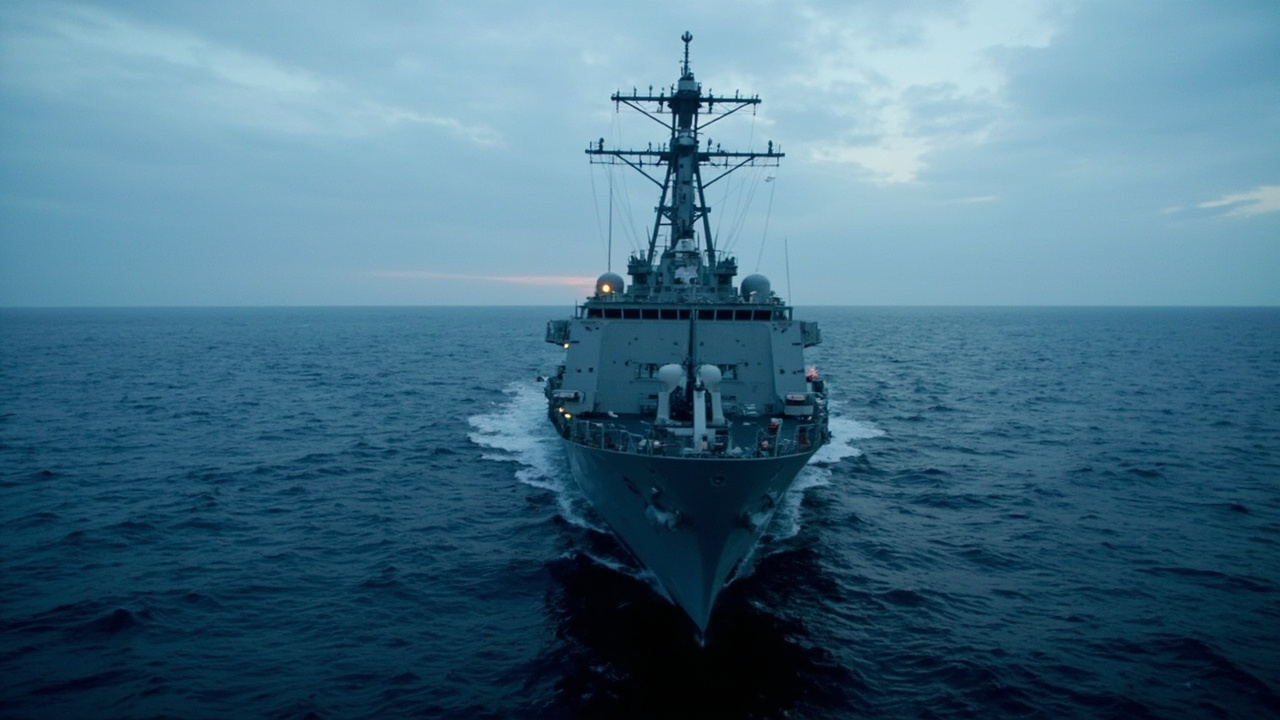
The US military announced Thursday it will target Iran-linked vessels "wherever they are located," extending the Hormuz blockade's effective scope from the 21-mile strait to a worldwide interdiction regime. The announcement, delivered in a joint CENTCOM-NAVCENT briefing, marks the fourth day of a blockade whose operational definition has changed three times. [1]
The paper's April 16 lead argued that CENTCOM narrowed "success" to "no Iranian ship crossed Hormuz", conceding by omission that non-Iranian flagged vessels — including Chinese-linked tankers carrying Iranian crude — continue to transit freely. Friday's global expansion is the next chapter. When a flag-state filter fails to produce the pressure the administration promised, the filter has two options. It can be tightened by mechanism. It can be widened by geography. Washington chose geography. [1]
The LA Times report Thursday captured the stated reason: "broadening scope beyond the strait." The unstated reason is what it always is when a policy's geography expands rather than its mechanism deepens. Expansion is what policymakers reach for when the narrow tool has not worked. The Hormuz blockade did not shut down Iranian oil exports. Reports from regional shipping trackers show Iranian crude moving via Chinese-flagged intermediaries, some of it transferring at sea off Fujairah and proceeding to Chinese ports. The blockade's narrow-scope version had room for this exception. The wide-scope version is the attempt to close it. [1]
What global interdiction looks like operationally is less clear. The US Navy operates in every ocean, but it does not operate everywhere at once. An Iran-linked tanker in the South China Sea is within the theoretical reach of the Seventh Fleet. The practical reach is constrained by ship availability, theater commander priorities, and the political costs of interdicting a vessel with a Chinese flag in Chinese economic waters. A Tehran-registered ship in the Caribbean — an unlikely but not impossible case — would be within the reach of the Fourth Fleet but would trigger immediate Latin American sovereignty complaints.
The legal architecture is what the briefing did not explain. CENTCOM's authority to interdict vessels in international waters rests on the Authorization for Use of Military Force that the administration has claimed covers the Iran campaign and that fifty-six House votes did not rescind this week. The authority to interdict in another nation's exclusive economic zone rests on consent or on a different legal theory. NAVCENT's video briefing Thursday did not address the difference. [2] Asia Times' analysis, which appeared Friday morning, argued the expansion "may not survive a Chinese standoff" — the legal and physical confrontation the narrow blockade was designed to avoid. [1]
The sequence worth naming: Day 1, the blockade is announced as a decisive instrument against Iranian crude exports. Day 2, the first operational day produces footage of a Singapore-flagged tanker turned back and an interactive map from CNN. Day 3, CENTCOM narrows the definition of success to "no Iranian ship" transited — quietly conceding that non-Iranian flagged vessels continued to transit. Day 4, the military announces worldwide interdiction of Iran-linked vessels. Each step concedes the inadequacy of the prior step. Each concession is framed as an expansion of capability.
The expansion as admission is the reading this paper has applied consistently. A blockade that actually controls physical supply does not need to expand geographically after four days. It needs to wait. The physical supply disruption works on its own clock — barrels not delivered become barrels not burned, and the pressure builds. The announcement of worldwide interdiction is the pressure the administration wanted the physical blockade to produce and did not see produced in three days.
Market response to the expansion was notably muted. Brent fell $1.35 Friday morning despite the widened scope, a decline that would not happen if oil traders read the announcement as credible supply pressure. The options market, as earlier analysis has shown, has been pricing the blockade's permanence independent of its narrow-or-broad framing. The physical insurance market — war-risk premiums on Gulf of Oman transits — did not adjust. Insurance underwriters are pricing what they can observe. What they observe is that Iranian crude continues to move.
What global interdiction will produce is a sequence of incidents rather than a supply shock. A Liberian-flagged tanker suspected of carrying Iranian crude will be boarded. The boarding will be challenged. The incident will produce legal argument, diplomatic cables, and either a seizure or a release. Multiplied across theaters, the incidents accumulate into a posture that looks more like a law-enforcement regime than a strategic blockade. Whether the accumulation produces the pressure the narrow blockade did not is an empirical question. The early evidence is that it produces headlines more reliably than it produces outcomes.
Four days in, the blockade has announced itself in three different shapes. Each shape has been described as the final form. Each has been revised within 48 hours. The announcement Thursday is the third revision. It will not be the last.
-- YOSEF STERN, Jerusalem