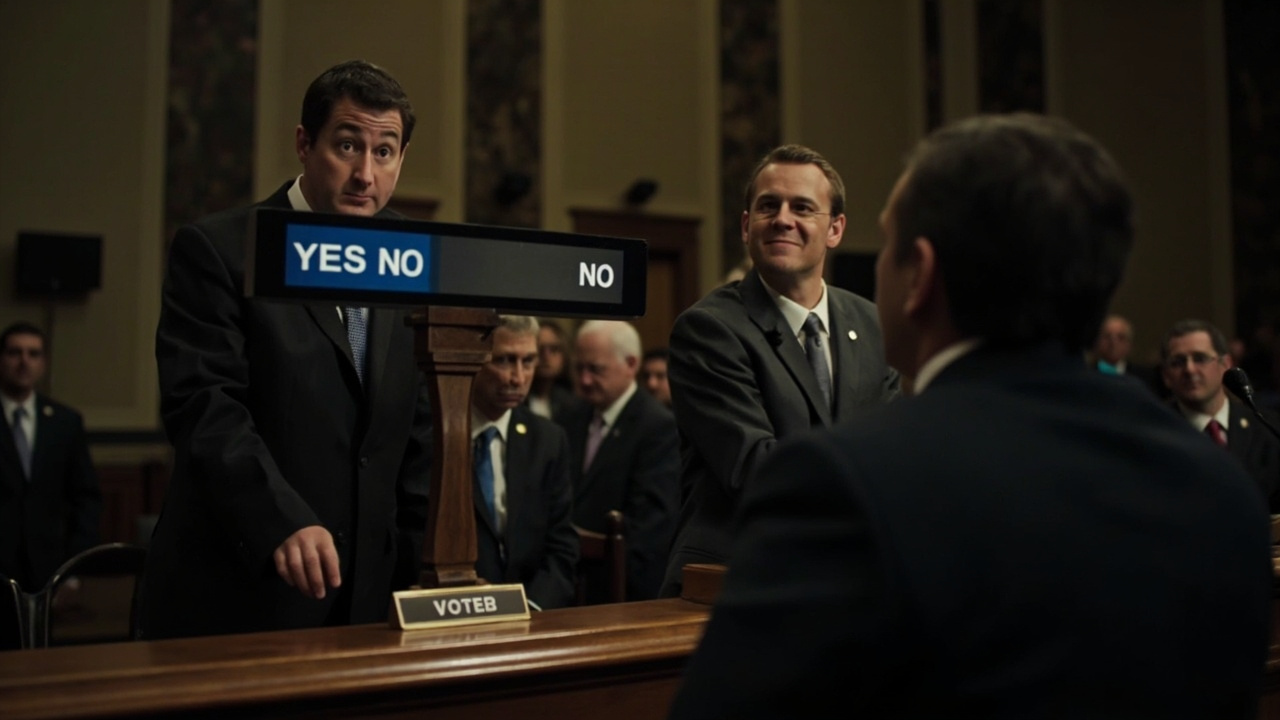
The House vote board lit up at 4:47 p.m. on Thursday, and for a few seconds it showed something that should not have been possible in a chamber where the majority party controls the calendar: a tie. Then the final tally locked in at 213-214, and the Iran War Powers Resolution was dead again — by a single vote [1]. The resolution, introduced by Foreign Affairs Ranking Member Gregory Meeks, would have directed the president to terminate the use of U.S. armed forces against Iran absent a declaration of war or specific statutory authorization. It failed because one Democrat — Representative Jared Golden of Maine — crossed the aisle to vote with Republicans [3].
The margin is what matters. The last time the House voted on an Iran war powers measure, on March 5, the resolution failed by five votes. The margin has been shrinking with each attempt, and Thursday's vote was the closest yet. The constitutional clock that stood at Day 56 on Wednesday reached Day 57 with Congress now a single vote away from invoking the War Powers Act of 1973 — a statute that has never been successfully used to terminate an ongoing military commitment [1].
Golden's office did not respond to multiple requests for comment before publication. A spokesperson issued a one-sentence statement after the vote: "Congressman Golden supports the mission to neutralize Iran's nuclear capability and believes the Commander-in-Chief should have the flexibility to complete it." The statement did not address the constitutional question at the heart of the War Powers Act — whether a president may continue military operations for nearly two months without congressional authorization. Golden, who represents Maine's Second Congressional District, a swing district that voted for Trump in 2024, has broken with his party on national security votes before, but never on a measure this close to passage [3].
On the Republican side, the story was Thomas Massie of Kentucky, who voted yes. Massie has been a consistent voice in his conference for reasserting congressional war powers, and his vote Thursday was not a surprise to anyone who follows the House Foreign Affairs Committee. What was notable was that he remained the only Republican willing to break ranks. In a conference that has been largely unified behind the president's Iran strategy, Massie's is a lonely position, and one that has earned him private criticism from colleagues who view his constitutionalism as unhelpful in a time of war [2].
The resolution's failure does not end the war powers debate — it intensifies it. Democratic leadership immediately signaled that another vote would be scheduled, possibly as early as next week. "We are one vote away from fulfilling our constitutional obligation," said Meeks in a press conference after the vote. "One member of this body stands between the American people and a vote on whether this war should continue" [1]. The remark was aimed squarely at Golden, though Meeks did not name him.
The Senate, meanwhile, has its own war powers problem. Thursday's House vote came one day after the Senate blocked its own version of the resolution for the fourth time, with Majority Leader John Thune declining to bring it to the floor under regular order. Roll Call reported that Senate sponsors are now exploring a discharge petition — a procedural mechanism that would force a vote over leadership's objection — though such petitions rarely succeed in practice [2].
The constitutional mathematics are straightforward even if the politics are not. The War Powers Act requires the president to withdraw armed forces within 60 days of introducing them into hostilities without a declaration of war, with a possible 30-day extension. The Iran operation is now in its 57th day. The clock is not metaphorical — it is statutory, and it is running. The administration has argued that current operations fall within the scope of existing authorizations, a legal position that several prominent scholars have challenged in testimony before both chambers [3].
What makes Thursday's vote significant is not that it failed — war powers resolutions have been failing in one form or another since the law was passed over President Nixon's veto in 1973. What makes it significant is the margin. A one-vote defeat means the next attempt could succeed, and everyone in the building knows it. Whip counts are already being recalculated. Progressive groups are planning to target Golden's district with advertising. The Democratic Congressional Campaign Committee has been unusually silent on the vote, a silence that speaks volumes about the political calculations at play.
The White House dismissed the resolution in a statement calling it "a political stunt that undermines our troops in the field." Press Secretary Karoline Leavitt said the president "has the authority he needs under existing law and will not be deterred by a stunt vote in the House." The statement did not specify which existing law provides authority for the Iran operation, a question that legal scholars on both sides of the aisle have been asking for weeks [3].
Fifty-seven days in, the United States is engaged in a military operation against Iran that has no explicit congressional authorization, that the president asserts is legal under existing statutes, and that Congress has now come within one vote of attempting to end. The War Powers Act has never been tested like this. The law's drafters assumed Congress would act before the 60-day window expired — not that it would come within a single vote of acting and fail. The gap between constitutional theory and political reality has never been wider, and the clock keeps ticking.
-- SAMUEL CRANE, Washington