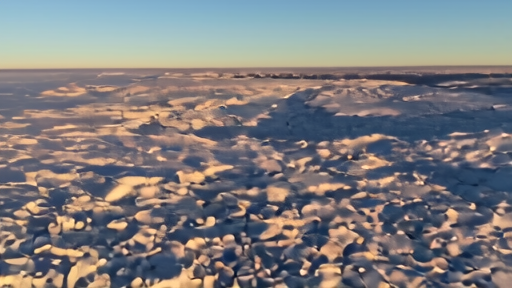
A paper in Nature Climate Change by Ricarda Winkelmann, Julius Garbe, Jonathan Donges and colleagues maps the temperature thresholds at which individual Antarctic ice drainage basins cross from gradual retreat into self-sustaining decline. [1] The paper's headline number: the Thwaites/Pine Island, Ronne, and Ross West (Siple Coast) basins — the three most vulnerable in West Antarctica — may already be at risk of substantial long-term ice loss below +1°C of global warming above the pre-industrial reference. [2] The paper does not claim imminent collapse. It quantifies when retreat becomes dynamically locked in.
The arithmetic reads sharply. Global mean warming currently stands at approximately 1.3°C above the late-19th-century baseline. [2] If the Nature paper's modelled thresholds are correct, three West Antarctic basins have already crossed them. Three more — Abbot/Venable, parts of the Peninsula, George VI — would cross at between 0 and 0.7°C additional warming, i.e. at 1.3°C to 2.0°C of cumulative pre-industrial warming. [1] That is the Paris Agreement's 1.5°C ceiling reframed as geology. The total sea-level relevant ice volume at stake in the six basins is measured in metres, not centimetres. [3]
The paper's authors, affiliated with the Potsdam Institute for Climate Impact Research, describe the behaviour as hysteretic. A basin past its tipping point does not reverse when temperatures fall; it requires temperatures below pre-industrial levels in many model realisations. The implications are more procedural than kinetic. Ice sheet collapse plays out over decades and centuries. But the question of whether the process has begun — the question for planning, for coastal policy, for reinsurance — the paper answers with a clarity the politics has not yet caught up to. On Earth Day week, the math is cold.
-- KENJI NAKAMURA, Tokyo