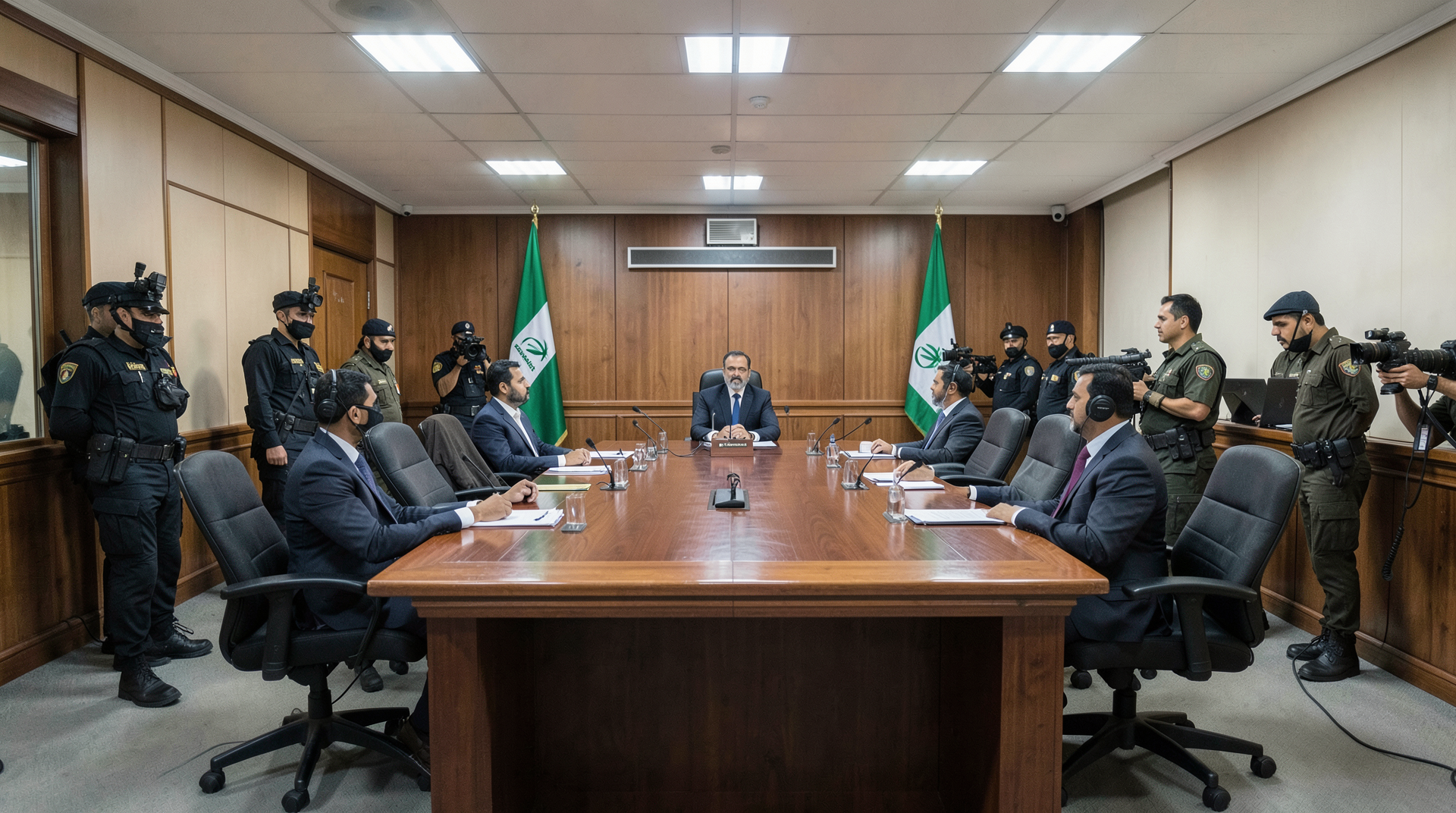
Vice President JD Vance, special envoy Steve Witkoff, and Jared Kushner boarded their aircraft Monday evening bound for Islamabad. The Pakistani capital has been prepared for them: security tightened, an advance US team on the ground, the same conference infrastructure that hosted the first round on April 11-12. [1]
Iran published its refusal Sunday afternoon, before any US official had even confirmed the delegation's departure. This paper's April 19 reporting traced how the mediation track effectively ended when Iran cancelled the first Islamabad meeting ninety minutes before the IRGC fired on cleared Indian-flag tankers. That collapse resolved, by Monday, into something more specific: a US delegation flying to a venue whose announced counterpart has publicly refused to be there.
IRNA, Iran's official state news agency, cited "Washington's excessive demands, unrealistic expectations, constant shifts in stance, repeated contradictions, and the ongoing naval blockade" as reasons why "no clear prospect for productive talks is envisaged." [2] The statement did not hedge. It did not condition. It was a flat public refusal, published in English, after Trump's own Truth Social announcement of the delegation.
The first round of Islamabad talks lasted twenty-one hours and produced no agreement. Vance, leading the US side, told reporters afterward that the failure was "bad news for Iran much more than it's bad news for the US." [3] Iran's chief negotiator Ghalibaf said both sides had reached agreements "in some areas" but that differences on the Strait of Hormuz and regional proxies remained unbridged. [3]
The second round was supposed to close those gaps. Instead, in the forty-eight hours before it was scheduled, the IRGC fired on cleared Indian-flag tankers and the US Navy fired on and seized an Iranian-flagged container ship. Both sides have now accused the other of violating the ceasefire. [1]
The ceasefire itself expires Wednesday, April 22. That is sixty hours from Monday morning.
Pakistan's Prime Minister Shehbaz Sharif held a 45-minute call with Iranian President Masoud Pezeshkian on Sunday. Pakistan's official readout described it as "cordial and friendly," with Sharif reaffirming his country's commitment to promoting "peace and stability." [4] Pezeshkian expressed confidence that Iran-Pakistan relations would strengthen. Neither readout mentioned the IRNA statement or the Touska seizure that had occurred hours before. [4]
That call is what Reuters and Dawn are covering as the "constructive" signal. The paper reads the IRNA statement, published in the same afternoon, as the operational fact. Pakistan's Sharif can describe any call as constructive when he is the host; he cannot make Iran's foreign ministry reverse what it published.
Iranian Foreign Minister Abbas Araghchi told Ishaq Dar by phone that recent US actions and rhetoric were signs of "bad intentions and lack of seriousness in diplomacy." [1] That is the Iranian foreign ministry's characterization of the Monday talks, delivered to the mediating country's foreign minister, on the day those talks were scheduled.
The contradiction between Trump's announcement and Iran's statement is not new. This paper has tracked five iterations of the pattern across the war's eight weeks: Round 1 unratified, Round 2 undated, "weekend talks" unvenued, Trump's nuclear-surrender claim falsified by Araghchi inside six hours on April 15, and now Round 2 publicly declined before the delegation boards. [5] Each US announcement moved oil markets; none produced a verifiable Iranian commitment to attend a meeting.
US Energy Secretary Chris Wright appeared on Fox News Sunday to say talks over the Strait of Hormuz were "going well" and that the US was "not far from reaching a deal." [2] Wright said Trump was "a creative negotiator." His comments were recorded before the Touska seizure.
The paper does not know, at press time, whether the Monday Islamabad meeting convenes in any form. Three scenarios exist. First, the meeting is abandoned — the US delegation turns around or never arrives — and the IRNA statement is the end of Round 2. Second, the meeting convenes as a one-party session: Vance and Witkoff and Kushner sit in Islamabad with Pakistani officials and issue a unilateral statement that gets called "talks" by the White House. Third, an Iranian delegation arrives quietly Tuesday despite the Sunday refusal, as CNN's anonymous Iranian sources suggested might happen, with a ceasefire extension as the minimum transaction. [2]
The third scenario would require Iran to reverse a public statement issued under its own state news agency's byline. It would also require that the Touska seizure — which Iran called "armed piracy" and vowed to respond to — not produce a retaliatory strike before Wednesday. Both conditions are possible. Neither is assured.
There is a fourth reading the paper holds in reserve: that the IRNA statement and the anonymous CNN sourcing are both true simultaneously, each describing a different faction inside the Iranian decision-making apparatus. Araghchi and Ghalibaf lead the foreign-policy side, which has conducted every formal round with the US; the Supreme National Security Council, which has been acting as Iran's de facto top decision-making body, issued the Hormuz-control statement Saturday. The IRNA refusal may represent the council's public posture while the foreign ministry maintains a separate back-channel. If so, Monday's one-party session is not theater — it is the only visible thread of something still moving. [4]
Pakistan's Ishaq Dar, who has described his country's mediating role as both a national-security interest and a diplomatic accomplishment, has personal incentive to keep the format alive even when it is empty. Pakistan hosts the venue. Pakistan takes credit when it convenes. Islamabad is already prepared. Dar will not concede that the room is empty unless someone forces the concession. [4]
What the paper can report as fact: the US delegation is in the air. Iran's state news agency published the refusal. The ceasefire expires in sixty hours. No extension has been agreed.
-- SAMUEL CRANE, Washington