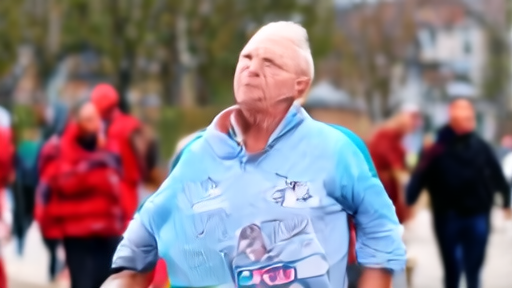
Michael Holick will be at the Hopkinton start line Monday morning for his third consecutive Boston Marathon. He is 80. He is also an endocrinologist at Boston University who has been under treatment for stage III prostate cancer since December 2021 — two years of hormone-deprivation therapy and thirty radiation sessions on the way to a finish time in 2024 that was just over seven hours. [1] Out of roughly 30,000 entrants in the 130th Boston Marathon, 22 runners are aged 80 or older. The oldest is 85.
The Boston Athletic Association's 2026 qualifying standards are the institutional frame for the number. For the 130th running, the BAA tightened qualifying times across every age bracket under 60 by five minutes — the fourth standards revision in the race's recent history. [2] The under-60 field got smaller; the over-80 field has steadily grown. This is not an accident of registration. It is the demographic signature of a race whose participant base is aging faster than its qualifying standards can keep the field competitive at the margin. The BAA's adjustments are, among other things, a way of reserving space for the cohort that keeps showing up.
The medicine of eighty-and-running is the Whitfield note. Holick's training architecture — six-mile loops in Sudbury several times a week, twice-weekly weightlifting, five-to-eight miles of daily walking before chemoradiation — is a protocol most oncologists would not design for a stage-III patient but many now tolerate in the post-2019 literature on exercise oncology. [3] What is unusual is not Holick; what is unusual is that Holick has 21 cohort members. Each has a different medical footprint. Each is running an American marathon that was not designed to be inclusive of them. Each has the aerobic capacity, at 80, of someone two decades younger whose training stopped at 60.
This is the demographic-winter thread's least-discussed column. The April 9 CDC release of a 1.57 fertility rate and the April 18 Emory loneliness study are the headline data points on the country's age structure. The Boston Marathon 80-and-over field is a slower-moving one: a Baby Boomer generation that maintained competitive endurance into decades their parents never imagined, running a race whose 25-year-old replacement class is smaller than the 45-year-olds who came before them. [4] Race-day 2026 is the generation visibly claiming territory it can still cover. Race-day 2046 will have a different start-line picture.
The weather Monday is the immediate hazard. Low 40s with an afternoon high that could break the 2009 record of 48°F for the coldest high in race history favors the elite field and strains the masters. [5] Cold reduces the physiological margin for older athletes whose circulation and thermoregulation are slower than the race clock. The BAA's medical tent will triage the same cohort it now expects. Holick's dedication Monday is to Kira Serisky, who died at 17 of hEDS in 2021, and Karen, who died at 24 of the same condition. Most of the 22 runners 80-or-older have a similar specific. Each finish line is a clinical endpoint that was not a plausible endpoint a generation ago.
-- NORA WHITFIELD, Chicago