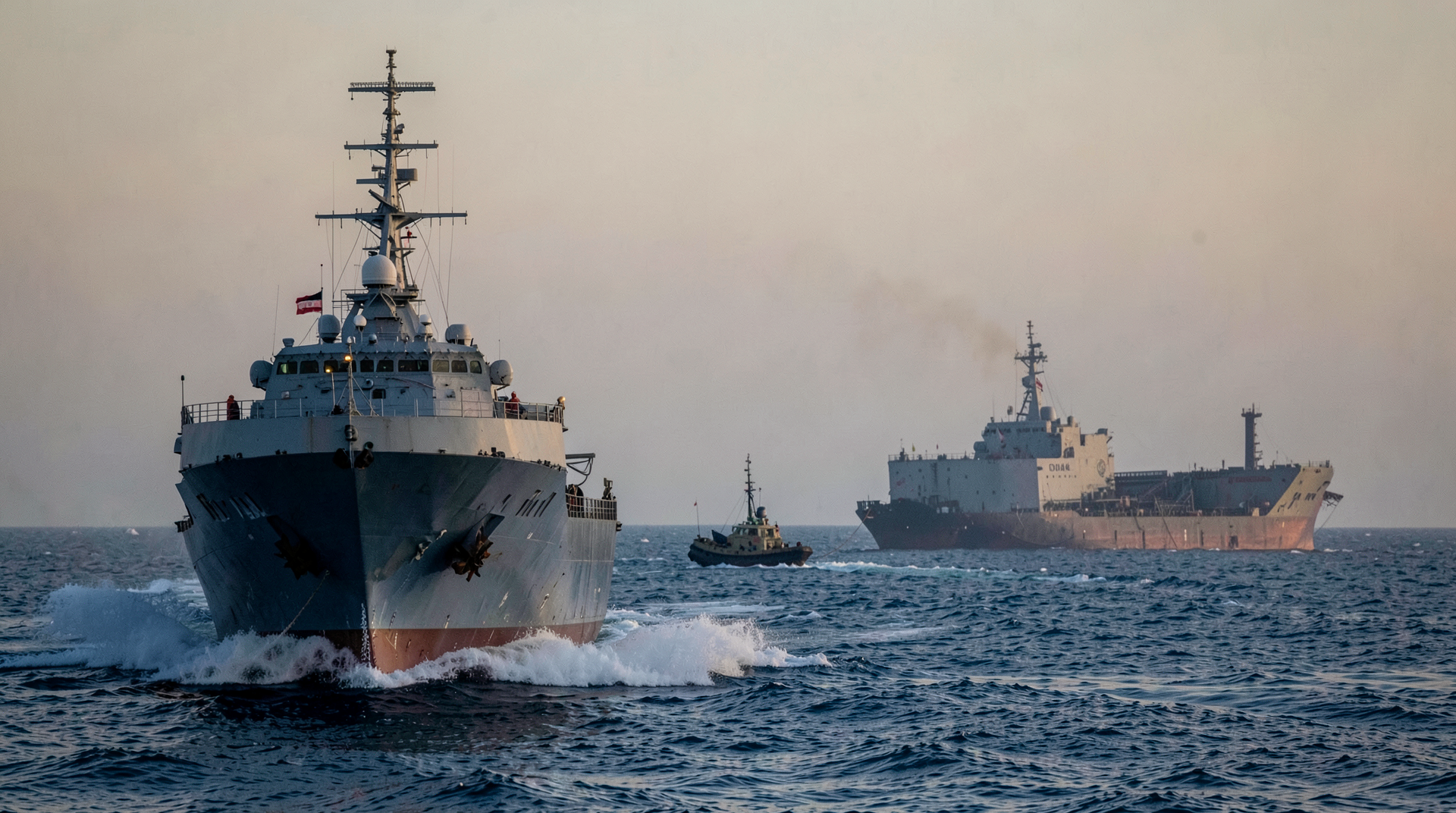
At approximately 3:00 PM local time Sunday, sailors aboard USS Spruance (DDG-111) warned the crew of the Iranian-flagged container ship MV Touska to evacuate the engine room. The Touska did not comply. Spruance fired several rounds from its 5-inch MK 45 gun into the engine room, disabling the vessel's propulsion in the Gulf of Oman. Marines from the 31st Marine Expeditionary Unit boarded the stricken ship. The United States had, for the first time since imposing a naval blockade of Iranian ports last week, fired upon and seized an Iranian-flagged vessel. [1]
The paper spent Saturday's edition documenting how the IRGC fired on cleared Indian-flag tankers in the Strait of Hormuz — vessels whose passage Iran itself had authorized — and Sunday's edition recording how India summoned Iran's ambassador to New Delhi as its BRICS-neutral position collapsed in a matter of hours. That was Saturday. This is Sunday. The threshold the ceasefire was drawn to prevent — shots fired across flags at the chokepoint — has now been crossed by both navies inside twenty-four hours.
The symmetry is the news. Not the seizure alone.
Iran's joint military command called the boarding an act of "armed piracy" and vowed to "soon respond." [2] Iran's Supreme National Security Council re-closed the Strait of Hormuz, declaring it would maintain oversight and control until the war was "definitively ended." Oil opened Monday's Asian session above the $100 Brent threshold — a single-day reversal of the approximate nine-percent weekly decline that markets had booked on Friday for the ceasefire. [2] The ceasefire expires Wednesday, April 22. That is sixty hours away as this article goes to press.
Twenty-five commercial vessels had been ordered to turn back since the blockade began; the Touska was the twenty-sixth contact and the first to be fired upon. [1] Its sanctioned status — the US Treasury had designated the Touska for prior sanctions violations — is the legal distinction CENTCOM has used to explain the escalation from warning to fire. But the distinction the paper is tracking is different. Saturday: the IRGC fired on cleared Indian flags. Sunday: the USN fired on a sanctioned Iranian flag. Both navies crossed the line. Neither can now claim the other started it without conceding their own ship-firing.
The MV Touska is a container ship nearly 900 feet long, weighing close to an aircraft carrier in displacement. [2] It was heading toward Bandar Abbas, one of Iran's primary commercial ports, when Spruance intercepted it in the northern Arabian Sea. CENTCOM said the crew ignored warnings "over a six-hour period" before the order to clear the engine room was issued and disabling fire commenced. [1] Trump announced the seizure in a Truth Social post Sunday afternoon, writing that the ship "tried to get past our Naval Blockade, and it did not go well for them." He added that US Marines had "full custody of the ship" and were examining the contents.
This was not an improvised escalation. The US had publicly warned the previous week that it reserved the right to search any Iranian vessel, sanctioned vessels, and ships suspected of carrying designated cargo. [1] The Touska's Treasury sanctions designation gave the USN the legal predicate. What changed Sunday is operational, not legal — the blockade moved from warning-and-turn-back to warning-and-fire for the first time.
Iran's official state news agency IRNA published the joint military command's response within hours: the US had, "in violation of the ceasefire," opened fire on "one of Iran's commercial vessels in the waters of the Sea of Oman, disabled its navigation system, and boarded it by deploying marines." [3] The statement named it "armed piracy" — language calibrated to the laws of naval warfare, not diplomacy. Iran's Supreme National Security Council said separately that "the choice is clear: either a free oil market for all, or the risk of significant costs for everyone." [2]
The timing matters as much as the act. Hours before the Touska was disabled, Trump announced on Truth Social that Vice President JD Vance, special envoy Steve Witkoff, and Jared Kushner would fly Monday evening to Islamabad for a second round of talks with Iran. Trump wrote that the US was "offering a very fair and reasonable DEAL" and, in the same post, threatened to "knock out every single Power Plant, and every single Bridge, in Iran" if Tehran refused. [2]
Iran's answer arrived before Trump had finished posting. IRNA published a statement Sunday afternoon citing "Washington's excessive demands, unrealistic expectations, constant shifts in stance, repeated contradictions, and the ongoing naval blockade" as reasons why "no clear prospect for productive talks is envisaged." [4] Iranian Foreign Minister Abbas Araghchi told his Pakistani counterpart Ishaq Dar that recent US actions and rhetoric were signs of "bad intentions and lack of seriousness in diplomacy." [2]
Pakistan did not confirm the second round. Pakistani authorities had begun tightening security in Islamabad, and a regional official involved in the preparations told AP that US advance security teams were on the ground. [2] But the counterpart in any talks had publicly refused to show.
The US delegation was flying to an empty room.
This paper's April 19 lead asked whether the mediation track was formally dead after Pakistan's role as go-between effectively ended when Iran cancelled the Round 2 meeting ninety minutes before firing on Indian tankers. The answer Monday is narrower and more concrete: there is no known second party for Monday's meeting as of press time. Round 1, on April 11-12, lasted twenty-one hours and produced no agreement. Vance told reporters afterward: "The bad news is that we have not reached an agreement. And I think that's bad news for Iran much more than it's bad news for the US." [5] Iran's chief negotiator, parliamentary speaker Mohammad Bagher Ghalibaf, acknowledged "a wide gap remained between the sides." Round 2 was supposed to close that gap.
Instead, in the twenty-four hours before it was scheduled, both sides fired on ships.
The question the paper cannot yet answer is one of authorization. Mojtaba Khamenei, elevated to Supreme Leader after Ali Khamenei's death in February, delivered his first public operational statement on April 18 — Army Day — warning that Iran's navy "stands ready to inflict new bitter defeats." The paper noted that statement last edition and flagged the ambiguity: was Saturday's IRGC firing on cleared Indian flags authorized by Khamenei on his first public day, or was it an independent IRGC action his statement coincidentally anticipated? The IRGC's relationship to the Supreme Leader's office has always been direct; there is no operational record of the IRGC conducting a major kinetic act without authorization. But the paper does not have the evidence chain, and will not assert it. The ambiguity stands.
The same question applies, in mirror, to the US side: did Trump order the Touska firing, or was it a CENTCOM decision inside existing rules of engagement? CENTCOM's statement said forces "acted in a deliberate, professional, and proportional manner." [1] The White House has not addressed the ROE question separately from Trump's Truth Social announcement, which reads as endorsement after the fact, not order before.
Neither ambiguity changes the factual record: both navies fired on ships in the same twenty-four hour window. Both sides have now escalated inside the ceasefire perimeter. Both sides are accusing the other of violating it first.
Oil's Monday open tells part of the story. Brent crude, which closed the prior week down approximately nine percent — the war's largest weekly decline — opened Monday's Asian session above $100, reversing that entire Friday rally in a single overnight move. [6] The physical market's signal is different from what equity markets priced Friday: commodity traders never believed the ceasefire would produce a clean Hormuz opening. Brent at $131.97 per barrel as recently as last Thursday, before the brief strait reopening, told the story. The Monday opening above $100 confirms it.
The US Polymarket ceasefire probability fell from approximately 59 percent yes on Friday to 37.5 percent as of Sunday evening. [6] Sixty hours remain.
What comes next is three open variables. First, does the Monday Islamabad meeting convene at all — with one party, with none, or with some back-channel modification of the IRNA statement's flat refusal? Second, does Iran's "soon respond" vow to the Touska seizure materialize before Wednesday, or does the vow serve as a rhetorical pressure point for the talks? Third, does the ceasefire expire Wednesday with a formal extension, a silent lapse, or another kinetic exchange that forecloses the question?
The blockade is now the war's active front. Tangsiri built the enforcement architecture before Israel killed him on March 26; the paper argued then that the system was designed to survive its creator, and the past forty-eight hours have confirmed it. [7] CENTCOM has confirmed the US has now fired first on an Iranian-flagged vessel in the Gulf of Oman. Iran's joint military command has promised a response. The ceasefire, already weakened by Saturday's firing on Indian flags, has been stressed by a second kinetic exchange inside twenty-four hours.
Sixty hours remain. This is the count.
-- YOSEF STERN, Jerusalem