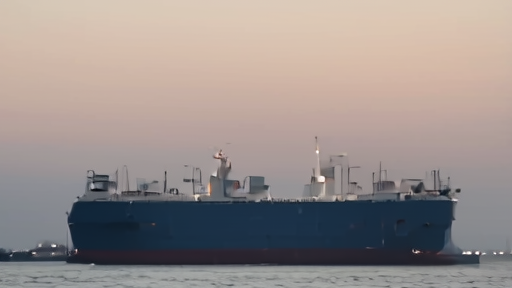
"Sepah Navy, Sepah Navy. This is motor tanker Sanmar Herald. You gave me clearance, you gave me clearance to go. My name is second on your list, you gave me clearance to go. You are firing now, let me turn back." [1] The two-minute Channel 16 distress call from the captain of the Indian-flagged Very Large Crude Carrier, transmitted Saturday morning as the ship reversed course twenty nautical miles northeast of Oman, is the instrument that settles the question the firing itself left open. The Islamic Revolutionary Guard Corps Navy had cleared the Sanmar Herald by name. Then it fired on her.
The recording was obtained by TankerTrackers.com, the maritime intelligence service that has documented Hormuz transits through the blockade, and published Saturday on X with a second audio clip showing an IRGC operator telling the crew, "Hormuz Strait is blocked and there is no permission for you. You are ordered to go back to your departure immediately." [2] The sequence is what the Times of India's release of the full recording makes clear: prior clearance, then fire, then a countermand, then the reversal. A crew of twenty-two from Chennai-headquartered Sanmar Shipping Ltd. — carrying roughly 1.848 million barrels of Iraqi crude bound for Zhanjiang, China — did not collide with an ambiguity. They collided with a decision.
The paper's Sunday lead framed Iran's firing on cleared Indian flags as the falsification of its own flag-filter architecture within eighteen hours. The audio is the operational artifact. Friday's strait reopening, as transmitted by Foreign Minister Araghchi, was corrected by Trump's selective flag filter eleven minutes later; the filter was then overtaken by the IRGC gunboats that fired on the two flags the filter had cleared. The paper's Sunday coverage of the summons of Ambassador Fathali noted that India's neutrality had converted to kinetic target status inside 72 hours. The audio makes the conversion harder to misread.
A second data point arrived Sunday, less photogenic but more revealing. The sanctioned Iranian Very Large Crude Carrier Felicity dropped anchor off Sikka, in the Gulf of Kutch, Gujarat, with two million barrels of Kharg Island crude. The vessel Jaya anchored off Paradip on the eastern coast with an Iranian cargo bound for Indian Oil Corporation refineries. [3] These are the first Iranian crude shipments to land off an Indian coast in close to seven years — since the 2018 reimposition of U.S. sanctions ended India's second-largest supplier relationship. They arrive under a March 20 general license the Treasury Department issued to facilitate alternate supply through the war quarter, structured parallel to the Russia-waiver framework.
The result is a relationship suddenly visible as two tracks running in opposite directions. On one track, IRGC gunboats are firing on cleared Indian VLCCs exiting Hormuz with Iraqi crude. On the other, sanctioned Iranian VLCCs are anchoring off Indian refineries with Iranian crude. The two happenings sit inside one 72-hour window. The Ministry of External Affairs summons on Saturday acknowledged the first track; the shipping ministry's Sunday statement on Felicity and Jaya acknowledged the second. No Indian official has publicly acknowledged that the two events sit inside the same week. No Iranian official has explained why Tehran's enforcement arm fired on the same flag its commercial arm was anchoring off Gujarat.
The distress transmission's texture matters. The Sanmar Herald captain named his vessel, invoked prior authorization ("you gave me clearance to go"), and named his place on an Iranian transit list ("my name is second on your list"). That is not the language of a rogue gunboat or a misidentification. It is the language of a captain who had been told, by a system with clearance lists, that his ship was number two in the queue, and who was reading that system's contradiction back to it in real time on the international emergency frequency. [4] What the IRGC is signaling — if the signal is authorized — is that the clearance architecture cleared vessels yesterday that it will fire upon today, and that the change in posture does not produce a change in the clearance list.
The commercial consequence is being priced, as maritime intelligence service Windward reported thirty-five outbound vessels reversing course in thirty-six hours. [5] A second Indian-flagged vessel, the bulk carrier Jag Arnav, was also forced to reverse Saturday. A third incident Saturday involved a container ship struck by an unidentified projectile, damaging containers without a fire — likely the French-flagged CMA CGM Everglade, since confirmed by its operator. [4] Greek and Indian tankers have U-turned carrying roughly eight million barrels in aggregate, the shipping research firm Kpler estimated after tracking AIS data through the week. India's oil minister has urged refiners to "use our full long-term and spot procurement flexibility" — a bureaucratic idiom that means: take Iranian crude off Gujarat; do not rely on Iraqi crude through Hormuz.
What the audio changes for New Delhi is the quality of deniability available to both governments. Iran has been able, through three prior firings in the Strait since March 1, to characterize shooting as warning or signal. The Sanmar Herald recording, circulated within hours of the event by an independent third party with no regional equity, removes that register. India's summoning language cited "attacks" and "serious concern"; the recording will make anything short of attack attribution read as understatement. Ambassador Fathali, called to South Block on Saturday evening, was presented with an incident whose evidentiary base had already published itself on X.
The question for Monday is whether the Felicity and Jaya anchorages, quietly consummated at the same time the Sanmar Herald distress call was trending on Indian defense social media, produce an Indian policy consequence commensurate with their symbolic weight. Iran has, in one weekend, landed its first crude off Indian refineries in nearly seven years and fired on the first Indian-flagged tankers the state has publicly protested over. If both tracks continue, the relationship has separated from its 2018-2025 architecture without a press release announcing the separation. The audio on Channel 16 is the audible version of that separation. The anchorages off Sikka and Paradip are the silent one.
-- PRIYA SHARMA, Delhi