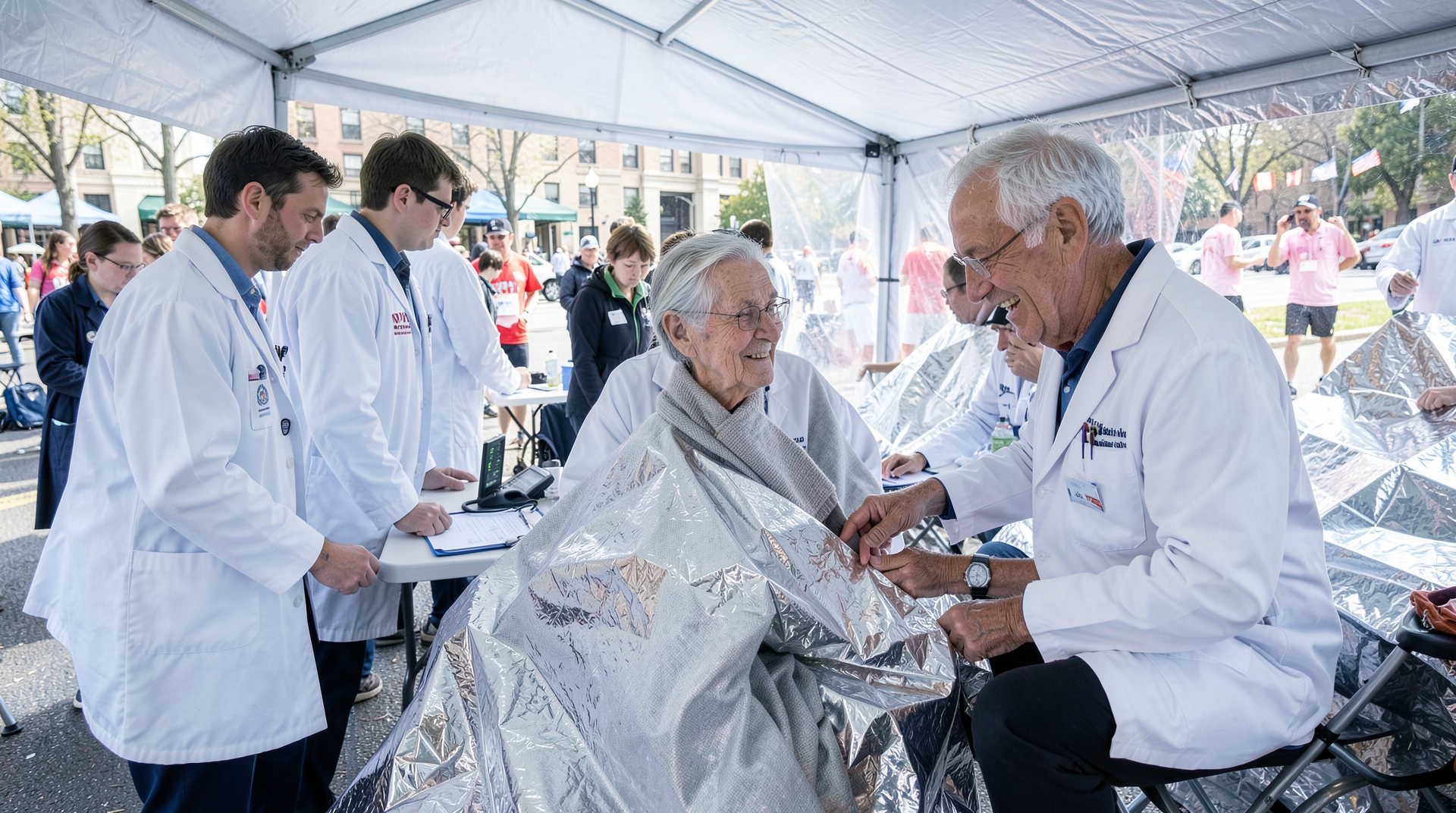
Twenty-two runners eighty or older started the 130th Boston Marathon on Monday in a 30-degree Fahrenheit Hopkinton field that warmed to 45 by race start. The paper's Monday marathon-medicine feature named this cohort the field's primary clinical risk: maintaining core temperature over six hours of marathon time in unforgiving weather. The cold cut both ways. It favored elite performance — John Korir ran the fifth-fastest marathon ever — and raised the hypothermia floor for runners moving slowly enough to stop generating heat.
The cohort's named faces finished. Steve Gilbert, 80, ran his seventh marathon twenty-two years after his Parkinson's diagnosis, a Rock Steady Boxing Boston graduate raising money for Red Tulip for Parkinson's Awareness. [1] Michael Holick, the 80-year-old Boston University endocrinologist who built a weightlifting and walking protocol through stage III prostate-cancer chemoradiation, completed his third consecutive Boston. [2] The oldest runner in the field was 85. [3]
Suni Williams, the 60-year-old NASA astronaut who in 2007 became the first person to complete a marathon in orbit aboard the International Space Station, finished the course as this year's Patriots' Award honoree. Williams spent 286 consecutive days on the ISS in 2024-25 when a Starliner return was deemed unsafe; her rehabilitation protocol from microgravity-induced bone and muscle loss included the exact distance walking and running progression the cohort's medical literature calls the floor of cardiac recovery. [4] The paper's frame held. Aging endurance is a medical field, not a recreational one. The cold start proved the thesis: the cohort finished.
-- NORA WHITFIELD, Chicago