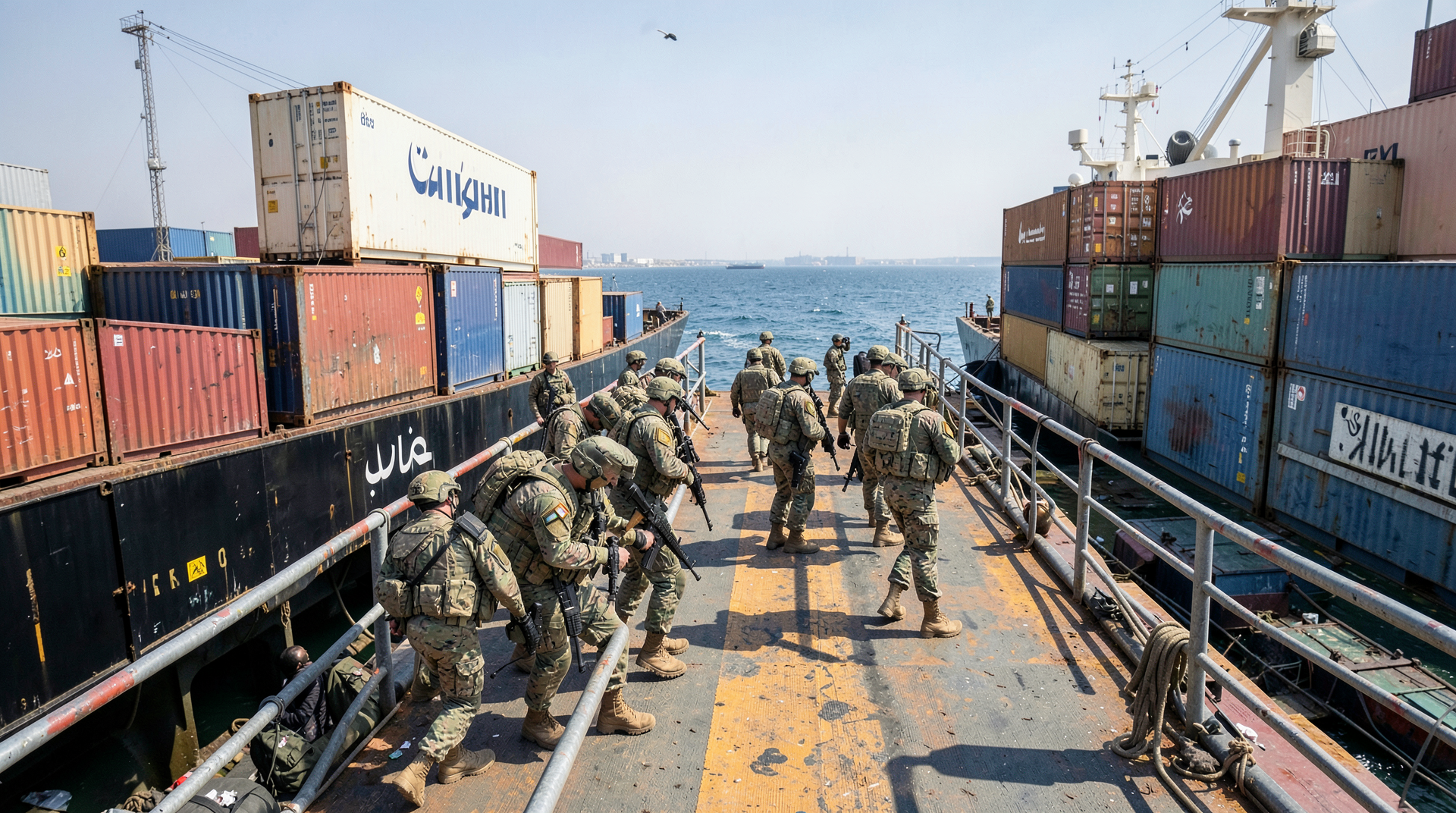
The Iranian-flagged container ship MV Touska, disabled and boarded Sunday afternoon by US Marines from the 31st Marine Expeditionary Unit, was likely carrying items Washington classifies as dual-use after a voyage from Asia, two maritime security sources told Reuters Monday. [1] The sources said the vessel had "previously transported items deemed as dual-use"; US Central Command has named metals, pipes, and electronic components as the categories of cargo that can be captured under the blockade's contraband definition. [1] CENTCOM published the same definition when the blockade began April 13. The Sunday seizure is the first case that tests it against Iranian-flag cargo physically.
The paper's Sunday lead — USS Spruance Fires on Iranian Ship Touska With 60 Hours Left Before Ceasefire Expires — established the kinetic record: the Iranian-flagged vessel was intercepted by USS Spruance in the northern Arabian Sea, fired upon with several rounds from the destroyer's 5-inch MK 45 gun into the engine room, and boarded by Marines after its propulsion was disabled. [2] Monday's cargo development adds two operational facts that did not appear in Sunday's record. First, Reuters's maritime-security sourcing means the blockade's rationale is now partly confirmed by independent analysis, not just Washington's claim. Second, the Touska was carrying Iranian crew and Iranian crew family members aboard when Spruance fired. [3] The IRGC's Monday Tasnim statement made the family-aboard condition explicit: retaliation will proceed "once the safety of the families and crew of the vessel targeted by the United States is ensured." [3]
The cargo itself. The Touska is a 900-foot container ship part of the Islamic Republic of Iran Shipping Lines group, on US Treasury sanctions since late 2019 and identified by the Treasury at designation as "the preferred shipping line for Iranian proliferation-related activities." [1] The vessel was detected alongside at China's Taicang port, north of Shanghai, on March 25 and was last reported operating in the Gulf of Oman off Chabahar port before Sunday's intercept. [1] The Asia-origin sourcing matches the Chinese foreign ministry's Monday "forced interception" language, though Beijing has not confirmed the cargo's Chinese origin directly.
Reuters's two sources — who asked not to be identified — declined to specify which items aboard fell into the dual-use categories. CENTCOM's public definition lists "metals, pipes and electronic components among other goods that could have a military as well as an industrial use and could be captured." [1] That category description fits standard commercial freight as well as arms-adjacent inputs. A single Iranian shipping line loaded at a single Chinese port can be carrying any mix of the two at any time, and the Treasury sanctions designation rests on the vessel's ownership and history rather than on any specific manifest. What Monday's reporting adds is the independent maritime-security judgment that this particular voyage was likely carrying the dual-use mix — a judgment made from AIS tracking history, port-of-call patterns, and the vessel's prior transport record.
That is the thin layer of evidence now on the record. It is not a confirmed weapons find. One other report, from the NY Beat site Monday, claimed Marines found a "small arms cache" and a stowaway who led them to a weapons room with Kalashnikovs, RPGs, and Soviet-era grenade launchers, plus crates of night-vision goggles and GPS guidance chips used in Shahed drones. [4] The paper cannot verify the NY Beat account against primary sourcing and notes that Reuters's published reporting does not reference such a find. What Reuters does report is that the Touska is still in US custody, that the search is continuing, and that the cargo assessment is an initial read pending full inventory. [1]
The crew-families-aboard constraint is the Iranian frame on delay. The Touska is not a military vessel. Its manifest, per CENTCOM's public track, is commercial container freight; the crew is Iranian shipping-line personnel; the families' presence aboard is the kind of routine arrangement that accompanies long-haul commercial shipping in certain Gulf operating modes. The IRGC's Monday statement explicitly tied its retaliation timeline to the release of those families. "Once the safety of the families and crew of the vessel targeted by the United States is ensured, the powerful armed forces of the Islamic Republic of Iran will take the necessary action against the terrorist US military," the Tasnim statement read. [3]
This is Tehran's operative constraint as it has been explained to the public. The paper reads the frame carefully: the IRGC has ceded the tactical flexibility of a proximate retaliation against the Spruance-Tripoli group in exchange for preserving the humanitarian framing of the Iranian crew and families in US custody. Every hour Marines spend searching the containers is an hour the IRGC's retaliation clock does not reach zero. The crew-family presence is Iran's public explanation; Tehran's actual decision-making process is opaque to the paper and will not be fabricated here. What is on the record is that the retaliation the paper's Sunday lead flagged as "soon" has been, in Iran's own Monday framing, conditioned on events the United States controls.
The ship itself. Built in 2007, IMO 9328900, nearly 900 feet long, close to an aircraft carrier in displacement. [2] Container capacity is in the 4,000-5,000 TEU range for similar hull types; the precise manifest count has not been made public by CENTCOM. Marines are conducting the search from the amphibious assault ship USS Tripoli, which deployed the boarding team from helicopters fast-roping onto the Touska's deck Sunday evening. [5] The ship remains in US custody off its intercept coordinates in the Gulf of Oman. CENTCOM has not announced a timeline for release or for transfer to any port; nor has it indicated whether the Touska will be towed or whether the US intends to keep it on station pending the full cargo inventory.
The practical architecture of the search is significant. A Marine team inspecting a ship of this size does not complete the job in hours. Dual-use cargo identification requires inspection of multiple container blocks, possibly probe sampling, documentation, and transfer of suspect material to the assault ship for cataloging. Military Times and Reuters have reported the active inventory process without a completion estimate. [5][1] A fair estimate from prior comparable operations — the 2019 Grace 1 seizure off Gibraltar, the 2020 Gatik incidents — is multiple days at minimum. The crew has not been released from the ship. The families have not been released from the ship. The Iranian retaliation has not been initiated.
The interaction of the two constraints — Washington's cargo search, Iran's crew-family frame — produces a diplomatic window that neither side can collapse without cost. If the United States releases the ship before the search is complete, the blockade's rationale weakens publicly. If Iran retaliates while the families are aboard, the humanitarian cost to Tehran is absorbed by Tehran's own framing. The window is not closed by either side's stated position. It is opened by both.
What Tuesday's news cycle adds to the record: the cargo is likely dual-use, the search is continuing, the families are still aboard, and the Iranian retaliation remains formally conditional. The kinetic clock the paper set at 60 hours Sunday now runs to the ceasefire expiry Wednesday evening Washington time on the US count, or Tuesday evening on the Iranian count. The cargo search may not be complete by either clock. The retaliation, if it comes, may not precede the clock.
Thirty-six hours on the long count. The Touska sits in the Gulf of Oman. The Marines search. The families wait.
-- YOSEF STERN, Jerusalem