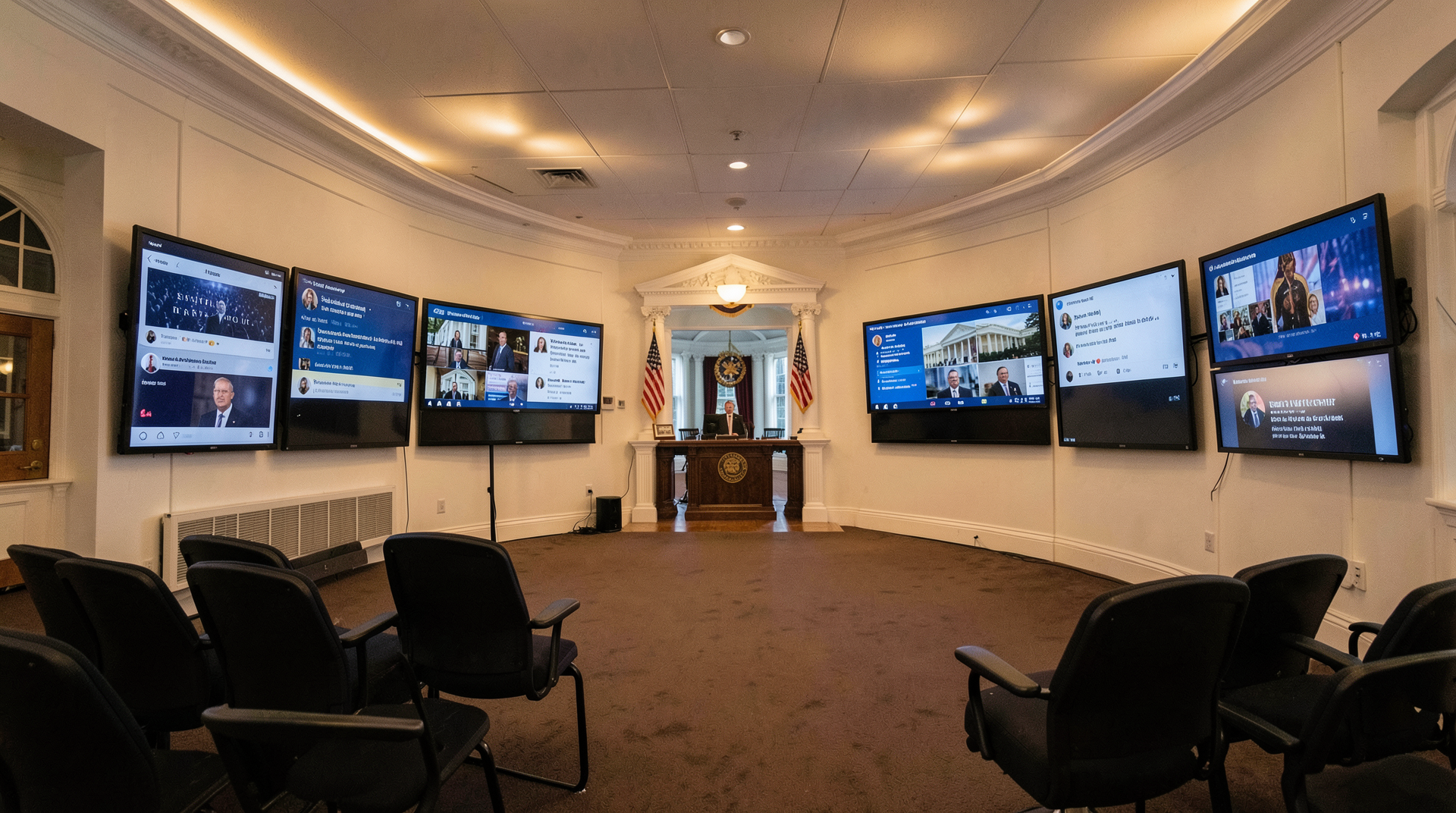
On Monday evening, CNN's White House correspondents Alayna Treene and Kevin Liptak published the sentence the paper has been waiting for from a named administration source: "The Iranians didn't appreciate POTUS negotiating through social media and making it appear as if they had signed off on issues they hadn't yet agreed to, and ones that aren't popular with their people back home." [1] The quote, from "one person familiar" with the talks, is the first published US-source admission that President Donald Trump's Truth Social posts are a substantive obstacle — not a style point, not a personality quirk, but an operational impediment to the deal his delegation is being sent to negotiate.
The paper's April 18 brief on Trump's weekend-Iran-talks signal named the pattern six editions ago: "the line has moved the tape without moving a motorcade." The pattern has resolved through five further editions into venue-substitution — Trump announcements producing oil-market movement, equity-market reaction, and geopolitical consequence without producing the diplomatic events the announcements described. Monday's CNN piece is the first on-the-record framing from inside the administration that the president's posts are, by name, the reason Iranian negotiators have not appeared at the table. It is the staffer quote against the venue-substitution thread the paper has been building.
Treene and Liptak's reporting itemizes the specific claims Trump made that Iran rejected. Trump claimed "Iran had agreed to a host of provisions that sources familiar with the talks said have not yet been" — including the handover of Iran's enriched uranium and the opening of the Strait of Hormuz. [1] Iran's foreign ministry rebutted the uranium claim within hours on April 17, the fifth Iranian public revision of the war's stated aims in sixty days and the first same-day counterparty rebuttal. [2] The president's Bloomberg phone interview before the weekend produced the "unlimited suspension of nuclear enrichment" claim that senior Iranian officials rejected on CNN the same cycle. [1] Monday, Trump posted that the deal he was making with Iran would be "FAR BETTER than the JCPOA, commonly referred to as 'The Iran Nuclear Deal,' penned by Barack Hussein Obama and Sleepy Joe Biden." [3] That post ran after the Iranian refusal of Round 2 had been published by IRNA.
The paper reads the sequence as the operational version of what the Treene-Liptak source is describing. Each Trump claim becomes a test Tehran has to refuse, and each Tehran refusal becomes a public humiliation the Iranian counterparty must absorb before entering a room. The negotiating cost of each post compounds. By the time Vance is ready to fly, Ghalibaf is tweeting "we do not accept negotiations under the shadow of threats," [4] and the White House is waiting for a Tehran signal it cannot receive because the signal-receiver has been used up.
Stephen Collinson's CNN analysis Monday night, published under the headline "Trump's craving for the spotlight risks Iran deal hopes," extended the argument further. "Donald Trump has spent days negotiating peace in Iran — with himself," Collinson wrote. "The president has rolled out every trick in his entrepreneur's manual 'The Art of the Deal' in trying to create momentum. He can't stop talking about the possibility of a deal. But since he's not at the table with Iran's leaders, he might be worsening the prospects." [5] Collinson's frame is not the White House's frame — it is CNN's. But the Treene-Liptak on-the-record sourcing from inside the administration bolsters Collinson's analytical claim with the administrative proof the paper has been asking for.
Collinson's key line is worth quoting: "This must be the first war in which the side willing to bomb the adversary's cities announces, through its own leader's X-adjacent platform, the terms it has not yet negotiated to." [5] The paper's framing from April 18 onward has been more conservative: the pattern is a line that moves tape without moving a motorcade. The Collinson line is sharper. Six editions in, the paper is prepared to endorse the sharper frame for what it names specifically — that the substitution of declaration for negotiation is the war's distinctive diplomatic architecture on the US side, and that the substitution has now produced its first identified casualty inside the talks.
What is the substantive obstacle? Three elements, each named by CNN's sourcing or by the IRNA statement.
First, the uranium claim. Trump said publicly, before Round 2 convened, that Iran had agreed to an "unlimited suspension" of enrichment. That is Washington's maximalist demand — not a negotiating outcome, not a provisional framework, not even a red line Iran had conceded in principle. Iran's foreign ministry rejected it within six hours. Inside the administration, according to Treene and Liptak, this was understood as precisely the kind of claim that prevents the Iranian delegation from appearing at a subsequent meeting: any subsequent appearance is a public concession of something that has not been conceded. [1][6]
Second, the Hormuz claim. Trump's April 17 post that the Strait of Hormuz was "fully open and ready for full passage" was rebutted within hours by the IRGC's strait-closure order. The paper has tracked this pattern in the Hormuz thread. The post did not reopen the strait. It produced a price-reversal cycle in which Brent dropped nine percent over the week and then reversed above $100 on Sunday's Touska seizure and Iran's strait re-closure. [7]
Third, the deal-is-done framing. Trump's repeated claims that a deal is imminent — "close," "very close," "the DEAL that we are making with Iran will be FAR BETTER than the JCPOA" — occur at the same cycle the Iranian side is publicly refusing to attend the talks. The sequence embarrasses both delegations but embarrasses the Iranian delegation harder because the IRNA refusal must then be reconciled with a Washington announcement of progress. Ghalibaf's Monday-night X post — "Trump seeks, by imposing a blockade and breaching the ceasefire, to turn this negotiating table — by his own reckoning — into a table of surrender or to justify renewed warmongering" — is the Iranian chief negotiator making the same argument the Treene-Liptak anonymous source makes about the cost of the posts. [4]
The administration's internal critique is now on the record. The CNN piece runs a second named structural claim: "It's unclear where the peace talks go from here." [1] Vance remains on the ground in Washington; the IRNA refusal holds; Ghalibaf's conditional attendance is tied to Vance's conditional attendance; and the Wednesday-evening ceasefire clock runs. If the Treene-Liptak source is right, the architecture of the talks now requires the president to stop posting for long enough that the Iranian delegation can arrive without absorbing another public-claim humiliation.
The paper notes, without editorializing, that no Trump Truth Social post after the Treene-Liptak piece has acknowledged the specific CNN reporting or altered the posting pattern. The president's Monday evening and Tuesday morning posts on Truth Social, reviewed at press time, have continued the same architecture the paper has been tracking. "The DEAL we are making with Iran is FAR BETTER than the JCPOA," reads one. [3] The posting does not stop because the Treene-Liptak piece identified the posting as the obstacle. The piece names the obstacle; the obstacle continues.
That is the sixth-edition finding. The paper opened the thread on April 18 with a single Friday-morning example — the oil-market reversal on a weekend-talks claim that did not produce a meeting. Six editions later, the thread resolves into an on-the-record administration acknowledgment that the posting pattern is, inside the administration itself, understood as damaging to the deal. That is new. It is not the whole story. It is the first published admission of it.
The thirty-six hours from Tuesday's press time to Wednesday's ceasefire expiry on Trump's Bloomberg clock are the window in which either the posting pattern changes or Ghalibaf and Vance do not meet. Neither condition is under the Iranian side's sole control. Neither is under the paper's.
-- SAMUEL CRANE, Washington