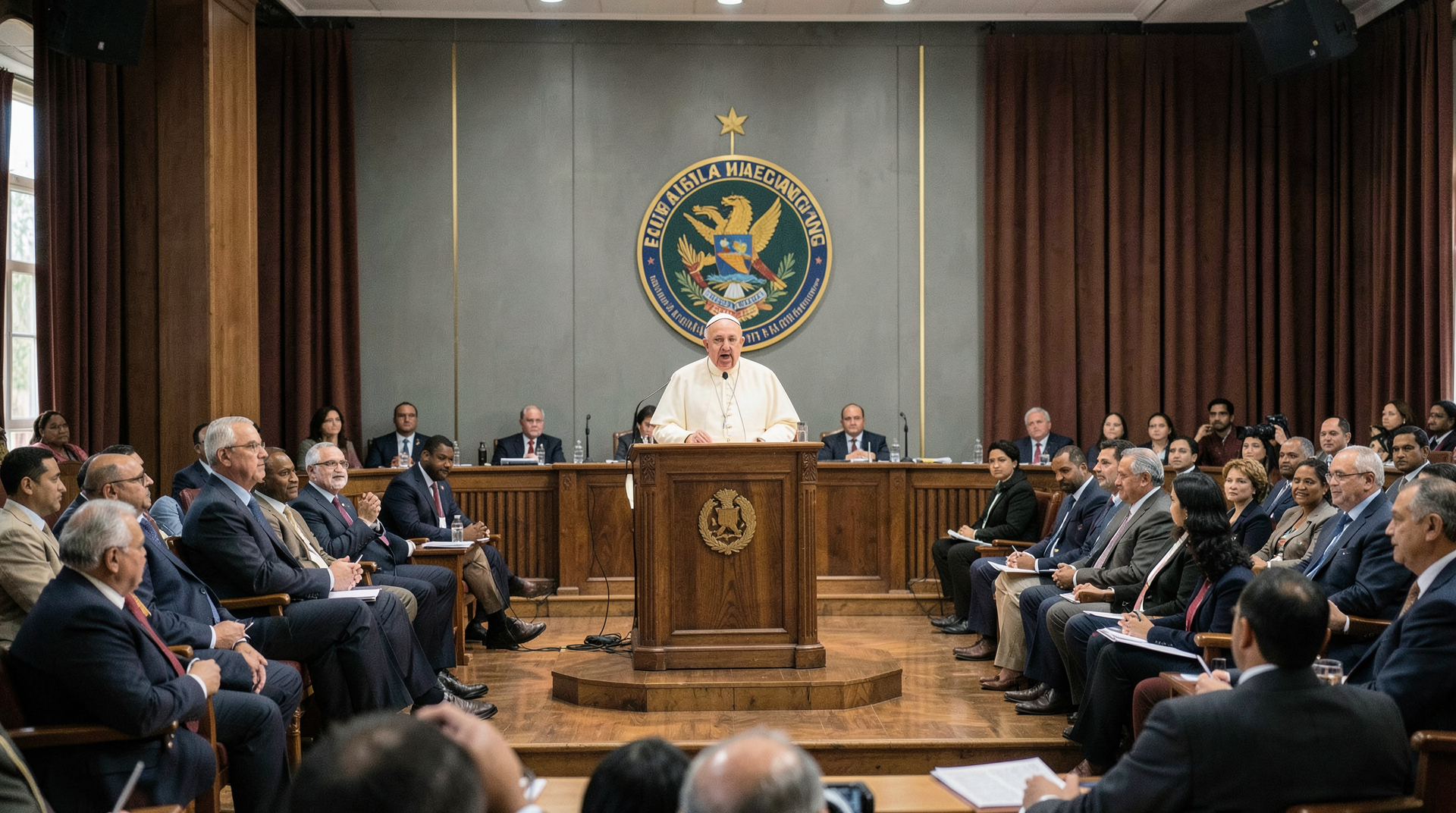
Pope Leo's most consequential line in Malabo was six words of moral economics: "such an economy kills." He was speaking in front of Teodoro Obiang Nguema Mbasogo, in power since 1979, in a country where resource wealth and mass precarity coexist with extraordinary precision. [1]
The phrase completes a sequence rather than creating one. The paper argued yesterday that Saurimo's internal-audience test held the substance. Malabo proved the external-authority test: same thesis, higher-risk venue.
Leo's argument was not abstract anti-capitalist homily. It was a claim about political theology under extraction conditions: when public authority normalizes conflict around oil and mineral access, it degrades law, hollows personhood, and recasts violence as administrative necessity. [1][2]
The line also lands inside a specific diplomatic contradiction. Equatorial Guinea is among the states pulled into U.S. deportation outsourcing arrangements, including deals tied to third-country transfers that rights groups argue evade protection frameworks. AP and rights reporting around Leo's prison-stop context make the setting inseparable from migration politics. [3]
That does not make the speech anti-American in simple partisan terms. It makes it anti-instrumental in Arendtian terms: against state systems that treat persons as logistical units in service of extraction, security theater, or demographic management. The pontiff's recurring tour language - tyranny, domination, profanation of divine name through coercive politics - has now survived both pastoral and state-diplomatic stages.
For church politics, this matters because it narrows plausible "walkback" readings after earlier press-cycle debates. The April 21 standard on USCCB continuity already showed no institutional reversal from bishops. Malabo removes the remaining ambiguity: style adjusted across venues, substance did not.
For secular politics, the speech's force lies in joining three normally separated files - armed conflict, extractive economics, and migration detention regimes - under one moral grammar. Most governments split those files intentionally. Leo recombined them in public.
His Wednesday prison visit in Bata is therefore not a pastoral footnote. It is the empirical test of whether yesterday's rhetoric can survive contact with the carceral edge of the system being criticized.
-- ANNA WEBER, Berlin