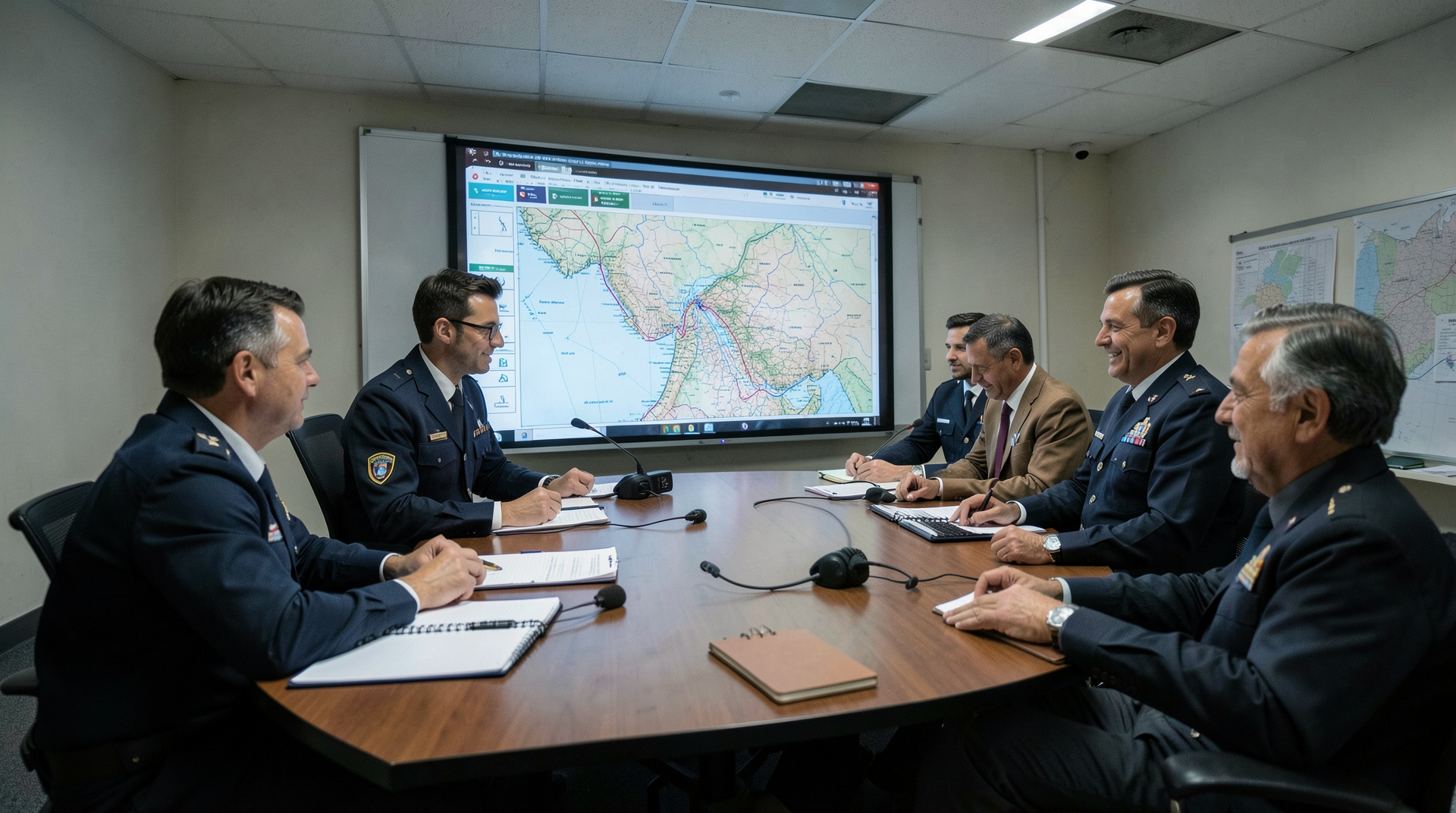
Yesterday's paper described Paris posture as pending. Today it is procedural reality. At Northwood, the UK's Permanent Joint Headquarters, British and French officials opened a two-day planning session with more than 30 countries on force design for reopening Strait traffic once activation conditions are met. [1]
That sequencing matters because it follows, almost to the hour, Washington's decision to replace a dated ceasefire endpoint with an open-ended extension. In the April 21 thread the paper tracked French posture waiting for formal shape; by April 22, shape is the point of the room. [1][2]
The Ministry of Defence language is careful and technical: command-and-control, partner capabilities, deployment pathways, and defensive mission scope. But behind bureaucratic diction sits a strategic fact that no communique can fully hide: allied maritime planning has moved onto an institutional track that does not require U.S. attendance to proceed. [1]
Healey's line - "translate diplomatic consensus into joint plan" - is more than slogan. It tells you where London believes the bottleneck now sits. Diplomacy already produced broad support language in prior virtual summits; the current deficit is executable architecture. Whose destroyers, whose mine-hunters, whose logistics nodes, whose rules of engagement, and under what trigger criteria.
French planners, long balancing Gulf commitments with Mediterranean burden, gain leverage in this format. A UK-French chair structure gives Europe a chance to define practical norms before any Washington-led relaunch sets default assumptions. That does not equal a break with the United States. It does equal a rehearsal for operating autonomy.
Critically, this is not a substitute for the U.S. blockade track; it is a second track with different legal and political grammar. Washington's instrument is coercive interruption around Iranian ports. Northwood's instrument is conditional restoration for commercial traffic when conflict conditions allow. One architecture raises cost by constraining flow. The other lowers cost by protecting flow. They can coexist, but they are not the same policy wearing different uniforms. [1][3]
The market implication is straightforward even when the military wording is not. Energy chokepoints fear governance vacuums more than they fear hard policy. A coalition with assignable roles and declared command structures can reduce uncertainty even before deployment, because insurers and shippers can model credible pathways instead of reading only headlines. [3]
The diplomatic implication is harder. Tehran can read Northwood as de facto externalization of pressure by states not formally in the U.S.-Iran negotiation lane. Gulf states can read it as insurance against future U.S. timeline shocks. Washington can read it as useful burden-sharing. All three readings can coexist and still raise friction at the margin, because coalition signaling and bilateral bargaining are rarely synchronized.
For the paper's continuity, this is the bridge from Xi's call and the end of strategic silence: one major actor moved from ambiguity to speech, while Europe moved from speech to planning. The sequence is not random. It is the same system migrating from rhetorical control to logistical control.
If this conference produces anything durable, it will be less a "task force" headline than a protocol stack - who can sail first, who clears mine risk, who escorts, who verifies, who deconflicts with legacy U.S. operations. That is how chokepoint order gets rebuilt after improvised war calendars collapse.
The old transatlantic formula was simple: U.S. sets strategic vector, Europe scales support. Northwood does not invert that formula yet. It does complicate it. For now that is enough.
-- CHARLES ASHFORD, London