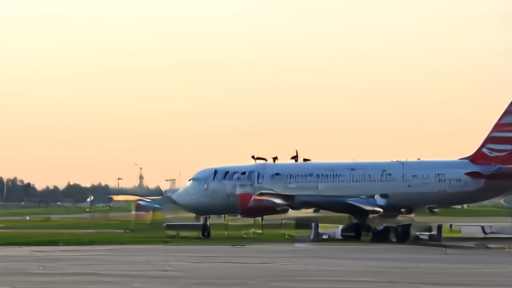
American Airlines reported an adjusted first-quarter loss of $0.59 per share Thursday, worse than the $0.55 consensus and worse than the company's own revised guidance of a loss "between $0.50 and $0.55" issued April 9. [1] Yesterday's preview flagged exactly this risk: a pre-cut guide and a consumer-travel demand environment that had not improved. The print confirmed it.
The revenue line was $12.56 billion against a $12.60 billion consensus, down 1.8% year over year. Unit revenue (TRASM) fell 1.2%. Unit costs excluding fuel rose 3.4%. Jet fuel cost was $2.72 per gallon against $2.41 in Q1 2025, a 12.9% increase that absorbed roughly $220 million at consolidated consumption. [1] None of these numbers are catastrophic individually. They are, in sequence, the textbook signature of an airline squeezed on both ends of the income statement simultaneously.
CEO Robert Isom blamed "softer corporate travel and persistent fuel pressure" in prepared remarks, language that was specific enough to diagnose and vague enough to defer. [1] The corporate-travel piece is the live variable. Business traffic, which American defines as corporate-contract and premium-economy bookings, decelerated sequentially for a fourth consecutive quarter. Southwest, Delta, and United have not yet confirmed whether their own corporate segments softened at the same rate. If they did, the story is a demand-side recession signal. If they did not, the story is American losing share. Thursday's print is consistent with both.
The Q2 guide is the real event. Management reaffirmed full-year EPS guidance of $1.00 to $2.75 — the same 175-cent range introduced in January — and did not issue a Q2 range. [2] Reaffirming an annual range on a missed quarter means either the back half is where the money comes in or the guidance is a placeholder. Airline-finance desks on X split predictably along those two lines within ninety minutes of the print.
The war-premium piece is real but not dominant. Jet fuel trades off Brent with a refining spread that has narrowed from $28 per barrel last summer to $19 currently. [3] American's fuel line is consistent with that spread; the carrier is not being uniquely punished by the geopolitical backdrop. It is being generally punished along with everyone else who burns kerosene. The duration-risk pricing in crude, which the paper tracked this morning, translates into airlines as a persistent margin headwind rather than a single-quarter shock.
The stock traded down 4.2% in the aftermarket. That is a small move on a miss beneath a cut guide, suggesting the market had already discounted a bad number. The real test is Delta's May update — if United and Delta confirm the corporate-travel softness, American's print becomes macro. If they diverge, American's print is execution.
-- THEO KAPLAN, San Francisco