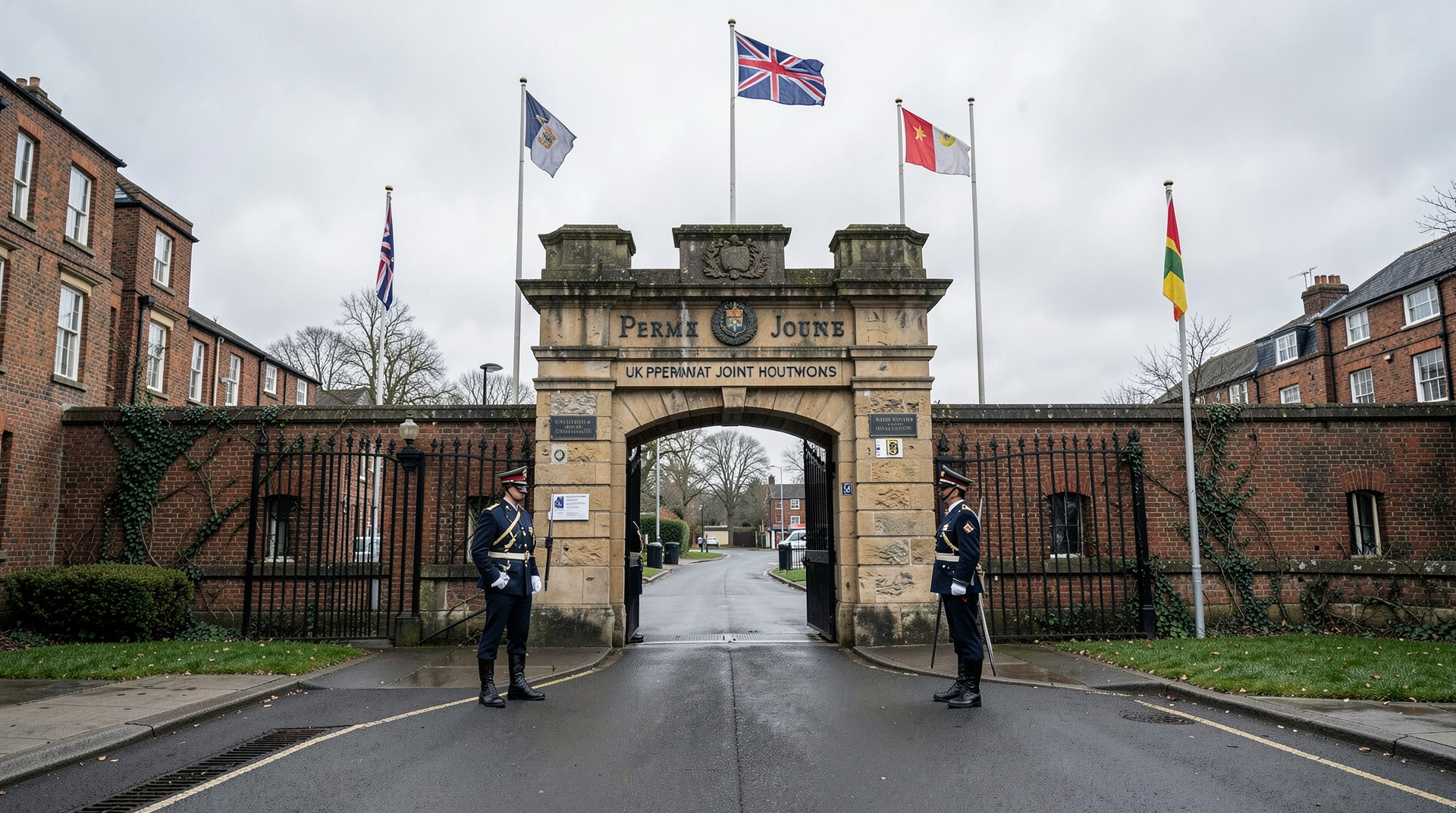
The British Ministry of Defence on Wednesday morning published the day-one readout from its two-day Strait of Hormuz planning conference at the Permanent Joint Headquarters in Northwood, and the readout did something the paper had not quite expected it to do on day one: it named command and control. [1] The conference, Defence Secretary John Healey's statement said, would include "detailed discussions on military capabilities, command and control, and how military forces can deploy to the region." [1] The sessions would "advance military plans to reopen the Strait, as soon as conditions permit, following a sustainable ceasefire agreement." [1] Over thirty nations attended. None of them was the United States.
This is the article the paper owed after Tuesday. The April 22 lead reported that the UK and France had hosted thirty nations at Northwood while Washington sat out; the frame then was that a second Hormuz architecture was being erected in parallel to the American blockade. The British readout on Wednesday converts that claim into a document. Command and control is not diplomatic vocabulary. It is the language of the operations branch — the allocation of vessels, the chain of call signs, the rules governing when the escort fires. When a readout puts command and control on day one of a planning conference, day two is where escort packages and mine-clearance boxes get drawn on actual charts.
TASS, reporting from London on the same day and citing the British MoD, confirmed the ambit: "discussions will focus on ways to deploy armed forces in the region, as well as issues related to the command and control of the mission currently in development." [2] The Russian wire is not an authority on coalition substance, but it is a useful mirror on what Moscow is reading — a non-American, non-Russian naval command structure being stood up in a North London office park. The French presence is the institutional spine. The UK hosts the facility. Germany, Italy and Poland were among the European contributors confirmed by Healey in March, when he first disclosed that British demining systems were already deployed in the Middle East. [3] The remaining twenty-plus flags are the long tail — Mediterranean navies, Gulf partners, Commonwealth maritime states, and, per Paris summit readouts, several East Asian contributors whose flags sit awkwardly on an American-allied roster but comfortably on a post-American one.
That roster is the point. The Paris summit of April 17, chaired by Prime Minister Keir Starmer and President Emmanuel Macron, produced fifty-one signatories to the principle of "unconditional, unrestricted, and immediate re-opening of the Strait of Hormuz" and the establishment of "an independent and strictly defensive multinational mission to protect merchant vessels, reassure commercial shipping operators and conduct mine clearance operations." [1] The Northwood work is the military conversion of the Paris diplomatic commitment. Independent is the operative word. It means the mission is not CENTCOM-coordinated. It means the mission will not use U.S. Fifth Fleet command structures. It means, to use the honest phrase that British defence officials have declined to use on the record, that European navies and their partners are preparing for a world in which the United States Navy is not the freedom-of-navigation guarantor in the Gulf.
Lord Coaker, a Minister of State at the UK MoD, told the House of Lords on April 13 that "the Government's approach is to try to ensure that we bring together a co-ordinated, independent and multinational plan," with "independent" delivered precisely enough that parliamentary correspondents noticed. [4] The word has become the organising euphemism. In Whitehall it means "not dependent on U.S. command"; in Paris it means "capable of operating without American assent"; at Northwood this week it means "we are writing rules of engagement we would ordinarily leave the Americans to write." For a coalition of allies whose defence doctrine has been built for seventy years around American conductorship, that is a considerable re-scoring of the orchestra. It also carries the dry Whitehall dignity of being presented as a technicality rather than a rupture.
The planning stack is, in substance, the 1987 playbook retooled for the 2026 threat environment. Al Carns, the UK armed forces minister, told Parliament in March that reopening the Strait last time "took 30 warships to escort in the Strait of Hormuz. That gives you just an example of the resources required." [5] The current Iranian mine threat is denser than 1987's, the drone threat is entirely new, and the commercial shipping base that Hormuz serves has tripled. Healey has been candid that "in circumstances of conflict, demining any waters is extremely difficult" [6] — a concession to the technical reality that the published day-one language then papers over with the C2 vocabulary. The mine-clearance element is the long pole. Escort is well-understood. Rules of engagement against small-boat swarms and Iranian kamikaze drones will be the hardest text to write.
The absence of the American flag is the text not being written. Washington's position, as laid out in Trump's Monday Truth Social posts and reiterated in Secretary Bessent's "Economic Fury" statements, is that the Strait is under U.S. naval blockade pending Iranian delivery of a "unified proposal," and that the blockade will persist until a "final peace deal" is signed. [7] The Paris-and-Northwood coalition proposition is that the Strait should be reopened "as soon as conditions permit, following a sustainable ceasefire agreement." [1] The two formulations are not congruent. The American construction conditions reopening on Iranian capitulation; the coalition construction conditions it on a ceasefire. Tehran, as the paper's Thursday lead records, has its own construction, which names the blockade as itself the precondition for any substantive talk. Three incompatible constructions, three different instruments, one narrow waterway. Northwood is where the middle construction — the coalition one — is being given an operational skeleton.
There are limits to the independence the coalition is drafting, and the day-one readout did not pretend otherwise. Reopening is contingent on "a sustainable ceasefire agreement," which at present does not exist; [1] the mission will not deploy into an active war. The Paris chair's statement called for "an independent and strictly defensive" posture, which rules out offensive clearance of Iranian mining positions and leaves the coalition to clean the waterway only after the mining stops. [1] The plan is therefore a day-after architecture, not a day-of one — but day-after architecture is exactly what is absent from Washington's instrument set, and its absence is the reason Tehran can treat the American blockade as an open-ended siege rather than a time-bounded coercion campaign. If Northwood publishes a credible day-after plan on Friday, Tehran acquires a diplomatic off-ramp that does not require Washington's signature.
Healey's closing line on Tuesday — that reopening would be "most quickly sorted and the Straits… most likely to be quickly opened by a de-escalation of the conflict" [6] — is the public-facing expression of that theory of the case. It is also the piece of coalition language Washington has the hardest time absorbing, because it locates the variable in American behaviour rather than Iranian behaviour. A coalition of thirty navies has quietly decided, over two days in an office park twenty miles from Downing Street, that the quickest path to reopening Hormuz runs through a blockade lift, not through a Tehran climbdown.
It is possible to read this too grandly. Northwood sessions produce plans, not deployments. The day-one text is more than summit rhetoric but less than a deployment order. No vessels are moving on the plan yet. The political cohesion of a thirty-plus-flag coalition is notoriously brittle once the American umbrella is removed, and British defence analysts privately flag Gulf Arab participation as the most fragile seam — Saudi and Emirati patience for a non-U.S. multinational command will be tested by the first Iranian provocation of the escort force. A coalition does not always arrive at a chart; it sometimes arrives at an argument. Both outcomes are consistent with Wednesday's readout.
What is not consistent with Wednesday's readout is the summit-optics reading MSM has defaulted to. The BBC and Reuters covered the Northwood sessions as allied messaging with a planning garnish. [1] That reading survives as long as one does not quote Healey's actual text. Once the Defence Secretary's own statement mentions "command and control" on day one, the coalition-optics framing becomes untenable. Day two will close Thursday evening with a UK-France joint statement that the paper's sister brief is tracking separately. The measure of the statement's weight will be simple: whether it names vessels, ports of embarkation, or a target date, or whether it retreats into the vocabulary of forums and further consultations. Day one was not forums. It was command and control. Day two has to either go further or step back. There is no middle here.
For Britain, the session is a late and unexpected return to the stage of major-power convening — the first multilateral security planning conference that a UK prime minister has chaired since the Libya intervention. For France, it is the operational payoff of Macron's decade-long investment in European strategic autonomy. For the United States, it is a coalition writing rules that Washington is not writing and an absence that grows louder with each passing day the blockade holds without a published American off-ramp. The Strait remains closed. The flag count at Northwood is still thirty. The instrument count is, for now, still two.
-- CHARLES ASHFORD, London