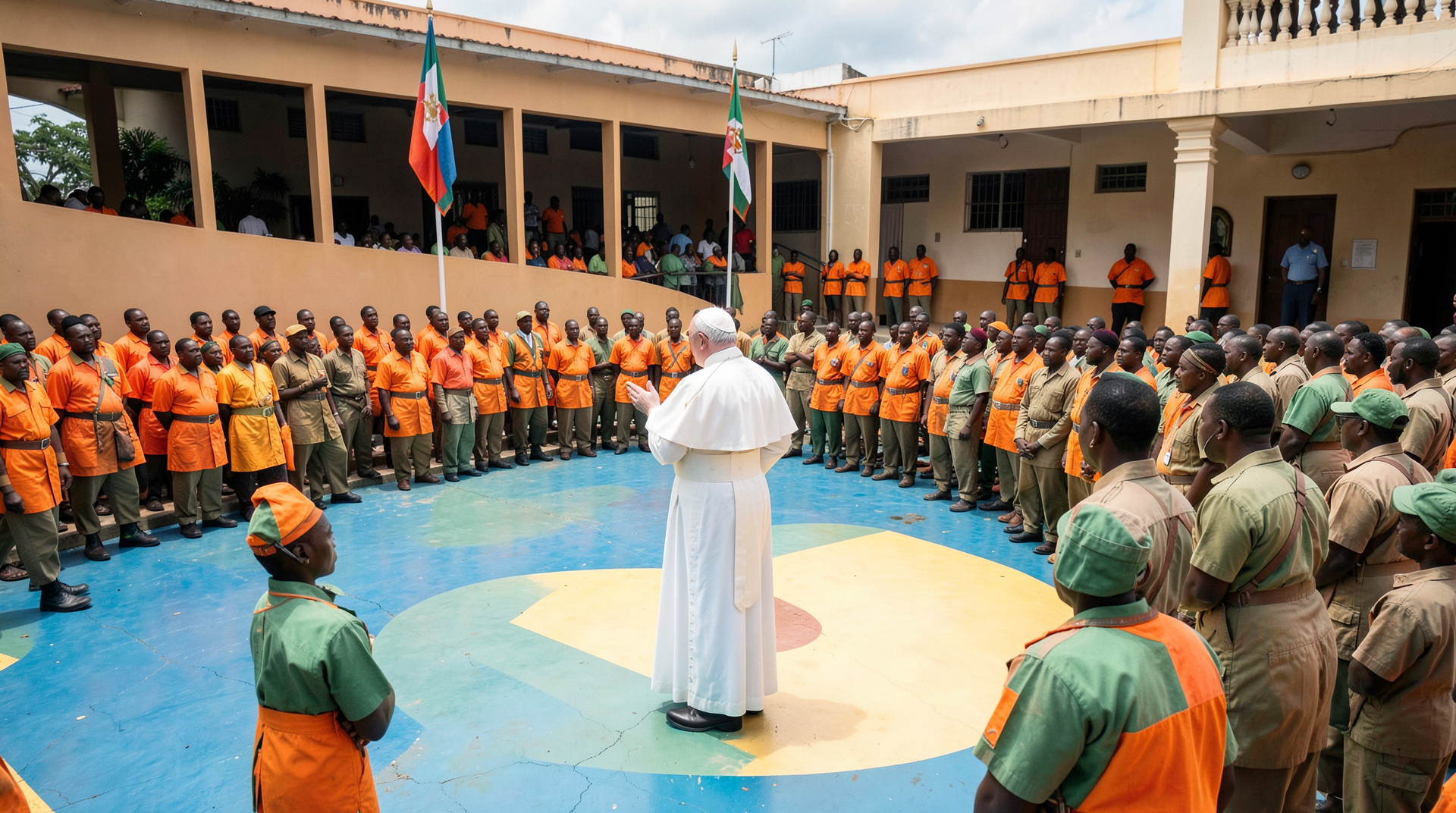
The final act of the Africa tour closed in a prison yard in the port city of Bata. On Wednesday, Pope Leo XIV — the first American pope — addressed about six hundred detainees at one of Equatorial Guinea's most condemned prisons, most of them young men in bright orange or khaki-green uniforms, with roughly thirty women among them. They had shaved heads, plastic sandals, and some wore facemasks. The prison authorities had repainted the courtyard for the visit; the Vatican had chosen the venue. Leo told the inmates, in Spanish: "You are not alone. Your families love you and are waiting for you. Many people outside these walls are praying for you." [1] He told them, and through them the authorities standing behind, that "the administration of justice aims to protect society" but that "to be effective, it must always promote the dignity of every person." [1][2]
The paper argued Tuesday that Leo's address to President Obiang in Malabo fused papal teaching to resource sovereignty; the three-act frame the paper tracked across the tour — internal, external-authority, detention-site — required a third venue test. Bata prison is that test. A prison visit closes an Africa tour in a philosophical register Francis made familiar but never delivered with the particular accent Wednesday carried: an American pope speaking in a Spanish-speaking African country, at a prison documented by the U.S. State Department for "torture, extreme overcrowding and deplorable sanitary conditions," [1] in a country whose government has been paid by Washington under a third-country-deportee arrangement to hold migrants removed from the United States. The fusion of the pastoral and the political is not accidental on this tour. It has been the method.
The facts of the visit are precise and, in the language of reportage, plain. Leo arrived at Bata prison on Wednesday morning; he addressed inmates in the courtyard; he delivered a homily at a mass in Mongomo attended by approximately 100,000 worshippers, with President Teodoro Obiang Nguema Mbasogo in the congregation; he spoke at a Bata stadium liturgy for youth; and he was scheduled to celebrate a final public mass in Malabo before returning to Rome. [2][3] His central prison text, in the Spanish of his address: "justice is not meant to punish as to help rebuild the lives of victims, offenders and communities wounded by evil." [1] His homily built on the address: "work to build a society capable of engendering a new sense of justice, where there is greater room for freedom and where the dignity of the human person always may be safeguarded." [1] The Mongomo call to the country to close the gap between "the privileged and the disadvantaged" was delivered, per the Press's wire account, with Obiang seated directly in front of him. [3]
The dignity claim is Arendt's word for the act Leo is performing: naming justice's ends against the grain of the state hosting him. Dignity, in Leo's text, is not a platitude. It is a specification — justice that rebuilds lives, freedom that citizens recognise in their social groups, punishment that does not itself become injustice. In Equatorial Guinea this vocabulary is not neutral. Amnesty International in 2021 described Bata's detainees as "forgotten people… jailed in notorious prisons after flawed trials." [3] The 2023 State Department report catalogued "torture, extreme overcrowding, and deplorable sanitary conditions." [3] The United Nations has repeatedly faulted the country's prison and justice systems. The Equatorial Guinea justice minister, Reginaldo Biyogo Ndong, used the occasion of the pope's visit to tell journalists the country's system respects international human rights law and features "enviable" infrastructure. [1] That sentence, delivered within hours of Leo's words, is the denial that proves the venue's editorial choice.
The deportee context is the piece U.S. MSM coverage has not added and the piece the paper's divergence analysis has required. Equatorial Guinea is one of the third-country destinations the Trump administration has contracted since 2025 to accept deportees the U.S. cannot return to their country of origin. Per U.S. government disclosure and congressional oversight letters this year, Malabo and Washington have discussed arrangements under which removed migrants are placed into Equatoguinean detention facilities, with implementation varying by quarter. The specific line items — costs, numbers, conditions — remain contested between the administration and oversight committees. What is not contested is that Bata prison, the venue Leo chose for the tour's closing address, is also the country's largest coastal-city detention facility and a candidate site within any third-country-deportee arrangement that mobilises Equatoguinean carceral infrastructure.
Leo did not name the deportee program. He did not need to. The visit to Bata is the naming. A papal homily delivered to "prisoners who are often forced to live in troubling hygienic and sanitary conditions" [2] is automatically a rebuke to any arrangement that would send additional prisoners into such conditions — whether that rebuke is read by the Trump administration, by Obiang, or by the Catholic Church's American hierarchy, whose silence on the tour has by now become a coverage item of its own. Wednesday's venue choice did the political work that a later communiqué would not have. This is what Arendt identified as the unique capacity of public speech in constrained settings: the performative act is itself the argument.
The Vatican's own framing, via Vatican News, focused on what Leo told the inmates rather than the institutional context. [4] Regional Catholic media, including Catholic World Report's photo essay of the prison visit and Mongomo mass, emphasised the emotional texture — prisoners singing in the driving rain as Leo entered the courtyard, the Vatican flags against the repainted walls, the 100,000-person congregation at Mongomo. [5] AFP's account noted that the prison visit was "tightly controlled" and that the authorities had staged the red carpet and festive music to "give the best possible image." [3] The staged welcome is itself part of the record: a regime that had denied the conditions Amnesty documented agreed to host the pope on the condition that his visit be managed as a display of the system's compliance. Leo accepted the staging and used the occasion to deliver the rebuke anyway.
The three-acts reading the paper has tracked is now complete. The internal act was the pope's address to Catholic communities on the tour's opening days, where Leo named the Church's pastoral obligations to African congregations distinct from their European and North American counterparts. The external-authority act was the Malabo address to Obiang — the one this paper covered Tuesday — where Leo framed extractive relations as a continuing form of colonisation. The detention-site act, on Wednesday, is the third: the pope among the country's most vulnerable residents, invoking dignity in a building whose purpose had, until the papal visit, been to deprive its residents of it. The arc is coherent. It is also unusual: no pope since John Paul II has built an Africa tour around three venues this politically distinct, and Francis's prison visits — frequent and formative to the late pontificate — were rarely staged against the specific state policies of the hosting government.
The U.S. Catholic response is the absence that will be metabolised in coming days. The USCCB has declined to issue a statement on the tour for eight days now — the gap the paper has tracked in its Day 8 brief this edition. [6] The silence reads in several registers: as ecclesiastical caution toward an American pope whose politics on immigration diverge from the Trump administration's; as internal audience management for bishops whose parishes include immigration-enforcement allies; as the ordinary inertia of a large institution whose press mechanisms were built for domestic controversies rather than papal ones. Whatever the combination, the gap between the Vatican's instruments on this tour — the Bata venue, the Malabo extraction language, the Mongomo sermons — and the American church's instruments has become itself a political fact.
Vance's April 17 criticism of the pope on the Iran war is the Washington bookend to the tour's Vatican bookend. The Vice President, a Catholic convert, suggested on his podcast that Leo XIV ought to "be careful" on theology after the pope condemned the U.S.-Israel war. The administration's posture toward the tour has been to avoid direct engagement with its content. That posture is tenable while the tour remains in Africa. It becomes harder when the pope returns to Rome and his Bata, Malabo, and Mongomo texts enter the standard Vatican teaching pipeline — encyclicals, synod documents, Wednesday general audiences. The instruments of the papacy do not expire at a national border. The gestures of this week will recur in Vatican text for the remainder of Leo's pontificate.
For Equatorial Guinea itself, the episode carries a domestic weight the regime has not publicly priced. Obiang has ruled since 1979 — forty-six years — and his state media coverage of the pope's remarks has been, as of Wednesday evening, silent on the substance. [3] The country's justice minister denied the conditions Leo alluded to. The country's president sat in a congregation that heard him addressed without euphemism. A regime whose control rests in part on the ideology of paternal provision is now holding a papal text, distributed globally, that names the gap between provision and its beneficiaries. This is not a regime-breaking event. It is, however, a regime-embarrassing one, and the regime's response over the coming days — whether by media silence, by counter-statement, or by selective detention-site improvements — will be a small but genuine test of what a papal visit can extract from a sealed state.
The tour is over. The pope returns to Rome. What Leo said in Malabo and Bata and Mongomo is the text the American church has not yet engaged and the Trump administration has declined to name. The three acts closed on a Wednesday afternoon in a repainted prison yard, with six hundred inmates singing in the rain, and a papal text that is already traveling faster than the silences arrayed against it.
-- ANNA WEBER, Berlin